Isaac Samuel
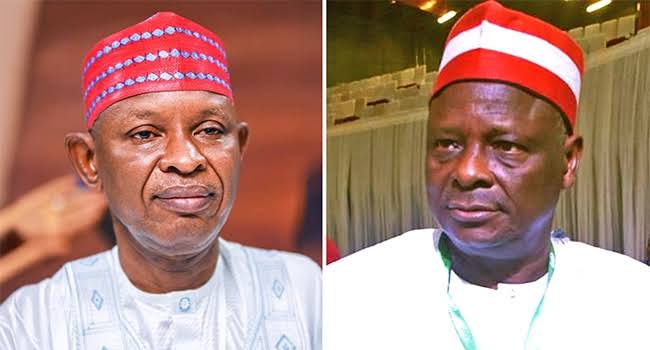
Outrage has trailed Kano State Governor Abba Kabir Yusuf’s revelation that the leader of the New Nigeria Peoples Party (NNPP), Rabiu Musa Kwankwaso, allegedly sent him to meet President Bola Tinubu to negotiate a possible return to the All Progressives Congress (APC).
Yusuf made the disclosure in an interview with the BBC Hausa Service, where he claimed that Kwankwaso authorised him to approach Tinubu over an arrangement that would see them return to the APC if the Supreme Court ruled in his favour in the Kano governorship dispute.
According to the governor, the proposed arrangement was that Tinubu would not interfere in the judicial process, while the political leaders would consider returning to the APC after the court verdict.
Yusuf further alleged that Kwankwaso asked him to swear on the Holy Qur’an to demonstrate his commitment to the agreement.
The revelation reopened questions about the political negotiations preceding Yusuf’s defection to the APC in January 2026, particularly against the backdrop of earlier denials by both Kwankwaso and the governor’s camp.
In January 2024, Kwankwaso reportedly denied reaching any agreement with anyone over the political dispute, saying: “To the best of my knowledge, I did not reach any agreement with anybody.”
The then Director-General of Media and Publicity to the governor, Sunusi Bature Dawakin Tofa, had also dismissed reports of an agreement involving Tinubu and the Kano governor.
Yusuf’s latest account, however, presents a different version of events, with the governor claiming that the proposed arrangement was discussed before his eventual defection.
He also explained that Kwankwaso did not eventually join him in the APC because of alleged public comments by the NNPP leader that complicated the arrangement.
The governor said he had communicated Tinubu’s positive response to Kwankwaso but that subsequent developments affected the plan.
Yusuf also claimed that members of the Kano State House of Assembly had independently approached Kwankwaso over the possibility of returning to the APC, after which the NNPP leader allegedly asked him to facilitate a meeting with the President.
The governor’s account has attracted renewed attention because Kwankwaso had previously described his defection as “the worst betrayal I have witnessed in my life.”
Yusuf had announced his defection from the NNPP to the APC in January 2026, initially citing the need for political stability, stronger cooperation with the Federal Government and accelerated development in Kano State.
In a reaction to the latest disclosure, a statement by a group, Kwankwasiyya Amana, argued that the alleged negotiations, if accurately represented, raised questions about the relationship between political negotiations and the judicial process surrounding the Kano governorship dispute.
The group also recalled the earlier denials by Kwankwaso and the governor’s former media aide, arguing that Yusuf’s latest account warranted clarification from those involved.
The statement called on the NJC, chaired by the Chief Justice of Nigeria, Justice Kudirat Kekere-Ekun, to examine the issues raised in the governor’s interview.
“When Governor Yusuf eventually announced his defection to the APC, his public justification centred on Kano’s interests, political stability, development and the benefits of stronger couperation with the Federal Government.
“Yet, in his latest interview, he has introduced an entirely different account, suggesting that an understanding to return to the APC had existed even before the Supreme Court delivered its judgment. This raises a fundamental question: was his defection a decision taken in the interest of Kano State, as inttially presented, or the fulfilment of an alleged political understanding reached long before his judicial victory?
“More disturbing is the implication of this latest revelation for public confidence in Nigeria’s judiciary. The Supreme Court judgment of 12 January 2024, which restored Governor Yusuf’s mandalc, was delivered by a five-member pane! led by Justice John Inyang Okoro.
“The governor’s own account has flow introduced an alleged political arrangement connected to the period preceding that judgment, placing the circumstances surrounding the judicial process under uncomfortable public scrutiny.
“However, when the principal beneficiary of a landmark judgment publicly introduces claims involving a political understanding and presidential non-interference in the judicial process, such statements cannot be dismissed as ordinary politcal disagreements. They warrant serious institutional attention, particularly given the constitutional importance of judicial independence.
“Consequently, we formally call on the National Judicial Council (NJC), under the chairmanship of the Chief Justice of Nigeria to take formal notice of Governor Yusuf s publicly reported statements, examine any implications they may have for the independence and integrity of the judicial process, and take appropriate measures to protect public confidence in the judiciary. The Council should also consider seeking relevant clarification from the judicial officers concerned where necessary.
“We understand that political decisions carry consequences and public office demands consistency, accountability and credibility. His attempt to explain one political decision has instead opened a series of contradictions that extend from his former political allegiance to the highest judicial institution in the country,
“In a desperate attempt to defend the embarrassment arising from publicly airing his nearly twenty-year marital breakdown and justify his colossal miscalculation of joining the APC.
“Governor Yusuf has only compounded his predicament. Rather than accepting responsibility, he has resorted to blame-shifting, making Kwankwaso the convenient target for his personal and political failures. In the process, he has contradicted his own positions and dragged the judiciary into a controversy of his own making. His attempt to defend himself has only deepened his credibility crisis and exposed the consequences of his own political misjudgments.
“The people of Kano deserve better than political convenience disguised as public interest. Nigeria’s judiciary must never become collateral damage in the aftermath of a politician’s political choices.”