Yusuf Bangura
After 31 days and 100 matches involving 48 countries from all of FIFA’s six confederations, we’ve now entered the ultimate business end of the tournament—the semi-finals, where four teams will battle it out for two places in the final on Sunday, 19th July.
It has been an extraordinarily competitive and exhilarating tournament. We’ve seen nations as tiny as half a million—Cabo Verde—qualify for the knockout stage and make the greatest player, Messi, cry after pushing the star-studded and reigning champions, Argentina, to extra time.
We’ve also seen some major upsets, such as Morocco’s elimination of the Netherlands in the Round of 32, Paraguay knocking out Germany—winner of four World Cups—in the same round, and the downfall of Brazil—five-time world champions and a country whose name is a byword for football.
Two-time world champion Uruguay failed to make it out of the group stage; England had to wait until the 79th minute to get back into its match against the DRC and win; and Spain failed to beat Cabo Verde in their opening group stage match.
Africa also showed great promise and wowed the football world by setting a record as the best performer in the group stage. It was the only regional confederation that had a 90% record in transitioning to the knockout stage—it had 9 out of the 10 teams it sent to the tournament in the Round of 32.
Despite these upsets, thrills, and remarkable performances by new footballing nations, the four teams that have qualified for the semi-finals—France, Spain, England, and Argentina—are exactly the ones the bookies had as favourites. Why is it so difficult for teams that have never won the World Cup to win it?
Is the World Cup an Oligarchy? Some Fun Facts
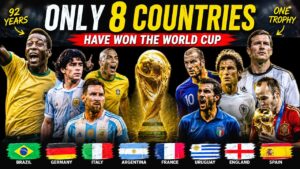
It may surprise some readers to know that the World Cup has been won by only eight countries—Uruguay, Italy, Germany, Brazil, England, Argentina, France, and Spain. Three of those winning nations—Brazil (5), Germany (4), and Italy (4)—have won a combined 13 titles, accounting for 59.1% of all completed tournaments and suggesting oligarchic control over the sport. This year marks the 23rd tournament.
Interestingly, however, the Brazil-Germany-Italy dominance has fractured: Italy failed to qualify for three consecutive tournaments (2018, 2022, and 2026); Germany didn’t get out of the group stage in 2018 and 2022, and was knocked out in the Round of 32 in 2026; and Brazil has failed to progress past the quarterfinals since its ignominious exit on home soil following a 7-1 shellacking by Germany. In fact, this year, Norway knocked them out even earlier, in the Round of 16. It seems like France, Argentina, and to some extent Spain are the new powerhouses of global football.
Here are a few facts that may surprise those unfamiliar with World Cup history. Only 13 countries—Brazil, Germany, Italy, Argentina, Uruguay, France, Spain, England, Netherlands, Hungary, Czechoslovakia, Croatia, and Sweden—have ever played in a final. From the semifinals onwards, the tournament becomes incredibly exclusive, and no country outside of Europe or South America has ever played a final.
While 54 countries have reached the quarter-finals, breaking through the final four, or semi-finals, grants entry into a much more exclusive club. Only 25 countries have managed to do so. Furthermore, there’s a distinct hierarchy in this group. The top tier, which I have categorised as an 8-Country Club, has done so multiple times—ranging from 3 for England and Spain, to 4 for Uruguay, 5 for Argentina, 7 for Italy, 8 for Brazil and France, and 12 for Germany. Only three other countries from the rest of the world—the Netherlands, Croatia, and Sweden—have also reached the semi-finals three times.
The remaining 14 countries to have made it this far have done so only once or, in very few cases, twice. Most of these countries are European—apart from the US (which played in the 1930 semi-finals), Chile, South Korea, and Morocco. The semi-final stage is well and truly a glass ceiling for new footballing nations.
Home Soil Advantage and Golden Generations
Football analysts have posited two pathways to breaking this glass ceiling or winning the World Cup for teams that have never won it before. The first is the home soil advantage. Four countries—Uruguay, Italy, Brazil, and Germany—completely dominated the seven World Cup tournaments between 1930 and 1962, with Italy, Brazil, and Uruguay each winning it twice and Germany once. Uruguay and Italy each won the tournament once on home soil, and Germany won it in Switzerland—a neighbouring country.
When England, Argentina, and France joined the 8-Country Club in 1966, 1978, and 1998 respectively, they had to do it on home soil, before Argentina and France later established themselves as serial winners in foreign venues. Remarkably, England has not won it again after 1966—a 60-year hiatus.
That said, it may require more than home-soil advantage to win the World Cup. Host nations have won the tournament only six times—or 27.3% of the time. Among the 8-Country Club, Brazil and Spain are the only countries that have not won the tournament as hosts. It is, indeed, remarkable that Brazil won all their five titles on foreign soil across Europe, Asia, North America, and other South American nations. It lost spectacularly on the two occasions it hosted the tournament—in 1950 and 2014.
The second path—possessing a golden generation of high-quality players—seems more persuasive than a home-soil advantage. Of all the countries that have gone deep into tournaments and failed to win, Hungary and the Netherlands are the most impressive. Both possessed outstanding players, with some rated the best in the world.
When Hungary appeared in the World Cup final in 1938, their style of play was already highly technical and sophisticated, driven by a competitive domestic league where clubs like Ferencváros were pioneering new ways to play the game. While still using the formations of the era, the Hungarians laid the foundation for a future tactical revolution by focusing on quick passing and attacking overloads.
However, it was the Hungarian team of the 1950s that truly overwhelmed the world. Called the “Mighty Magyars,” they are often seen as one of the greatest national teams ever assembled. Led by the legendary Ferenc Puskás, they completely transformed how the game was played through radical tactical fluidity. Players constantly swapped positions, creating the exact blueprint for what the Dutch later popularised in the 1970s as “Total Football.”
Leading up to the 1954 World Cup in Switzerland, Hungary went on an astonishing 31-match unbeaten streak from 1950 to 1954. This run included winning the 1952 Olympic gold medal and famously demolishing England 6-3 at Wembley Stadium in 1953—marking the first time a foreign team had ever won there. Consequently, entering the 1954 tournament, Hungary were rated as the overwhelming favourites.
They crushed South Korea 9-0, obliterated West Germany 8-3 in the group stage, and won gruelling 4-2 matches against both Brazil and Uruguay. However, hampered by a heavy downpour and Puskás playing through an injury, Hungary lost 3-2 to West Germany in the final despite scoring early and going 2-0 up in less than 10 minutes. It remains one of the most shocking results in World Cup history.
I was old enough to watch the Dutch side of the 1970s, which featured Johan Cruyff, the best player in the world at the time. Watching Cruyff, Johan Neeskens (the tireless runner), Ruud Krol and Wim Suurbier as dynamic full-backs, and Rob Rensenbrink and Johnny Rep as fluid wingers was an absolute joy.
They were clearly the favourites to win the 1974 tournament but were beaten 2-1 by West Germany—some say due to a hint of arrogance after they went a goal up very early in the match. The Netherlands made two other valiant attempts by reaching the finals in 1978 and 2010. However, they were without their talisman Cruyff in 1978, and they abandoned their fluid, attractive style of play for aggressive physicality when they faced Spain, losing 1-0.
Czechoslovakia, Croatia, and Belgium are three other countries that have made serious efforts to break into the club of World Cup winners. Czechoslovakia appeared in two finals –1934 and 1962, Croatia played in one final and a semi-final (2018 and 2022 respectively), and Belgium played in one semi-final and a quarter-final (2018 and 2022 respectively).
Czechoslovakia’s success has been linked to technical discipline, collective teamwork, and highly organised defensive systems, while Belgium and Croatia relied on a golden generation of world-class players hitting their peaks at the exact same time.
Unlike the great footballing nations that rely on a continuous supply of talented players, Belgium and Croatia sought to bridge the gap by having world-class players in every single position simultaneously. Belgium, for instance, had Eden Hazard, Kevin De Bruyne, Romelu Lukaku, Thibaut Courtois, and Vincent Kompany. And Croatia reached the 2018 final and 2022 semi-final with a midfield core of Luka Modrić, Ivan Rakitić, Marcelo Brozović, and Mateo Kovačić.
One strong criticism of the Golden Generation argument is why such teams have failed to win titles. Because the World Cup is often decided by fine margins, especially deep in the knockout stages, a country relying entirely on one generation may lack structural depth. If a superstar is injured or has a dip in form, the quality on the bench is often shallow compared to football powerhouses that can field two world-class teams. Furthermore, if the generation doesn’t win a tournament during their narrow 4-to-6-year peak window, the nation often plummets back down the rankings as the old stars retire.
Globalisation and Standardisation
However, the chances of countries outside the Big 8 winning the World Cup have greatly improved in recent World Cups. Football has become truly global, with European leagues serving as the primary sites where almost all the great players of the world ply their trade. Across more than 30 top-division European leagues monitored by UEFA, foreign players make up roughly 42% to 48% of all squad members. The average continues to rise annually as international transfer networks expand. However, these percentages differ drastically by country, with the Italian Serie A (61%) and English Premier League (60%) heavily dominated by foreign talent. By contrast, the French (45%) and Spanish (38%) leagues feature the lowest percentages among Europe’s “Big Five.”
For 80% to 85% of the players representing the 10 African teams in the tournament, European leagues are undisputedly the primary hub for player development and employment. The figure for South America stands closely behind at 75% to 80%. Even for the US and Canada, 75% to 80% and 65% to 70% of their respective squads play in Europe. Asia features the lowest export rate to Europe at 35% to 40%. Could this lack of European exposure be the reason why the region struggled to progress deeper into the 2026 tournament?
Europe-centred globalisation in the sport exposes international footballers to the same elite standards, tactics, formations, and discipline. Players from entirely different football traditions compete under the world’s best coaches, allowing them to intimately understand each other’s strengths and weaknesses. While there could be a lag before this structural globalisation completely breaks the historic grip of the world’s traditional footballing giants, recent tournaments—the Qatar one in 2022 and this World Cup—demonstrate that the yawning gap between the elite tier and the rest of the world is rapidly narrowing. Do not be surprised if a first-time winner lifts the World Cup trophy in 2030 or 2034.