By Celestine Mel
Akwa Ibom, the land of my birth, is the twin brother of Katsina. Both states were decreed into existence on September 23, 1987, by the stroke of President Ibrahim Babangida’s pen. In the 39 years since that shared dawn, my deep-rooted affinity for Akwa Ibom has birthed a corresponding desire for Katsina, the home state of many of my colleagues. Bound by this shared evolution, my immersion in Akwa Ibom’s affairs naturally fueled a burning curiosity about its northern twin. Are they faring better than we are? Are there lessons to learn? If so, which?
The road journey presented itself as both method and metaphor, a moving laboratory through which these questions might be explored For now, let us return to the journey itself.
Recall, we started from Abuja and had gotten to Kaduna in part one of this diary. The moment we branched off the bypass into the new Kaduna layout, the streets felt almost too quiet. They were flawlessly paved and governed by functional traffic lights. When I asked around and was told, Malam Nasir El-Rufai had built them during his recent tenure as governor. The city was neat, peaceful, and effortlessly mobile. We climbed a massive bridge lifting the bus from the Nigerian Defence Academy axis toward the Zaria Road Park at Kawo. I nodded, a smile of recognition playing on my face. I recalled when I lived in Kaduna in 1996; that exact spot was the undisputed epicenter of chaos. This time, it was a different environment entirely. A wave of sweet relief washed over me as the driver downshifted, adjusted his posture in the seat, and announced that our next stop would be Kano, sprinting over Zaria just 84 kilometers away.
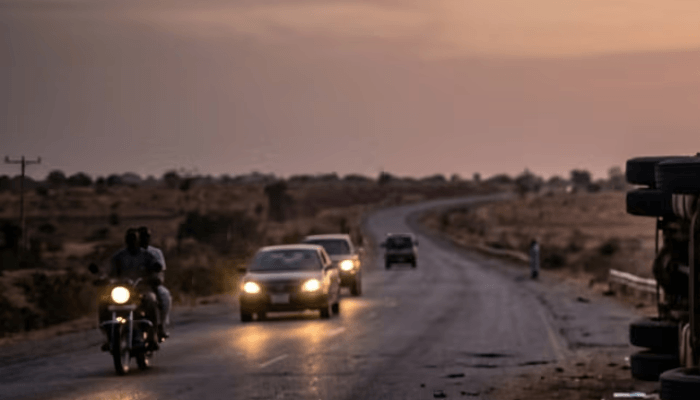
When I pressed him on why we wouldn’t take the shorter Zaria–Dabai–Dan Rimi–Layin Barayu Road straight to Katsina, his answer was chilling. The route was a notorious coven for banditry and kidnapping. The smartest play was the longer sweep through Kano, hooking onto Kankia road to Katsina. According to him, though branching to Katsina at Zaria was a shorter 233-kilometer journey, it was pregnant with insecurity risks. Routing through Kano added 100 kilometers to the odometer but brought the kidnapping risk down to near-zero. Better yet, the next 232 kilometers to Kano would be a breeze because the heavenly tarmac, which started at Olam’s Farm, stretched unbroken all the way to the limits of Kano city.
However anyone might tongue-lash the late former President Buhari, the credit for starting and completing that beautiful road cannot be taken away. We gave the driver the green light to fire on, while I sank back into my seat, mesmerized by the alluring, crystal-clear skies and the striking stone formations guarding both sides of the bustling expressway.
Nostalgia hit hard as we skirted Zaria. Memories of my last visit in the 1990s, to battle for admission into the prestigious Ahmadu Bello University, flooded my soul. To my eyes, a lot had changed, especially the bridge at the famous Zaria junction. I nudged my colleagues, asking about some of Zaria’s more stubborn residents, like Ibraheem El-Zakzaky, the fiery and controversial leader of the Islamic Movement in Nigeria (IMN). I recalled his bloody clashes with security agencies turning the streets of Zaria, Kaduna, and Abuja into war zones. They told me he was still in town, lying low. He had lost too many children and followers to brutal brushes with the law. Furthermore, the Iranian government, the traditional financial backbone of his Shiite flavor of the religion, was entirely consumed by its own fight for survival in the Middle East against the fangs of Netanyahu’s Israel and Trump’s America. No one knew his exact coordinates, but everyone knew he was alive, cocooned somewhere in the shadows.
My mind then drifted southward, attempting to deconstruct the stark divisions of the land. While Zaria town is a predominantly Muslim enclave, Southern Zaria is home to Christian minority tribesmen whose history is tragically docked in violence and bloodshed. My thoughts naturally gravitated to the late Dr. Obadiah Mailafia, a brilliant economist, development expert, and former Deputy Governor of the Central Bank of Nigeria (2005–2007) who later stood as the 2019 presidential candidate of the African Democratic Congress (ADC). He was a fearless public commentator and the unrepentant adversary of Malam Nasir El-Rufai, the enfant terrible of Nigerian politics. Before Mailafia’s passing in September 2021, he and I shared notes in a digital space—a WhatsApp group of eminent minds called the “Nigeria First Movement.” The platform was set up by Arc. Ezekiel Nya-Etok, an Akwa Ibom housing magnate who later transmuted into ADC’s 2023 governorship candidate in my state, and who today sits as an Executive Director at the Federal Housing Authority. Mailafia spent his twilight years leading a grueling campaign to project the agonizing pains of Southern Zaria—and Nigeria at large—onto the global stage until the very end. Sitting on that bus, I scrolled through my phone. His number, ending in 0990, was still saved. The profound irony of life weighed heavily on me. The very same ADC that struggled to gain traction, despite the sweat and tears of Mailafia and Nya-Etok, is today Nigeria’s leading opposition party. Even more ironic? The political predators who were deeply entrenched in the APC and PDP back then; the very forces Mailafia and Nya-Etok valiantly fought against, have now commandeered the ADC, hoping to ride it back to power to oust their former allies. Meanwhile, Nya-Etok, who once nurtured the ADC as a puritanical alternative to the ruling APC’s irresponsibility, has himself crossed the aisle into the APC, quietly pitching his ideas from the inside to fix the housing sector. And Obadiah, the sharp, loud arrow in the ADC’s quiver then, is gone. Alone. Forgotten. I said a silent prayer, snapping back to the present just in time to join a raging debate on the bus about Nigeria’s raw beauty, the scenic bushlands blurring past the Zaria-Kano road, and the endless stream of everyday Nigerians hustling on the shoulders for their daily “2K.”
We breached Kano city just ahead of the Friday Juma’at prayers. It was a calculated, nail-biting race against time. We were reminded that when Kano prays, the city stands still and highway traffic grinds to a total halt. We needed to put the urban sprawl in our rearview mirror before the mandatory hour-long shutdown. We barely made it.
As we navigated the expansive city, my colleagues pointed out its monumental historical anchors. Most breathtaking was Gidan Rumfa, the sprawling 14-hectare palace of the Emir of Kano, founded in the 15th century by Sarki Muhammadu Rumfa—Kano’s greatest Hausa King before Uthman Dan Fodio’s 1805 Jihad installed the Fulani dynasty. It stands as the oldest continuously used seat of authority in Sub-Saharan Africa, currently occupied by my idol, His Royal Majesty Muhammadu Sanusi II, the 16th Emir of Kano, formerly known as Sanusi Lamido Sanuai (Or SLS).
Just looking at the palace triggered a rush of memories. Around 2013, I collided head-on with powerful figures on social media defending this very man. Back then, he was the Governor of the Central Bank of Nigeria. I spent days in brutal cyber-warfare shooting down detractors of a hero I considered one of the sharpest intellects and purest moral compasses in the nation. I was an unashamed admirer and protégé. I devoured his writings, interviews, and speeches with gluttonous voracity. His frankness was a contagion I was happy to catch. In my eyes, he remains the most consequential CBN governor in Nigerian history; a fearless reformist who dragged Nigeria’s central banking into the modern age. He birthed internet and mobile banking, risk-based supervision, the BVN, NUBAN, etc. Because I idolized his willingness to challenge the status quo, I inherited his enemies, fighting them with everything I had. One of such duels stood out.
When President Goodluck Jonathan shockingly suspended SLS from office for daring to blow the whistle on the colossal culture of looting in the NNPC, I was livid. Jonathan aimed his fire at the wrong person rather than the thieves. Blinded by fury, I published several articles daring the Jonathan administration and hailing Sanusi. It put me squarely in the crosshairs of some of my southern brothers, who saw the Sanusi outburst as a continuation of the northern conspiracy to oust President Jonathan. This came to a climax when Pastor Eghes Eyieyen (of blessed memory), Sanusi’s classmate at King’s College Lagos, took the war to my doorstep by seeking to formally petition my employer to punish me for using official hours for the warfare. I escaped by a hair’s breadth because he shared his petition with one of our executive staff, Mrs. Adeyinka, whom I was close to, who begged him to stand down and promised to force a ceasefire. The next day, the executive pulled me into her office and scolded the daylight out of me. It was my second major tango with the dangerous consequences of writing an opinion. The first? Being hunted by the DSS in my post-secondary days for a press-club article that skewered General Sani Abacha. A story for another day.
And now, here I was in Kano, breathing the same air as the man whose ideals nearly cost me my job. I doubted the Emir even remembered that his friend, Otunba Olufemi Awoyemi, tried to connect us during those turbulent days of my pro-bono support for a reformist CBN governor, now the king of an ancient kingdom.
When we reached Kano city center, pushing toward Bichi town, 25 kilometers away, my travel mates stopped for their Friday prayers. I wandered into Yahuza Suya Spot, a bustling local outlet, to grab a chilled bottle of authentic “fura da nuno” to celebrate my good friday. It was not long before the “prayer warriors” returned, and we restarted the push through the ancient Kurmi Market, established more than 600 years ago, heading towards Bichi.
I couldn’t help but notice the freshly minted lampposts, plastered with the banners and buntings of Governor Abba Kabir “Gida Gida” Yusuf, who had recently defected from his legacy NNPP to join the bulging APC. Billboards choked the highways, like a desperate visual struggle to prove that President Tinubu and the APC had firmly planted their flag in NNPP’s stronghold. I pointed to a stunning marbled and layered bridge with an underpass at the edge of the old and new Kano towns. Auwal told me it was the handiwork of former Governor Ganduje. That was a jarring revelation. In my heart—and arguably in the hearts of most Nigerians, Ganduje is permanently cemented as the hunched, babanriga-wearing old man caught on tape stuffing his robes with dollar bills; the ultimate poster boy for Nigerian rot. I had no idea the man was also a statesman who engineered bridges to unclog the congested arteries of Kano.
Speaking of clogging, Kano is an overwhelming, breathtaking collision of uncountable humans of all tribes, nationalities, and cultures. It is also a swam of tricycles, motorbikes, wheelbarrows, and raw commerce. Every intersection was a theater of desperate survival; of a headless rat race for daily bread. They told me, the town was empty at that hour due to Friday prayers. Yet, I saw humans everywhere. Interwoven through the chaos were sleek banks and cutting-edge fintech hubs. It was a fascinating, intoxicating miasma of culture and sheer determination that will be etched into my mind for good.
Next, we entered Bichi. It was a stark contrast and breathed easier. At the heart of the town stood a massive, newly constructed market. Sprawled across the gates was the banner of Hon. Abubakar Kabir Abubakar, affectionately known as ‘Abba Bichi’, the federal representative for the Bichi Constituency. He was first elected in 2019 (where he chaired the Works Committee) and re-elected in 2023 (now chairing the Appropriation Committee). The UK-trained engineer’s “Bichi First, Kano First” mantra was stamped on every lamppost. I was told his impact is legendary. For instance, he personally hired and paid part-time teachers to plug the gaps in the public school system across the constituency. He funded a scheme sending constituents to schools abroad for training. Many hospitals, schools, and federal projects facilitated by him, dot the landscape. Listening to this, a bitter envy dawned in my heart. The sheer intentionality of his selfless leadership stood in damning contrast to some of his peers back in my state. That remarkable situation lingered in my heart as we drove on toward _Gidan Mutum Daya,_ meaning the “home of only one man”—a town that had defied its name to become a sprawling conurbation.
The final stretch to Katsina through Kankia broke the spell. It was a bitter disappointment. Looking out the window, there was little evidence that I was approaching a state that produced two Nigerian Presidents in the recent past. The environment was scorched and unforgiving. We were riding on a massive dual-carriage highway that had clearly been awarded for reconstruction in the past but tragically abandoned. There was a fleeting moment of asphalted bliss here, followed by the bone-jarring sorrow of potholes there, reminiscent of the sordid Calabar-Itu expressway back home.
For over a hundred kilometers, the topography transformed into an alien wasteland. The soil on the horizon looked like petrified swampland. Trees were interspersed. The earth laid bare, massive, and entirely fallow, baked by furious, intense sunburn. By this time, the vehicle’s air conditioning was losing the war against the blistering, violent April sun. A few beads of sweat trickled down my forehead as a quiet reminder from the universe that I was very far from my comfort zone.
Soon, a vast body of water appeared on the horizon, sitting patiently like a beast waiting to swallow us into its depths. “Do you guys have ‘Mami Wata’ in the North, too?” I joked to Auwal. He chuckled. “That’s just an articial lake welcoming you to town. It is used as a basin to hold down water for agricultural purposes.” “Wow!” I exclaimed, as we crossed it.
Suddenly, out of the heat haze, an expansive, fortified compound appeared on the near left. Inside stood hundreds of towering white wind turbines. Many had collapsed, lying prostrate on the dirt like gigantic, disowned children, cast out and left to rot by their parents. I turned to Auwal. He told me it was a multi-billion naira wind farm built by Umaru Musa Yar’Adua during his governorship days, entirely abandoned by his successors. “Not a single watt of energy was ever harvested from it,” Auwal muttered. The sheer scale and audacity of the dead dream took my breath away. I tried to count the turbines as we sped past, but the numbers blurred. A molten, white-hot anger flared in my soul—a rage hot enough to melt steel. But I exhaled and let it slide. “This is Nigeria”, that popular self-deprecating exclamation which I hate to use, escaped from my mouth. For once,
By this time we were thoroughly exhausted. Cars drifted sparsely through the sleepy town, slipping beneath the “Welcome to Katsina” underpass just as the evening tide began to swallow the sky. Within ten minutes, we pulled into the Hillside Hotel, reputed to be the finest in the city. I dragged my tired bones straight to the bar, searching for anything to cool my spirit from the drift of the long journey.
“Give me a bottle of ‘understanding’,” I beckoned to the barman. He blinked blankly, looking lost and worried, and retorted politely: “Please sir, what is ‘understanding’?” I answered him impatiently and fiercely: “I need a chilled bottle of beer to step down this stress, brother. ‘A bottle of understanding’ is the name we use while ordering beer at the bar in Akwa Ibom where I come from.” Instantly, the man’s face hardened. He simply turned his back and walked away. Auwal tapped my shoulder, reminding me that alcohol was strictly forbidden (haram) within Katsina’s borders. The reality hit me like a splash of cold water: I was definitely not in Akwa Ibom or Abuja anymore.
I retreated upstairs and checked into Room B302, desperate to wash off the road and settle in for what promised to be an unforgettable odyssey. I closed my eyes for a quick nap. Less than an hour later, I was jolted awake by a sharp, violent knock at the door. Panicking, I turned the handle. I was arrested and taken away…
TO BE CONTINUED…
++++++ Celestine Mel is a chartered banker and public affairs enthusiast.
Follow:
1. WhatsApp Channel: Celestine Mel Unfiltered (08088188805)
2. Facebook: https://www.facebook.com/owydoho.Idio
3. X: @melfication