By Farooq A. Kperogi
When I received an email in April inviting me to be the keynote speaker at the June 24-26 International Media and Communication Conference at the University of the West Indies’ St. Augustine campus in Trinidad and Tobago, I didn’t hesitate to accept. There were two reasons for this.
First, the invitation acknowledged and, in some ways, rewarded the visibility and significance of my contribution to media and communication scholarship. There are several competent professors of communication in the world who could have been invited to deliver the keynote, but they chose me. I felt both honored and flattered.
Second, I’ve had an inexplicably enduring curiosity about and emotional affiliation with the Caribbean islands, which I first encountered in my secondary school days as the “West Indies” when I read Samuel Selvon’s humorous yet gloomy and instructive 1956 novel, The Lonely Londoners. The novel chronicles the struggles of Caribbean immigrants in postwar London and features a notoriously slippery Nigerian character called Captain.
My curiosity about and emotional investment in the region deepened in 2017 when my mother and I took AncestryDNA tests to determine whether the Manding patronyms in her family, such as Manneh and Toure, could connect her to Mali, where they originated. They did, and I captured this in a February 13, 2021, column titled “Surprising American Cousins Through My Mother’s Ancestry.”
But I also discovered that I have many Caribbean cousins and that one of my “ancestral journeys,” which is Ancestry’s term for places where people with whom one shares distant common ancestors live, is “Afro-Caribbean Peoples.”
That discovery both quenched my curiosity and deepened my emotional attachment to the Caribbean. I now know that I share common ancestry with several of the Africans there whose ancestors were stolen from West Africa hundreds of years ago.
I couldn’t help sharing this before the start of my keynote, particularly because the event’s MC, Abeo Jackson, an infectiously energetic doctoral student at the University of the West Indies, looked almost exactly like a maternal first cousin of mine. The resemblance was made even more pronounced by the fact that she was dressed like a Nigerian.
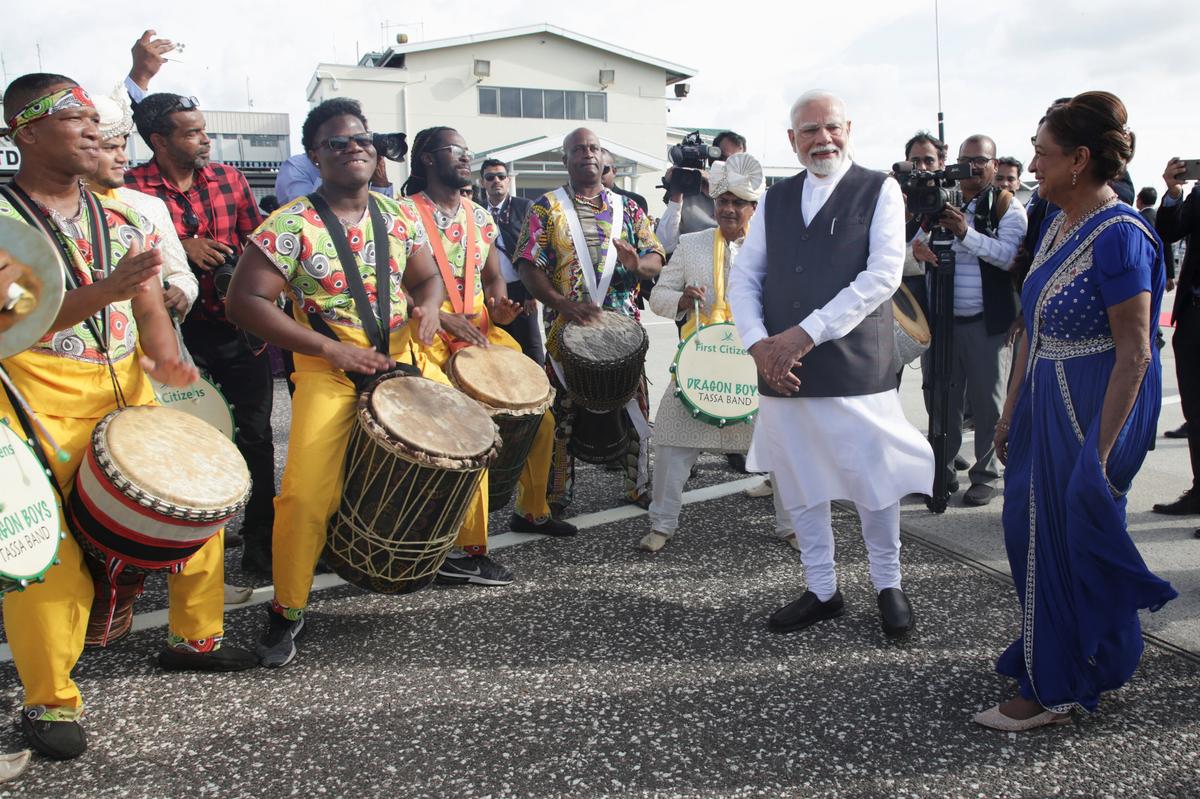
But Trinidad and Tobago, a tiny island nation of just 1.5 million people, isn’t populated only by African descendants. It also has a large Indian-descended population that slightly outnumbers the African population. That’s why I describe the country as a place where West Africa and India meet.
Indians became part of Trinidad primarily through the British colonial system of indentured servitude after the abolition of African slavery there in 1838. The end of slavery caused many formerly enslaved Africans to leave the sugar estates, reducing the supply of plantation labor and enabling workers to demand better, fairer wages.
The former British enslavers compensated for this by going to colonial India to recruit cheap, malleable workers under fixed-term labor contracts known as indentured servitude. The first Indian indentured workers arrived in Trinidad aboard the Fatel Razack on May 30, 1845.
Historically, Afro-Trinidadians enjoyed numerical dominance, but that began to slip in 1990. According to the country’s latest census, conducted in 2011, 35.4 percent of the population is Indian while 34.2 percent is African. About 8 percent identified as mixed African and East Indian. More than 15 percent identified as belonging to another mixed background and 6.2 percent did not state an ethnicity.
The driver who picked us up from the airport and took us to our hotel was an Indo-Trinidadian who spoke a charming, Hindi-inflected Trinidadian Creole English that both intrigued and escaped us. We resorted to hand gestures whenever verbal communication broke down.
Interestingly, Samuel Selvon, whose novel introduced me to Trinidad and Tobago in the 1980s, was Indo-Trinidadian. I didn’t know this until my visit to the country. Because the characters he describes are mostly Afro-Caribbean, I had assumed he was Black.
My wife accompanied me to Trinidad, and we had planned to explore the country beyond the university, but the intense three-day conference left us with no opportunity to do so. We plan to return on vacation in the coming years. Still, in our limited interactions with people within and outside the university, we encountered many fascinating things about the country.
While I was an undergraduate at Bayero University in Kano, I had the great fortune to read the works of Professor Maureen Warner-Lewis, a Trinidadian and Tobagonian linguist and scholar of African-Caribbean languages who wrote Trinidad Yoruba: From Mother-Tongue to Memory and Yoruba Songs of Trinidad. Her works examine the history, phonology, syntax and vocabulary of the Yoruba spoken in Trinidad, as well as the domains in which it survived the longest, particularly personal names, religious songs and rituals.
That led me to assume that most Trinidadians were descended from Yoruba people. But my wife, who is part Igbo, was the first to notice that many of the people we encountered at the university and the mall looked transparently Igbo, Cross Riverian or Akwa Ibomish.
So, I did a little research and found Trinidad’s 1813 slave census, which provides an unusually detailed snapshot of the African origins of its enslaved population. It recorded 25,696 enslaved people, including 13,984 who were African-born and 11,633 who were Creole-born, meaning they were born in Trinidad or elsewhere in the Caribbean.
Among the African-born population, the Igbo, rendered as “Ibo” at the time, had the largest representation, with about 2,863 people. They were followed by Congo people, with 2,450, Moco, with 2,240, Mandingo, with 1,421 and Kormantyn, with 1,068. Smaller recorded groups included Kwakwa, Temne, Susu, Kissi, Ibibio, Rada, Chamba, Fulani, Popo, Hausa and Yoruba.
I showed my wife the statistics and said they probably explained why so many people we saw in Port of Spain, the capital, and St. Augustine, the location of the University of the West Indies campus, looked so unmistakably Igbo.
Of course, all the ethnic groups have become so intermixed that it is impossible for anyone to be “pure” anything. But some genetic traits become physically dominant despite mixture with others.
Although the 1813 slave census counted only 10 Yoruba people in Trinidad, Yoruba cultural prominence in Trinidad owes much to the later nineteenth-century migration of formerly enslaved Yoruba people.
For a small country, Trinidad is surprisingly diverse. I didn’t expect to see any trace of Islam in this former British colony, where Indians bear names such as Samuel, Amanda, Rebecca, Joseph and John. But we saw bearded men who looked like Muslims and women who wore hijabs. Then we saw signs bearing the words “Ahlan wa Sahlan” and inviting the public to an Islamic event.
I asked one of the professors at the University of the West Indies to explain the Muslim presence in Trinidad and Tobago. Although Muslims constitute a mere 5 percent of the country’s population, they enjoy a visibility incommensurate with their numerical insignificance.
The best-documented early Trinidadian Muslim leader was Jonas Bath, who was also called John Mohammed Bath. He was an Arabic-literate West African Muslim brought to the island around 1804 or 1805. After obtaining his freedom, he became the religious and civic leader of the island’s Mandingo Muslims.
The community pooled money to purchase the freedom of other Muslims and reportedly numbered about 140 by the 1830s. Bath unsuccessfully petitioned the British authorities to repatriate the community to Africa.
The much larger and more enduring Muslim presence began in 1845 when the British brought Indian indentured workers to Trinidad after emancipation. But a few Afro-Trinidadians, inspired by American Black Muslims, also converted to Islam.
One such Afro-Trinidadian Muslim, my Trinidadian colleague told me, was Yasin Abu Bakr, born Lennox Philip, the leader of Jamaat al Muslimeen. On July 27, 1990, he and 113 others attempted to overthrow the government, partly in protest against economic difficulties caused by IMF-imposed subsidy withdrawals.
As you can probably guess by now, Trinidad and Tobago is an oil-producing country where subsidies still exist and where petrol, diesel and electricity are still cheap. It is the most prosperous Caribbean nation, and its universities are also among the best-rated in the region.
But the World Bank and the IMF haven’t given up trying to encourage the country’s government to remove all subsidies and leave the people to their own devices, as they have done in Nigeria.
I can’t end this reflection without noting the surprising similarity between the paralinguistic oral gestures West Africans and Trinidadians use to express annoyance, disgust, contempt, impatience or disapproval.
In Nigeria, we call it “hissing.” Jamaicans call it “kissing one’s teeth.” Trinidadians call it “steups,” sometimes spelled “stewps” or “cheups.” The verb is “to steups,” and the action can be called “steupsing.”
During lunch, an older man who works for a Caribbean news agency “hissed” in response to something. For a moment, it felt as though I was in Nigeria. My wife and I looked at each other in pleasant amazement.
Trinidad and Tobago taught me that history survives not only in archives, censuses and scholarly books but also in faces, faiths, names, rhythms of speech and even in a steups across a lunch table. On these small islands, Africa and India were uprooted, transplanted and compelled to remake themselves beside each other. What emerged is neither Africa nor India in miniature but a distinctly Trinidadian civilization in which distant inheritances remain visible, audible and emotionally recognizable.

Farooq Adamu Kperogi is a Nigerian-American professor, author, media scholar, newspaper columnist, blogger and activist. He was a reporter and news editor at many Nigerian newspapers including the Daily Trust, Daily Triumph and the now defunct New Nigerian.