By Farooq A. Kperogi
I was in Japan for a 10-day vacation (workation for my wife), which gave us an opportunity to see our first daughter, a final-year engineering student at Georgia Tech, who is doing a three-month study-abroad program at the University of Tokyo.
Apart from Tokyo, we explored the sights, sounds, and smells of major Japanese cities like Yokohama, Japan’s second-largest city; Osaka, Japan’s third-largest city; Kamakura, a historic, picturesque former capital of Japan from 1185 to 1333; and Kyoto, a former Japanese capital before Tokyo, which is acknowledged as the headquarters of Japanese culture.
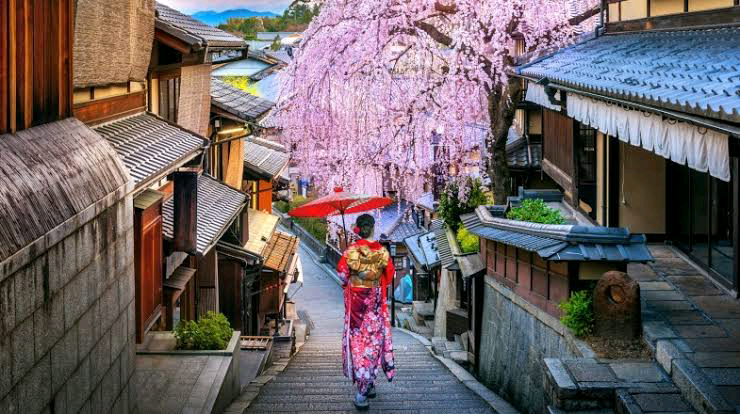
Kyoto held my curiosity the most. Its imaginative mix of tradition and innovation intrigued me greatly. When we got out of the train, the part of the city we first encountered was very noticeably traditional. People were either walking or on bicycles, and homes were of traditional Japanese architecture.
But as we walked further, we saw a massive city with charming structural poetry and beautiful, expensive cars. At Kyoto University, nonetheless, we were back to seeing seemingly limitless seas of bicycles. It appears that all students and faculty members have bicycles. In fact, you can’t enter the main gate of the university (Japan’s second oldest and second-most prestigious) with anything but a bicycle or on foot. We didn’t see that at the University of Tokyo.
From Militarism to Pacifism
Before my trip to Japan, my first ideational encounter with Japan came from reading Professor Sakah Saidu Mahmud’s 1996 book titled State, Class and Underdevelopment in Nigeria and Early Meiji Japan in my final year at Bayero University, Kano, in 1996. It was a gift from the author, who taught politics and international relations in Denver, in the U.S. state of Colorado.
Japan used to be a fiercely militaristic and imperial power that either outright colonized or militarily occupied its neighbors until its defeat and occupation by the U.S. during the Second World War.
Its 1945 defeat stripped it of its empire and military power and catalyzed a new pacifist national identity. Interacting with Japanese people in Tokyo, Yokohama, Kamakura, Kyoto, and Osaka, it was hard to reconcile their history of warmongering and their current peaceableness.
What immediately strikes you as you go to any city in Japan is the ever-present, almost compulsive, obeisance of the people. Everyone bows their heads to greet. The deeper the bow, the greater the respect. I never once saw anyone shake hands or hug to greet. This seems to be broadly Asian culture.
Ever-Present Courtesy and Obeisance
The excessive courtesy extended to us at every turn reminded me of the dutiful, submissive, oversolicitous behavior of the lower classes in Nigeria toward “big” men and women, except that in Japan, it is done with no expectation of reward, unlike in Nigeria, where such behaviors are often a symbolic act of begging.
In fact, in Japan, it is considered inappropriate, even rude, to tip anyone for their services. It will be promptly and politely returned. Maybe that’s why we never saw a beggar or a homeless person throughout our stay there.
Our daughter, who has been there longer than us and has visited a few other cities with her Japanese colleagues, said she, too, never once saw a beggar or a homeless person.
This is probably as much about Japan’s more evenly distributive prosperity as it is about its culture that is rooted in dignity and self-restraint even in the face of hardship. I heard it’s called gaman.
Japanese Don’t Say “No”
Another striking feature of Japanese culture is the premium it places on avoiding confrontation, especially for a culture that used to be militaristic until a few decades ago. Because Japanese culture values harmony, subtlety, and non-confrontation, it is rare to hear “no” among the people.
Our daughter told us that invitation letters to social events among her Japanese friends have only two options: yes or maybe. Saying “no” directly can embarrass the other person or create tension. Instead, people use indirect language, silence, or evasive phrasing to indicate “no.”
The Japanese would also rather tolerate minor inconveniences than cause another what they consider embarrassment. For instance, on their escalators in train stations, everyone automatically moves to the right so that people who are in a hurry and want to walk down the stairs can use the left side.
Sometimes, tourists (especially American tourists) unfamiliar with Japanese ways unintentionally block the left side. Japanese people almost never ask to be let through, however much in haste they might be. An American or a Nigerian would (im)politely say, “Excuse me!” in such circumstances.
To the Japanese, to complain because of a little inconvenience like that is considered being confrontational.
American Influence
It is doubtful if the Japanese have always been this averse to even the mildest hint of confrontation, given their history of militarism. It seems likely that it’s another auxiliary consequence of the American occupation and remaking of the cultural and political landscape of the country from 1945 to 1952.
During this period, the country was led by General Douglas MacArthur, on whose watch American officials wrote a constitution for the country in 1947, which imposed democracy on the country and includes an Article 9 that says, “The Japanese people forever renounce war as a sovereign right of the nation…”
The old militarist elites were purged, and a new civic culture emerged, which associated war and aggression with sorrow and shame rather than glory. This led to a redirection of the focus of the country from military conquest to economic development. It triggered the “Japanese economic miracle” of the 1950s–1980s.
Structural Poetry of Japanese Cities
By not spending heavily on the military, Japan channeled its resources into rebuilding its infrastructure, education, and industries. Today, the massive, sprawling, intimidatingly elegant architectural splendor of Japanese cities makes America look like one big village.
To experience sublime architectural grandeur in American cities, you go downtown. In Japan, most parts of every city look like the downtown. The structural elegance and spatial grace of Japanese cities have no equal anywhere in America.
Yet even busy, bustling parts of Tokyo with edifices of wonder, such as in Shibuya (often called the Times Square of Tokyo), are relatively quiet and subdued.
As it should be obvious by now, Japan’s greatest resource is its people. As I pointed out in my July 12, 2025, column titled “Problem of Paying Peanuts to Professors,” massive investment in public universities has been a cornerstone in Japan’s growth and continuing prosperity.
The high-growth period of the 1960s in Japan was coterminous with the rapid expansion of access to university education. In 1955, there were only 228 universities. There are now nearly 800 universities with a population of 125 million people.
This led to an explosion in student enrollment from 523,000 in 1955 to nearly three million now and the creation of a large pool of skilled labor for the country.
Were it not for the ingenuity of its people and its creative mix of tradition and innovation, Japan would have been one of the poorest, most miserable countries in the world—especially given that only about 13–20% of its national land area is cultivable.
It imports about 80% of its wheat and 90% of its soybeans, two crops that are central to its gastronomy. Most of its animal feed, which accounts for a significant proportion of meat, milk, and egg production, is also imported.
The ingenuity of the people ensures that they have relative food sufficiency even when they don’t grow all the food that they need.
No School Buses for Kids
I would be amiss to end this reflection without mentioning another comforting anomaly I saw throughout Japan: there are no school buses.
Children as young as six years old walk to and back from school without parental supervision. Sometimes they get on public trains and buses, which are omnipresent, timely, efficient, and cheap.
I grew up walking to school in rural Nigeria but didn’t think children would be doing that in big cities like Tokyo, Osaka, Yokohama, and so on in Japan. It speaks to the immense confidence the Japanese society has in its security.
Presenteeism and Noodle Harassment
However, although Japan seems perfect by most metrics, it’s not without its downsides. First, Japan is known for its long working hours and culture of “presenteeism” (that is, staying at work to be seen by your boss even if not working productively). Japanese work culture often extends well beyond official hours, so that people work from 9 a.m. to 8 p.m. every day.
It’s one of the reasons people aren’t getting married or having children, and why the population is aging and not being replenished.
Also, although the cities are incredibly beautiful, buildings are intimidatingly imposing, and the streets are extremely neat, the lawns aren’t always manicured. Grasses either overgrow or are cut with no care for aesthetics.
And although the Japanese are prim and proper in almost everything, their eating habits can be aggravating, especially for people who have a negative reaction to loud sounds from diners. When they eat their noodles, they slurp, smack, and make noises that grate on the nerves. Foreigners call this “noodle harassment”!
In the end, though, Japan left me with the conviction that true national greatness lies in the grace of everyday discipline, dignity, and collective purpose, not noise or spectacle.

Farooq Adamu Kperogi is a Nigerian-American professor, author, media scholar, newspaper columnist, blogger and activist. He was a reporter and news editor at many Nigerian newspapers including the Daily Trust, Daily Triumph and the now defunct New Nigerian.