By. Dr Stan Mojekwu.
There comes a point in politics when criticism of an opponent becomes so relentless that Nigerians begin to wonder whether the critic is actually campaigning against the opponent—or fighting his own insecurity.
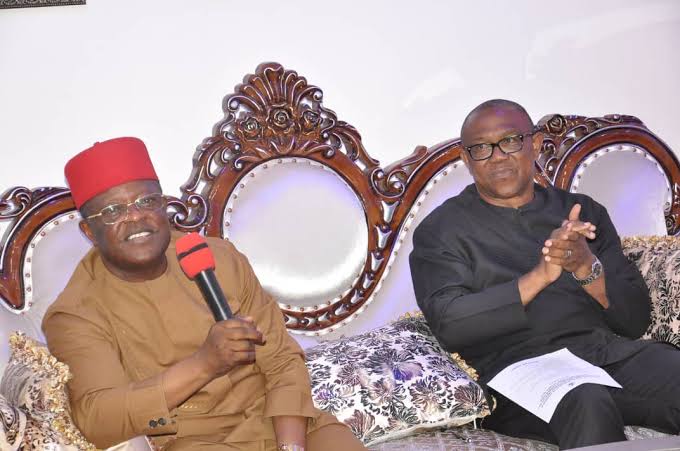
David Umahi appears to have reached that point with Peter Obi.
Umahi is a seasoned politician. He has been governor, senator and federal minister. He has occupied positions that should give him enough confidence to stand on his own record.
Yet, somehow, Peter Obi keeps appearing in the conversation.
Obi is not the Minister of Works. He is not a sitting governor. He is not occupying an executive office at the federal level. Yet his name seems capable of provoking an extraordinary amount of political agitation from some of his opponents.
At some point, Nigerians are entitled to ask:
What exactly is Peter Obi doing to David Umahi?
Because if Obi is truly as incompetent, insignificant and politically finished as his critics repeatedly suggest, why not simply ignore him?
Why the obsession?
Why the constant need to explain him away?
Why the desperate attempt to diminish his record?
Why keep dragging his name into political arguments?
That is where the language of inferiority complex begins to become politically relevant—not as a medical diagnosis, but as a description of a politician who appears unable to discuss his own relevance without first discussing someone else’s.
And there is something deeply ironic about it.
The surest evidence of political confidence is the ability to stand alone.
A politician who believes he has achieved more does not need to spend his political life shouting about the achievements of the man he claims is inferior.
He simply presents his own record.
Here are my roads.
Here are my schools.
Here are my hospitals.
Here are my investments.
Here are the jobs I created.
Here are the reforms I delivered.
Here are the figures.
Compare them.
That is how serious politicians behave.
Not by turning every political conversation into another opportunity to attack Peter Obi.
Let Umahi therefore bring the receipts.
If Peter Obi’s administration in Anambra was a failure, show Nigerians the figures.
If Obi mismanaged public resources, provide the evidence.
If his infrastructure record was exaggerated, dismantle it project by project.
If his economic philosophy was wrong, present a superior alternative.
If Umahi believes his own record is better, put both records on the table.
Let Nigerians judge.
But what Nigerians do not need is political theatre masquerading as evidence.
Peter Obi has become something rather uncomfortable for his political opponents: a benchmark they cannot easily make disappear.
You may dislike him.
You may oppose his presidential ambition.
You may disagree with his economic policies.
You may question his political strategy.
All of that is legitimate.
But pretending that millions of Nigerians did not identify with his message during the 2023 presidential election is simply political denial.
And political denial is not a strategy.
The more some politicians insist that Obi is irrelevant, the more they inadvertently advertise his relevance.
It is the oldest mistake in politics: trying so desperately to destroy a man’s image that you end up keeping his name permanently alive.
Umahi should be particularly careful.
The office of Minister of Works is not a debating platform for settling old political scores. Nigerians expect roads to be constructed, projects completed, contracts properly supervised and public resources responsibly managed.
The country does not need another politician whose greatest achievement is explaining why another politician is not important.
Show us what you are doing.
Build the roads.
Finish the projects.
Account for the money.
Give Nigerians results.
Then let the results speak.
Because there is a brutal truth every politician eventually learns: you cannot insult your way into greatness.
You cannot ridicule another man’s popularity into disappearing.
You cannot shout louder than another man’s record.
And you certainly cannot build your political stature by permanently standing in another man’s shadow.
If David Umahi believes Peter Obi is overrated, then he should stop talking about Obi and start demonstrating why Umahi is better.
That is the challenge.
Beat Obi with performance.
Beat him with ideas.
Beat him with integrity.
Beat him with results.
Not with insults.
Not with political noise.
Not with endless attempts to rewrite history.
Because the Nigerian public is not stupid.
Nigerians can see when a politician is confident.
They can also see when a politician appears haunted by comparison.
And perhaps that is the most uncomfortable question for Umahi:
If Peter Obi is truly as irrelevant as you claim, why does his name continue to live rent-free in your political arguments?
A genuinely confident politician does not spend his career fighting another man’s shadow.
He creates his own light.