Isaac Samuel
The House of Representatives Committee on Finance Tuesday intensified oversight of key revenue-generating agencies, scrutinising the Nigeria Customs Service (NCS) and the Federal Airports Authority of Nigeria (FAAN) over revenue gaps, debt recovery, and operational discrepancies.
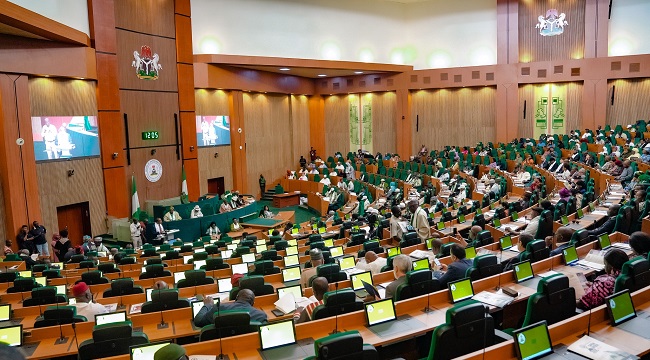
The session, chaired by Committee Chairman James Faleke, focused on improving federal revenue amid dwindling resources, with lawmakers demanding comprehensive documentation from both agencies for 2023 through 2025.
The lawmakers scrutinised the NCS over its revenue performance between 2023 and 2025, demanding detailed breakdowns of auction proceeds, contractor registrations and export documentation.
Presenting the agency’s performance, the Comptroller-General of Customs, Bashir Adeniyi, said the Service’s revenue base rests on three major heads: import duty, excise duty and fees.
“As a kind of background, the revenue base for the Nigeria Customs Service is basically three heads. We have import duty, we have excise duty, and then we have various fees that are collected from different services,” he explained.
He disclosed that in 2023, Customs generated N3.2 trillion, falling short of the N3.67 trillion target.
“In 2023, we collected total revenue of N3.2 trillion as against a target of N3.67 trillion,” he said, noting that performance was about 87 per cent.
According to him, economic headwinds in the first half of 2023 significantly affected performance, including currency redesign and election-related slowdowns, as well as exchange rate volatility. However, collections rebounded in the second half of the year.
Providing updates for 2024, the Comptroller-General said the Service exceeded its revenue target of N5.079 trillion, generating N6.1 trillion during the fiscal year.
“For 2024, our target was N5.079 trillion. Our revenue for 2024 was N6.1 trillion. The details are as provided,” he told lawmakers, referencing documents submitted to the committee.
He attributed the improved performance to a mix of policy implementation, operational reforms and strategic interventions carried out in 2023 that yielded results in 2024.
Among these was a major port decongestion exercise that cleared long-stay containers and created operational space for improved cargo processing.
“We took actions in 2023 that helped to produce results in 2024. One of them was the effort to decongest the ports. Old containers were removed, and we had better space for operations in 2024,” he said.
The Customs boss also disclosed that the Service secured presidential approval to review certain small consignments that often entered the country informally. A special compliance window was opened for such goods, generating about N325 billion in 2024.
“We are at the end of the exercise. We made about N325 billion in 2024 from that intervention,” he said.
He noted that the 2024 target was almost double the 2023 figure, requiring deliberate strategising and intensified enforcement.
Lawmakers commended Customs’ automation drive and sought clarity on its level of digitalisation, on a scale of 1 to 10.
Responding, the Comptroller-General traced the agency’s automation journey over the past two decades, noting that earlier systems were concessioned to private service providers.
He said Customs has since exited those arrangements and built internal capacity, recruiting IT-trained officers to manage its systems.
“In terms of automation, pre-arrival documentation is 100 per cent automated. Payment of customs duty has been automated. Transmission of manifests has been automated. Declarations have been automated. Release processes are automated,” he said.
Meanwhile, FAAN Managing Director Olubunmi Kuku appeared before the committee to explain discrepancies in internally generated revenue, debt recovery, and passenger service charges.
Lawmakers sought a breakdown of outstanding payments from airlines, citing a N25 billion shortfall in 2023 despite FAAN reporting over N8 billion recovered.
Kuku explained that some debts stem from defunct carriers or delays in the International Air Transport Association (IATA) billing system, which processes payments with a 14–30 day lag.
He also clarified variations between projected and actual revenue were partly due to exchange rate assumptions in the budget.
FAAN reported 17.5 million passengers in 2025, including 4.1 million international and 13.4 million domestic travelers.
The Lawmakers questioned revenue estimates from international passengers and sought assurance that all payments are remitted.
The committee demanded a detailed breakdown of debts for 2023–2025, including debtor airline names, recovery status, cargo revenue, and tollgate collections.
Kuku acknowledged that FAAN operates as an airport management company on behalf of the federal government, suggesting a possible review of its enabling Act.
Both agencies were directed to submit comprehensive documentation covering auction proceeds, contractor registrations, revenue breakdowns, debt profiles, and export records.
The committee stated that accurate and transparent reporting is critical for boosting federal revenue and reducing reliance on borrowing.
Faleke stated: “We are looking at revenue. How do we shore up more money for this country? We are tired of borrowing. We don’t want to borrow anymore.”