Isaac Samuel
Nigeria and South Africa have been drawn into a diplomatic row following a disagreement over the omission of Nigeria’s High Commissioner, Chief Femi Fani-Kayode’s speech from a livestream of a credentials presentation ceremony hosted by President Cyril Ramaphosa.
The disagreement escalated on Saturday after the Nigerian High Commission in South Africa exchanged strong words with Vincent Magwenya, spokesperson to Ramaphosa, over whether the South African President intervened after Fani-Kayode protested the omission of his address from Friday’s broadcast.
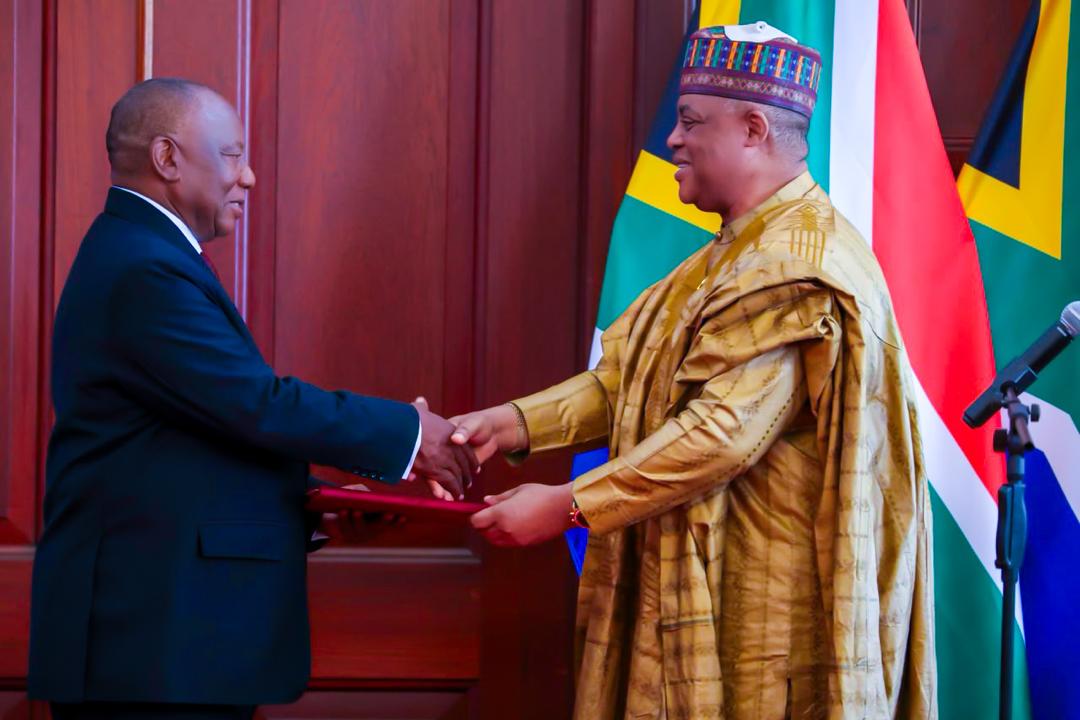
Fani-Kayode had presented his letters of credence to Ramaphosa alongside ambassadors from 14 other countries at the Sefako M. Makgatho Presidential Guest House in Tshwane, Gauteng, on Friday, November 13.
The former Minister of Aviation subsequently accused the South African Presidency of deliberately excluding Nigeria’s delegation from the livestream, claiming that the introductions and speeches of the other 14 diplomats were broadcast while his own was omitted.
According to him, the broadcast was interrupted shortly before his turn and resumed only after he had delivered his address.
He described the incident as deliberate, suggesting that some elements in South Africa were uncomfortable with Nigeria’s presence.
Fani-Kayode said he raised the matter directly with Ramaphosa during a photo session after the ceremony, adding that the President took him to relevant officials and questioned them over the incident.
He said Ramaphosa directed the officials to resolve the matter immediately, although it was too late to restore his speech to the original livestream.
The Nigerian envoy also disclosed that he declined an interview request from the South African Broadcasting Corporation (SABC) following what he described as the deplorable treatment of his delegation.
However, Magwenya rejected Fani-Kayode’s account, insisting that Ramaphosa neither intervened in the operations of the public broadcaster nor had the authority to influence its editorial decisions.
In a response to the Nigerian envoy, the presidential spokesperson said Ramaphosa merely directed him to Sophie Mokoena, SABC’s acting political and foreign editor, whom he identified as the appropriate person to address his complaint.
Magwenya also alleged that Fani-Kayode declined to speak with Mokoena, who could have clarified the circumstances surrounding the broadcast interruption.
“The SABC is a public broadcaster. The President carries no legal or political mandate to interfere with its operations or intervene in its editorial processes,” he said.
Describing the Nigerian envoy’s handling of the matter as “grossly inappropriate”, Magwenya urged him to establish a professional relationship with the broadcaster and engage South African institutions constructively.
The South African presidential spokesperson subsequently accused Fani-Kayode and the Nigerian mission of misrepresenting events.
“Even when it’s institutionalised, a lie remains a lie. There was no such intervention from the President or the Presidency and there will never be,” Magwenya said in a further exchange.
He also told the Nigerian mission to familiarise itself with South Africa’s constitution, laws and the SABC editorial code, adding: “Stop disgracing yourself and your country.”
The Nigerian High Commission, however, fired back, describing Magwenya’s comments as provocative and diplomatically inappropriate.
In a strongly worded response posted on X, the mission insisted that Ramaphosa personally intervened to resolve the disagreement and accused the South African spokesperson of attempting to undermine relations between both countries.
“You are the disgrace and no-one else. Outside of that your insolence and ignorance knows no bounds,” the commission said.
It maintained that Ramaphosa directed the relevant officials and the state broadcaster to address the complaint.
“Thankfully your President had the decency and presence of mind to put out the fire and direct you and your state broadcaster to do the right thing. He literally saved the day,” it added.
The mission also recalled an earlier controversy in which Magwenya reportedly described concerns expressed by Nigerian President Bola Tinubu and Ghanaian President John Mahama over xenophobia and Afrophobia in South Africa as fake news.
It said Nigeria had previously refrained from escalating the disagreement but questioned why Magwenya would publicly accuse its newly accredited envoy of lying.
“Did you really expect him to simply stomach your ill manners and keep quiet? If so, you have misunderstood the character and nature of the Nigerian. We cannot be easily cowed,” the commission said.
The High Commission further disclosed that several newly accredited ambassadors witnessed the proceedings, adding that it possessed a full video recording of events following the official photographs.
It said the disagreement should have been handled through diplomatic channels, urging Magwenya to exercise restraint and embrace reconciliation.
Although the Nigerian mission declared the matter closed, it warned that it was prepared to respond if the South African spokesperson chose to escalate the exchange.
“To us this matter is closed but if you wish to escalate it you are welcome to do so and we are up to the task. A word is enough for the wise,” it added.
Meanwhile, the South African Presidency subsequently uploaded a separate video of Fani-Kayode’s full address to its official YouTube channel, making the speech publicly available after the initial livestream controversy.
In his address, Fani-Kayode pledged to strengthen relations between Nigeria and South Africa, describing his diplomatic assignment as an opportunity to rebuild bridges and address areas of mutual concern.
“Nothing can come between the two of us. And part of my job here is to reset that relationship, to come and build that bridge, and to ensure that whatever concerns we have mutually, we can work them out and move forward together,” he said.
He also recalled Nigeria’s support for South Africa during the struggle against apartheid and called for closer economic and diplomatic cooperation between the two countries.
The controversy comes amid longstanding concerns over xenophobic attacks and the safety of Nigerians living and doing business in South Africa.