Isaac Samuel
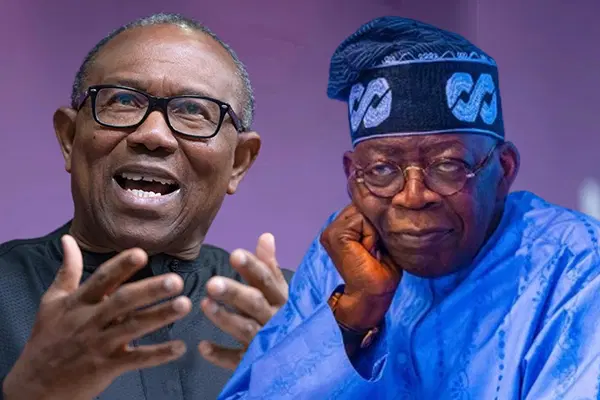
Former Anambra State governor and presidential candidate of the Nigeria Democratic Congress (NDC), Peter Obi, has criticised President Bola Tinubu over his bid to stop the release of records held by United States law enforcement agencies, saying the President should confront questions surrounding his past rather than seek to shield them from public scrutiny.
Obi made the remarks in a statement on Monday, in which he said he was saddened by the direction of the country and the example being set by political leaders.
The criticism followed fresh filings by Tinubu before a United States District Court for the District of Columbia, in which the President asked the court to reject a request for the release of unredacted records concerning him held by the Federal Bureau of Investigation (FBI) and the Drug Enforcement Administration (DEA).
The request was brought by American transparency activist Aaron Greenspan under the US Freedom of Information Act. Tinubu’s lawyers argued that US privacy laws protect the records and that there was no sufficient public interest to outweigh his privacy rights.
L
Greenspan’s requests reportedly include the FBI’s file on Tinubu, interview records from 1992 and 1993 and documents connected to a 1993 civil forfeiture case involving about $460,000.
The dispute is not entirely new. Greenspan’s case dates back to 2023, and a US federal judge ruled in April 2025 that the US Department of Justice had officially acknowledged FBI and DEA involvement in investigations concerning Tinubu, rejecting the agencies’ earlier attempt to rely on so-called “Glomar” responses — responses that neither confirm nor deny the existence of records.
It is against this backdrop that Obi, without going into the details of the US litigation, questioned the wisdom of a sitting Nigerian President seeking to prevent the disclosure of records concerning his past.
“It is profoundly embarrassing that we have reached a point where a sitting President is asking a foreign court to withhold records concerning his past, particularly records relating to matters of legitimate public interest,” Obi said.
The latest development has also revived questions about Tinubu’s personal and educational history as the country moves towards the 2027 presidential election.
In August, the Independent National Electoral Commission (INEC) published the personal particulars and academic credentials submitted by presidential candidates for the 2027 election.
A review of Tinubu’s EC9 nomination form showed that he listed a Bachelor of Science degree in Business Administration from Chicago State University, obtained in 1979, while the spaces for his primary and secondary school qualifications were left blank.
He attached his university degree and National Youth Service Corps certificate to the nomination documents.
The issue has particular significance because Tinubu’s educational history was already at the centre of litigation surrounding the 2023 presidential election.
In 2023, former Vice President Atiku Abubakar obtained an order from a US court directing Chicago State University to release Tinubu’s academic records.
The records subsequently became part of Atiku’s attempt to introduce fresh evidence in his challenge to Tinubu’s election victory.
The controversy included questions over the diploma Tinubu submitted to INEC.
Chicago State University’s registrar confirmed that the institution had an original academic record for Tinubu but said the university could not authenticate a particular diploma because it was not in the school’s possession. Tinubu’s representatives rejected allegations of forgery.
However, the controversy did not result in the nullification of Tinubu’s election. In October 2023, the Supreme Court upheld his victory and declined Atiku’s attempt to introduce the Chicago State University material as fresh evidence, holding that the alleged forgery issue had not been pleaded in the original petition.
The issue has nevertheless resurfaced ahead of 2027. Obi had already called on Nigerians during the launch of his campaign to scrutinise the academic records and credentials of all presidential candidates and demand that they defend their records publicly.
’
Obi said the latest controversy should not simply be viewed through the prism of political rivalry, arguing that leaders should be willing to confront uncomfortable questions about their past.
According to him, leadership requires “the courage and humility to confront one’s history” by acknowledging mistakes, explaining areas of uncertainty and apologising where necessary.
He said this was particularly important for matters relating to educational qualifications, arguing that Nigerians should not be left with unresolved questions about a leader’s foundational schooling.
“Issues surrounding foundational schooling — primary and secondary — should not remain unresolved or be addressed primarily through legal proceedings,” Obi said.
“Nigerians deserve clear, credible, and verifiable explanations, especially when such had been submitted in the past.”
The NDC candidate said the matter went beyond Tinubu personally, warning about the example being set for more than 200 million Nigerians, particularly young people in schools.
He argued that the Presidency should represent integrity, accountability, transparency and ethical leadership.
Obi also acknowledged that individuals could have imperfect pasts, but said what mattered was the willingness to confront them honestly, make amends and put the interests of the country ahead of personal ambition.
“When will our political class fully appreciate that individual ambitions are temporary, while the nation endures?” he asked.
“The Presidency is an office held for a season; the moral standards established by those who occupy it can influence generations.”
He added: “Nigeria is greater than any one person, and the integrity of the Republic must always come before the interests of the individual.”