Isaac Samuel
The recent disagreement between the Catholic Bishops’ Conference of Nigeria (CBCN) and the administration of President Bola Ahmed Tinubu is being presented in some quarters as though the bishops have suddenly discovered politics, or worse, as though they have suddenly become opposition politicians.
But history does not support that interpretation. From the Second Republic through years of military dictatorship and into the Fourth Republic, Nigeria’s Catholic bishops have repeatedly commented on elections, corruption, human rights, insecurity, poverty, constitutionalism and the conduct of government.
The personalities have changed. The administrations have changed. The political parties have changed but indeed, the principle has remained substantially the same.
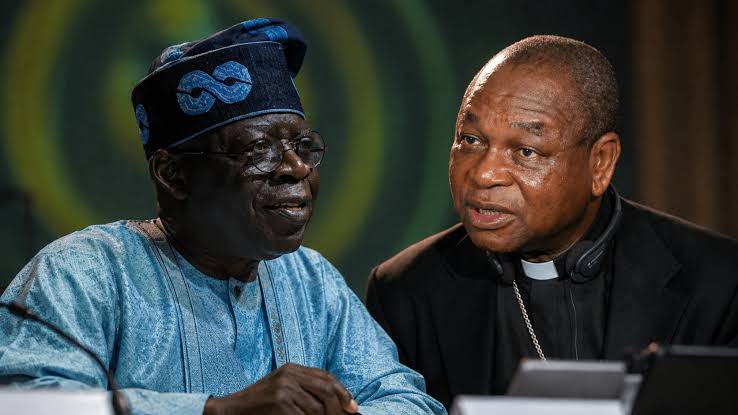
The present controversy did not begin with a random statement by Cardinal John Onaiyekan. It followed a meeting between President Bola Ahmed Tinubu and the Catholic Bishops’ Conference of Nigeria (CBCN) at the Presidential Villa on July 28, 2026.
The bishops had requested the meeting and came with what they described as a collective assessment of the state of the nation. According to reports of the meeting, the bishops raised concerns about worsening insecurity, economic hardship, poverty, infrastructure, the state of democracy, credible elections ahead of 2027 and the protection of constitutional rights.
The CBCN president, Archbishop Matthew Ndagoso, reportedly presented the concerns as part of the Church’s responsibility to contribute to the building of a just and peaceful Nigeria.
The bishops also raised concerns about education, including the issue of mission schools, and the welfare of ordinary Nigerians.
But President Tinubu did not accept the bishops’ assessment of the country. He argued that his administration’s reforms were producing measurable improvements and that Nigeria was moving in the right direction.
On security, he pointed to measures being taken by the security agencies. On the economy, he defended the reforms and argued that the country was emerging from the severe fiscal problems inherited by his administration.
The President also told the bishops that the issue of returning schools to their original owners was primarily a matter for state governments under the Constitution.
He reminded them that, as governor of Lagos, he had returned mission schools in the state.
So, at that point, this was essentially a disagreement between the bishops and the President over how Nigeria should be assessed. The meeting itself was not necessarily the controversy.
The controversy exploded after the meeting.
Three days later, on July 31, Cardinal John Onaiyekan appeared on Arise Television’s Prime Time programme and gave his account of what happened during the meeting. His account immediately changed the character of the story.
Onaiyekan said the bishops had deliberately presented the President with what they believed was the reality confronting ordinary Nigerians rather than giving him the flattering picture he might ordinarily receive from people around him.
He described the country as “bleeding” and said the bishops told Tinubu that the economy was not helping poor Nigerians.
According to Onaiyekan, Tinubu pushed back and insisted that the economy was doing well. But perhaps the most politically explosive part of the interview was not the economy. It was 2027.
Onaiyekan expressed concern that the Tinubu administration might be determined to win the 2027 election “by all means” and raised questions about the independence of the electoral process.
He stressed that the bishops were not asking Tinubu to help the opposition defeat him, but argued that, as an electoral contestant, the President should be subject to the same democratic rules as other candidates.
That took the matter from a disagreement over economic policy to a much bigger question about democracy, electoral integrity and the 2027 presidential election. And that is when the Presidency reacted.
The first major response came from Temitope Ajayi, Senior Special Assistant to the President on Media and Publicity.
Ajayi’s argument was not principally that the bishops had no right to criticise the government.
Rather, he attacked Onaiyekan’s decision to publicly discuss what he regarded as a private meeting.
Ajayi described the Cardinal’s interview as “an abuse of clerical privilege.”
He argued that the bishops had requested the meeting, the President granted them an audience, they presented their concerns, Tinubu listened and responded, and that should ordinarily have been the end of the matter.
Daniel Bwala, Special Adviser to the President on Policy Communication, took a more political line. While Ajayi concentrated heavily on the confidentiality of the meeting and the substance of the bishops’ assessment, Bwala questioned Onaiyekan’s political neutrality.
Bwala argued that Onaiyekan was speaking for Catholics, not Christians generally. More controversially, he linked the Cardinal’s intervention to the Catholic Church’s perceived support for Peter Obi, the Labour Party presidential candidate in the 2023 election.
He argued that Onaiyekan’s comments were political rather than purely spiritual.
Bwala was quoted as saying “Cardinal Onaiyekan wasn’t speaking for Christians; he was speaking for Catholics, the very institution rooting for Peter Obi.”
But the Bishop’s criticism of government is a tradition older than Tinubu. The CBCN is not a political party and its interventions cannot reasonably be reduced to partisan opposition.
The Conference has historically regarded its public responsibility as extending beyond the spiritual welfare of Catholics to questions affecting the wider Nigerian society. Its interventions have addressed governance, justice, peace, human rights, poverty, corruption and the responsibilities of political leaders.
But keen observers are of the opinion that the tradition did not begin with President Tinubu and that it certainly did not begin with the 2023 or 2027 election.
The Catholic hierarchy was speaking on Nigeria’s political direction long before Bola Tinubu entered the national political arena.
Perhaps, Cardinal Onaiyekan’s own episcopal career provides perhaps one of the clearest examples.
Onaiyekan was consecrated an auxiliary Bishop of Ilorin in 1983, at the end of the Second Republic. He later became Bishop of Ilorin, Archbishop of Abuja and eventually Cardinal. He also served as President of the CBCN. His public interventions subsequently cut across virtually every major political administration of the Fourth Republic.
He opposed former President Olusegun Obasanjo’s third-term ambition. He criticised successive governments over corruption and insecurity. He spoke against failures in governance under Goodluck Jonathan and Muhammadu Buhari.
His record therefore makes it difficult to sustain the argument that Catholic criticism of government is somehow synonymous with opposition politics.
If speaking truth to power was legitimate when the target was another administration, it cannot suddenly become partisan because the criticism is directed at Tinubu.
The argument becomes even weaker when the history of the military era is considered.
The Catholic hierarchy continued to engage questions of human rights, democracy and national governance during years when Nigeria was ruled by military governments. The atmosphere then was considerably different from what obtains under the present democratic system.
There was no constitutional guarantee of the political freedoms Nigerians now take for granted. Journalists were detained. Publications were banned. Political activists were arrested. Military decrees replaced normal democratic processes.
Yet religious leaders, including Catholic bishops, continued to challenge aspects of government policy and defend democratic principles. The struggle surrounding the annulment of the June 12, 1993 presidential election remains one of the defining moments in Nigeria’s democratic history.
Catholic leaders were among the voices calling for respect for the people’s mandate and a return to constitutional government.
For analysts, Onaiyekan’s rise through the Catholic hierarchy coincided with this turbulent period. He became coadjutor Archbishop of Abuja in 1990 and later the first Archbishop of Abuja when the see was elevated to an archdiocese.
His career developed alongside Nigeria’s struggle to escape military rule. The historical record is telling. It was why the March 18, 1996 edition of TELL magazine, published during the Sani Abacha military regime, carried the striking front-page headline: “We Are Tired of Dictatorship: Catholic Bishops Tell Abacha.”
More than three decades later, the headline offers a useful reminder that the Catholic bishops’ willingness to speak truth to power did not begin with the Tinubu administration.
And the Catholic hierarchy was part of that wider tradition. Reports have been extensively written on Bishop Matthew Hassan Kukah’s confrontations with the Buhari administration, particularly over his Easter homilies. Perhaps, that brings us to one of the most important contemporary examples.
For several years during the Muhammadu Buhari administration, Bishop Kukah’s Easter homilies became major national political interventions. Easter is ordinarily a solemn Christian occasion. But Kukah repeatedly used the occasion to reflect on the condition of Nigeria, including insecurity, corruption, poverty, leadership failures and the state of the nation’s democracy. His criticisms were often blunt.
And they generated equally strong responses from the Buhari Presidency.
In 2022, for example, the Presidency reacted sharply to Kukah’s Easter message, prompting the bishop to respond to government spokesmen.
This was not the first time Kukah had criticised the government. Nor was it the first time government officials had taken issue with him.
The significance of the Kukah episode is that it provides a direct answer to the suggestion that Catholic leaders only became vocal when Tinubu assumed office. They were vocal throughout Buhari’s presidency.
And they were vocal when Buhari’s government was led by the same political party now controlling the federal government. That is why history matters.
Political observers are asking that why then is Tinubu irascible?
This is where the present controversy becomes more political.
President Tinubu is entitled to disagree with the bishops. His ministers and aides are entitled to defend his policies. The Presidency is entitled to challenge the facts, assumptions and conclusions contained in episcopal statements.
But disagreement should not be confused with illegitimacy.
There is nothing inherently anti-government about a bishop saying that Nigerians are hungry. There is nothing partisan about a bishop asking government to protect citizens from insecurity.
There is nothing unconstitutional about a bishop demanding credible elections.
And there is certainly nothing unusual about religious leaders asking political authorities to account for their stewardship.
In fact, President Tinubu himself, when he was outside government, was a prominent critic of successive administrations. He understood the political value of speaking against those in power. The question, therefore, is why criticism becomes problematic when the person being criticised occupies the presidential office.
The bishops’ critics may legitimately argue that the bishops have exaggerated the country’s problems, ignored improvements or failed to acknowledge the achievements of the Tinubu administration. Those are fair political arguments.
But to argue that the bishops have suddenly become political because they criticise Tinubu is historically difficult to sustain.
Interestingly, some of the Presidency’s own responses provide evidence that the government understands this distinction.
In March 2025, following criticism from the Catholic bishops, presidential aide Bayo Onanuga defended the Tinubu administration and argued that the government was moving Nigeria in the right direction.
But rather than dismissing the bishops as inherently illegitimate actors, the Presidency acknowledged their interventions while disagreeing with their assessment of the country. That is how democratic debate should operate.
The bishops make their case. The government makes its case. The Nigerian people decide whose argument is more convincing.
The same applies to presidential aide Daniel Bwala and others who have criticised the bishops. They are free to challenge the Church’s position.
They are free to accuse the bishops of misjudgment. They are free to defend Tinubu’s economic policies and argue that the reforms will eventually produce greater prosperity. But historical accuracy requires a distinction between disagreeing with the bishops and rewriting their history.
Indeed, the Catholic Church’s social teaching has long maintained that faith cannot be completely detached from the conditions in which human beings live.
The bishops therefore do not need to contest an election to have an opinion about the government of Nigeria. If religious leaders could challenge military governments over human rights and democracy, why should they now be accused of destabilising the country merely because they criticise an elected government?
And if Tinubu himself could criticise governments when he was in opposition, why should Nigerians who disagree with his government lose that same democratic right simply because he is now President?
The answers may be uncomfortable.
But they are necessary. Because democracy cannot mean that criticism is legitimate only when one’s preferred political party is out of power.
The bishops are not infallible
None of this means the Catholic bishops are beyond criticism. They are not.
They can make mistakes. They can misread economic data. They can overstate the severity of a problem.
They can underestimate the difficulty of governing a country as complex as Nigeria.
Their political prescriptions can also be debated. The government and its supporters are perfectly entitled to say so. But the proper response is to engage their arguments rather than attempt to delegitimise their institutional right to speak.