
Isaac Samuel
Nigeria’s 2027 presidential election is still about five months away, but the familiar fault lines of religion and identity in the country’s political space is already beginning to re-emerge.
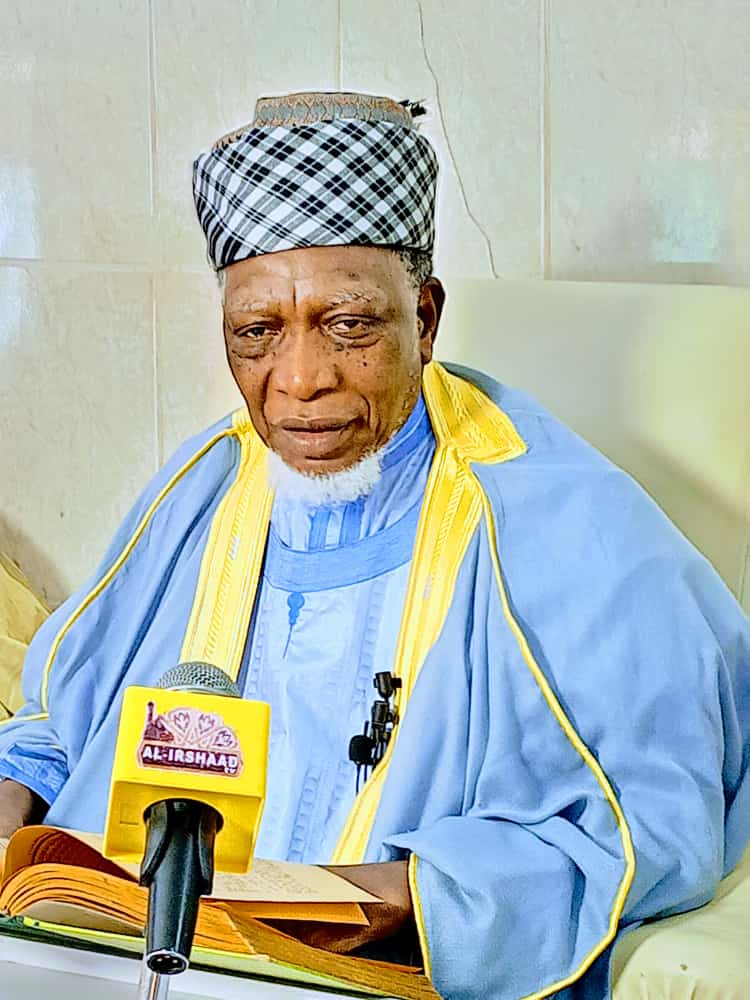
Indeed, the latest flashpoint is the intervention of Sheikh Sani Yahaya Jingir, a prominent Islamic cleric, who has openly renewed his support for a Muslim-Muslim presidential ticket and urged Muslims to mobilise their votes behind candidates of the same faith.
What has transformed the cleric’s intervention from an expression of political preference into a national controversy, however, is his use of the word “infidels” in urging Muslims to demonstrate their electoral strength.
Speaking at a political gathering in Kano tagged “Abba Go Again,” organised in support of Kano State Governor Abba Kabir Yusuf, Jingir praised President Bola Ahmed Tinubu for adopting the Muslim-Muslim ticket in 2023 and presented himself as a strong supporter of the arrangement.
Governor Yusuf was present at the event.
The major point here is that Jingir’s message was straightforward: Muslims should obtain their Permanent Voter Cards and use their numerical strength at the ballot box.
But in making the argument, he said Muslims should “show the infidels their limit” at the polls. He argued that the 2023 Muslim-Muslim ticket demonstrated that Muslims were more numerous than Christians in Nigeria.
But the question is no longer simply whether a Muslim is entitled to support a Muslim candidate. Of course, he is. The question is whether Nigeria can afford to turn religious identity into an explicit instrument of political mobilisation in a country where elections already intersect with ethnic, regional and religious sensitivities.
There is an important distinction between saying, “I am a Muslim and I will vote for a Muslim candidate,” and telling an audience to use its voting power to “show the infidels their limit.” The first is a political preference.
However, the second introduces an adversarial religious framing into an electoral contest. This is precisely why the response from Christian leaders has been so strong.
Rev. Joseph Hayab, Chairman of the Northern Christian Association, argued that Jingir could have urged Muslims to support their “Muslim brothers” without using language that categorises fellow Nigerians as “infidels.”
The Christian Association of Nigeria similarly condemned the remark, saying the language transformed what could have been an ordinary political campaign message into something capable of deepening religious tension.
The criticism is significant because it comes from Northern Christian leaders who have long complained that religious identity is being used to define political belonging in the region.
Hayab has gone further, calling for the inclusion of religion in the national census to settle competing and often unverified claims about the numerical strength of Muslims and Christians.
That argument also exposes another weakness in Jingir’s intervention: Nigeria does not have a recent official census establishing the religious composition of the population.
Consequently, turning an unverified demographic claim into a political weapon risks creating another contest over who constitutes the majority rather than addressing the more important question of what government should deliver to citizens.
But Jingir is not alone in defending the principle It would be simplistic to portray the controversy as Muslims against Christians.
There has also been disagreement among Muslim voices. Sheikh Ahmad Gumi, another prominent Islamic cleric, criticised the politicisation of religion, telling Jingir to keep religion out of what he described as “dirty politics.”
At the same time, Gumi cautioned against simply blaming Jingir for holding an extreme political view, effectively separating the cleric’s political position from Islam as a whole.
The debate should not become a referendum on Islam or Christianity. It should instead be about how religious identity is deployed in a democratic contest.
Former Kano State Governor Rabiu Musa Kwankwaso, himself a Muslim and a major political figure from the North, has also condemned Jingir’s remarks.
Kwankwaso said the people of Kano do not endorse what he described as divisive rhetoric and warned against utterances capable of undermining national unity.
Another Northern Muslim figure, Prophet Isa El-Buba, has also condemned Jingir, arguing that religious and political leaders should be concentrating on insecurity, poverty, criminality and displacement rather than deepening religious divisions.
These reactions are important because they demonstrate that Jingir’s position should not be mistaken for a consensus among Nigerian Muslims.
Perhaps one of the more politically intriguing reactions has come from former Aviation Minister Femi Fani-Kayode.
Fani-Kayode described Jingir’s comments as highly provocative and warned against allowing religion to dominate the 2027 contest.
One interesting point here is that Jingir’s objective appears to be to strengthen support for the Muslim-Muslim ticket. Yet, politically, the rhetoric could have the opposite effect.
The more the 2027 contest is presented as Muslims versus Christians, the easier it becomes for opposition parties to argue that the election is not about performance, competence, security, unemployment, inflation or the welfare of Nigerians, but about religious control of political power.
That could be particularly damaging to the governing All Progressives Congress if the party is perceived as benefiting from or tolerating such rhetoric.
Fani-Kayode has warned that religious mobilisation of this nature could alienate Christian voters and provide political ammunition to opponents of the Tinubu administration.
Jingir’s intervention has reopened a wound that never completely healed after the 2023 election. When Tinubu selected Kashim Shettima as his running mate, the APC became the first major Nigerian presidential ticket in the Fourth Republic to deliberately campaign nationally with two Muslims at the top of the ticket.
The decision generated fierce opposition from Christian organisations and some political actors, who argued that religious balancing had traditionally been an important component of Nigeria’s power-sharing arrangements.
The APC’s defence was different: competence, political calculation and constitutional rights should take precedence over religious balancing.
The ticket eventually won the election.
But the political argument did not disappear. Indeed, Nigeria has encountered Muslim-Muslim tickets before.
In 1993, Moshood Abiola and Baba Gana Kingibe, both Muslims, ran on the Social Democratic Party platform and won the June 12 presidential election, although the result was subsequently annulled by the military government.
The crucial difference is context. The Abiola-Kingibe ticket was not presented principally as a mobilisation of Muslims against Christians. In fact, the 1993 election is frequently remembered for the extraordinarily broad, cross-regional support attracted by Abiola.
That history provides an important warning for 2027: a same-faith ticket does not automatically produce religious politics. Political actors decide how such a ticket is presented to the electorate.
The more important issue is therefore not whether Nigeria will have another Muslim-Muslim ticket. It is whether religion will become one of the principal organising principles of the 2027 election.
Already, the political environment is moving in that direction. Jingir is explicitly calling for Muslim political mobilisation. Christian leaders are responding by warning about religious exclusion.
Muslim clerics are debating whether religion should be brought into partisan politics. Opposition politicians are also using the controversy to challenge the ruling party.
And political figures who were present at the Kano event are being drawn into questions about whether they endorse, tolerate or reject the cleric’s language.
One side mobilises around religion. The other side feels threatened and responds in kind. Political parties then discover that religious identity can be converted into votes. Clerics become political campaigners. Politicians become interpreters of theology. And an election that ought to be primarily about governance becomes a contest over communal identity.
However, there is danger in this demographic argument
Jingir’s claim that the Muslim-Muslim ticket proves Muslims are numerically superior to Christians deserves scrutiny.
There is no official contemporary religious census that can conclusively settle that question. Yet the demographic argument is being deployed as a political one: if Muslims are supposedly the majority, then Muslims should demonstrate that majority at the ballot box. This is a dangerous way to frame democracy.
Democracy is not supposed to be a census conducted every four years.
A Muslim does not have fewer democratic rights because he votes for a Christian candidate. A Christian does not become less Nigerian because he votes for a Muslim. And a candidate does not become more legitimate because members of his religion outnumber members of another religion.
The fundamental unit of the Nigerian election is supposed to be the citizen, not the religious bloc. Indeed, the historical success of Abiola and Kingibe in 1993 demonstrated that Nigerian voters could transcend religious identity when other considerations became more compelling.
The real question: what has religion got to do with governance? This is where the intervention of lawyer and activist Deji Adeyanju becomes relevant.
Rather than engaging Jingir’s argument purely on theological grounds, Adeyanju questioned what the Muslim-Muslim ticket had delivered to Nigerians.
That is arguably the debate Nigeria should be having. Has the ticket reduced insecurity? Has it improved the economy?
Has it reduced unemployment? Has it improved the purchasing power of ordinary Nigerians?
Has it strengthened national cohesion?
Has it improved the lives of Nigerians regardless of their faith?
These are questions that cannot be answered by pointing to the religion of the President and Vice President.
The same applies to every other political ticket.
A Christian-Christian ticket would not automatically make Christians better governors. A Muslim-Muslim ticket does not automatically make Muslims better governors. Religious identity is not a substitute for competence.
There is, however, a political logic to Jingir’s position. Nigeria’s presidential elections are won through coalitions.
The North remains electorally crucial. Mobilising voters around a common religious identity can potentially create a strong voting bloc, particularly in areas where religious identity overlaps with regional and communal loyalties.
Jingir appears to believe that the Muslim-Muslim ticket should not merely survive politically but should become a source of Muslim mobilisation.
His call for Muslims to obtain their PVCs is therefore more than religious rhetoric. It is an electoral strategy. But it carries a serious risk.
Nigeria is too religiously diverse for any major political party to comfortably turn a presidential election into a religious headcount. If Muslims are told to mobilise as Muslims, Christians can reasonably be expected to ask themselves whether they too should mobilise as Christians.
That is the point at which an electoral contest becomes a religious contest.
And that is precisely the scenario Nigeria should be trying to avoid. The responsibility of political leaders
The most troubling aspect of the episode may therefore not be Jingir’s statement itself, but what politicians do with it.
If political leaders condemn inflammatory rhetoric regardless of who makes it, they help draw a line between religious expression and political mobilisation.
If they remain silent when the rhetoric benefits their political interests, they risk legitimising it. This is why the presence of political leaders at the Kano event matters. Governor Abba Kabir Yusuf was reported to have attended the gathering where Jingir made the remarks.
The question is not necessarily whether his presence means he endorsed everything the cleric said. Presence is not endorsement. The more relevant question is whether political leaders will clearly distinguish between legitimate political advocacy and language that casts fellow citizens as religious enemies.
That distinction becomes increasingly important as the 2027 election approaches.
It would be premature to conclude that Nigeria has already entered another era of full-blown religious politics.
Nigerian voters have repeatedly demonstrated that they are more complicated than the stereotypes imposed on them by politicians and religious leaders.
People vote according to religion, yes. But they also vote according to ethnicity, region, personality, party affiliation, economic interests, performance, patronage, local relationships, security concerns and expectations of government.
Religion is only one part of the equation.
But Jingir’s comments are nevertheless a warning sign. They demonstrate that religious identity is already being deliberately inserted into the 2027 electoral conversation.
And the response shows how quickly the language can travel across Nigeria’s political and religious divide.
The danger is not that a Muslim cleric supports a Muslim candidate. Nor is the danger that Christians organise politically around their interests.
The danger begins when political opponents are described in religiously derogatory terms; when elections are presented as contests between faith communities; when demographic superiority becomes a justification for political dominance; and when politicians allow clerics to turn the ballot box into an arena for religious confrontation.
