Isaac Samuel
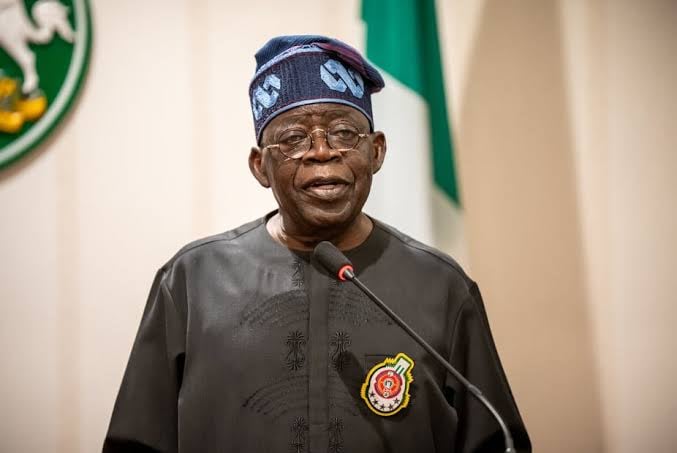
President Bola Ahmed Tinubu’s acceptance speech after clinching the All Progressives Congress (APC) presidential ticket for the 2027 election was more than a ceremonial address to party faithful.
It was a carefully constructed political statement aimed at defending his administration’s record, resetting public perception ahead of another electoral battle, and outlining what could become the core policy themes of his re-election campaign.
Standing before party leaders, governors, lawmakers, and supporters at the Bola Ahmed Tinubu International Conference Centre in Abuja on Sunday, the President attempted to project continuity, stability, and reform as the defining pillars of his second-term bid.
But it is worrisome that beneath the optimism and celebratory tone of the speech were acknowledgements of the deep anxieties confronting Nigerians. From insecurity, high electricity costs and poor supply, inflation, and growing public frustration over economic hardship.
The President’s speech also revealed an administration increasingly aware that the 2027 election may not be won merely on promises, but on whether Nigerians believe the government has genuinely improved their lives.
However, one of the most politically significant aspects of Tinubu’s speech was his renewed push for state police.
The President openly called on the National Assembly to amend the Constitution “as a matter of national emergency” to allow the creation of state police.
He argued that Nigeria’s worsening insecurity requires a decentralised policing structure.
The President’s comment comes at a time when insecurity is expanding beyond traditional flashpoints in the North-East and North-West into parts of southern Nigeria, where communities have raised concerns over kidnappings, attacks on farmers, and violent criminal networks operating along highways and rural settlements.
Just recently, there was an attack on communities in Oriire Local Government Area of Oyo state, during which armed bandits abducted pupils, teachers and other residents from Community High School, Ahoro-Esinle, and surrounding areas.
Several persons were reportedly killed in that attack, while one of the abducted teachers, Michael Oyedokun, was later beheaded after a video linked to the incident surfaced online.
Indeed, advocates of restructuring have argued that Nigeria’s highly centralised policing system has become overstretched and ineffective in responding to local security threats.
Governors across party lines have repeatedly demanded state-controlled policing, insisting that chief executives at the state level cannot remain constitutionally labelled “chief security officers” without direct operational control over security agencies.
Tinubu’s latest position may therefore resonate with many state governments and regional leaders who see constitutional reform as overdue.
However, critics argue that the President’s renewed call also indirectly exposes the slow pace of constitutional amendment efforts under the current National Assembly.
Despite sustained debates over restructuring and devolution of powers, lawmakers have yet to deliver sweeping reforms capable of addressing the country’s rapidly evolving security crisis.
The President’s challenge ahead may therefore lie not merely in advocating constitutional reforms, but in convincing Nigerians that his administration can produce measurable security outcomes before seeking another mandate.
Another major pillar of Tinubu’s speech was electricity reform.
The President noted his administration’s efforts to close Nigeria’s metering gap through the Presidential Metering Initiative and cited a peak generation figure of 6,000 megawatts, which he described as 50 per cent higher than what his administration inherited.
He also referenced the establishment of a N4 trillion bond programme to settle legacy debts owed to generation and gas companies.
On paper, the figures may revealed aggressive intervention in a sector long plagued by underinvestment, debt, and policy instability. But outside official government narratives, many Nigerians still experience persistent blackouts, unstable power supply, rising tariffs, and mounting energy costs.
Businesses continue to rely heavily on diesel and petrol generators, while households complain about estimated billing despite repeated promises of reform.
Throughout the speech, President Tinubu repeatedly framed the coming election as a choice between continuity and reversal.
The President argued that his administration had laid the foundation for long-term economic recovery through subsidy removal, foreign exchange reforms, infrastructure investment, and tax reforms.
According to him, abandoning those reforms midway could derail national progress.
This framing appears designed to position the APC as the custodian of economic restructuring while portraying opposition parties as lacking a coherent alternative vision. The economic pain associated with subsidy removal and currency reforms continues to shape public perception of the administration.
Tinubu acknowledged these hardships in his speech, admitting that many Nigerians are still struggling with economic adjustment.
Yet opposition figures are likely to seize on that admission as evidence that the reforms have not translated into immediate relief for ordinary citizens.
The speech also reflected an attempt to preserve and redefine the APC’s political legacy after more than a decade in power.
Tinubu praised the party’s governance record since 2015 and presented his administration as continuing the reform trajectory initiated under former President Muhammadu Buhari. At the same time, he sought to distinguish his presidency through infrastructure expansion, fiscal reforms, and human capital interventions such as the student loan programme.
For Tinubu, therefore, the road to 2027 may depend not only on political alliances or party dominance, but on whether Nigerians feel safer, more economically secure, and more hopeful than they did at the beginning of his presidency.