Correspondent, Patrick Ekpoh, examines the development of Akwa Ibom State University and the roles it has played in the last two decades.
Although it was born in controversy, Akwa Ibom State University (AKSU) is gradually taking it pride of place in the Nigerian University system, both in terms of physical development and contributions to tertiary education. The institution was recently capped the ‘Best Geoscience State University in Nigeria’ following it emergence as the second runner-up in the Basin Evaluation Competition (BEC), organized by the National Association of Petroleum Explorationists (NAPE), in 2024.
In the event which held at the Eko Hotel, Lagos, with the theme “Resolving the Nigeria Energy Trilemma: Energy Security, Sustainable Growth and Affordability”, the Geology students of the University beat their counterparts in other participating Universities, including Olabisi Onabanjo University; University of Nigeria, Nsukka; University of Lagos and University of Ibadan and others to clinch the position.
Established exactly 22 years ago, precisely on April 16, 2003 by the administration of Governor Victor Attah, the University has achieved its important core mandate for which it was established which is “fostering sustainable socio-economic development of the human society through the utilization of knowledge and technology, and unlocking the hidden treasures of nature and human minds within a sound cultural and ethical framework”
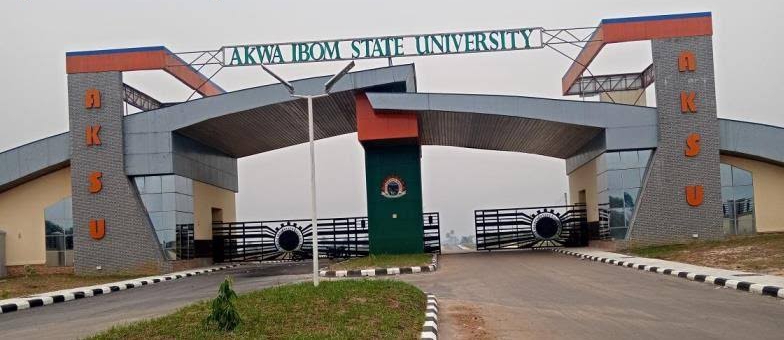
When our reporter visited the main campus of the University located at Ikot Akpaden,in Mkpat-enin Local Government Area of the state on Friday March 28, there were indications of a lively campus life – a typical university environment. There are both low and high rise structures and a network of tarred roads traversing the entire campus, each opening to a lecture hall. There are no on-campus hostels in both the Obio Akpa and the main campus. The over 10,000 students either rent private houses nearby or stay in hostels built by private developers outside the campuses. But the government is constructing a 1,600-bed space hostel at the main campus and is expected to be completed at the end of the year. New hostels are also being built at the Obio Akpa campus.
AKSU first started as Akwa Ibom State University of Technology (AKUTECH) with the first batch of students admitted into foreign Universities for post graduate programmes. They were to be trained as lecturers abroad so they can, upon graduation, form the foundation of lecturers in the newly established University of Technology. The intention was to make it a science-and-tech only university. But the plan was criticized by some citizens, some of whom argued that the students wouldn’t return after training.
The debate was so intense that the succeeding administration of Godswill Akpabio in 2010 changed the concept of the institution, turning it into a conventional, multi-campus university and renamed it Akwa Ibom State University (AKSU), with a campus at Obio Akpa and the main campus at Ikot Akpaden. But there is still a bit of a bias towards technical education. The first batch of students under the conventional University structure was admitted into the Faculty of Engineering, Natural and Applied Sciences; Oceanography and Naval Architecture. The Faculty of Social and Management Sciences were introduced in the 2011/2012 academic year.
The vice chancellor of the institution, Professor Nse Essien, said institution offers “diverse high-quality academic programmes that blend theoretical knowledge with practical experience to prepare students for professional success and personal growth”
University is making impact in various other disciplines and it graduates are contributing towards solving key societal issues across the state and Nigeria. A senior lecturer in the department of geology, Dr Paul Udofia, said institution’s graduates are steadily bridging manpower gap in various sectors of the economy and contributing to the sociopolitical developments of the state. “The University has contributed a lot in terms of manpower training’’, he said.
“Economically, some departments are generating a lot of revenue to the system. The Faculty of Agriculture, for instance, is contributing a lot to food security in Nigeria, by maintaining farms and raising livestocks. The faculty also have large palm plantation. I won’t be able to speak much for other departments but in my department there is a girl, Mbotidem, who graduated with a first class honour division and is currently working with the Nigeria National Petroleum Company, and contributing to the resolution of the Nigeria energy crisis in the country”, he stressed.
In terms of physical development, the institution has grown exponentially over the years. The Alumni Association is helping in the physical development of the school. It is laying foundations for many building and bringing in a bus to help facilitate the movement of students within the campuses. It is a testament to the support of the community and the government to the institution.