By Celestine Mel
President Bola Ahmed Tinubu has come and gone, but one moment from his visit to Akwa Ibom still hangs in the air. Before a roaring crowd at the magnificent Godswill Akpabio International Stadium, he gave his “approval”, yet again, to the Ibom Deep Seaport. Within hours, the old debate was alive again. Ablaze.
I have written on this subject so often that returning to it feels like walking a road I know by heart. No dream in our history has stirred more sentiment than this seaport. Some speak of it as though Akwa Ibom will wake up as El Dorado the morning the first ship docks.
Let me be clear: I am no sceptic. Our maritime wealth lies grossly underused, and the dividends of a seaport are immeasurable. But we must not deceive ourselves that a viable seaport will rise if its business case and fundamentals are not rock-solid. Not one day sooner. We have poured too much politics and emotion into this dream, and too little business sense and science. As Dr. Nestor Udoh rightly argued in a recent piece, it is time to stop the politics and start the building. It is time for those who have the means to come together, interrogate the numbers and get this ‘thing’ off the ground.
Yet even as we build, we should welcome every presidential approval that comes our way. Some critics sneer that there have been at least three such approvals with little to show for them. They miss the point entirely. An approval, however often repeated, is never wasted. Its absence, on the other hand, can be fatal. I know this because I watched it happen.
In the early 2000s, while I was still employed by the Cross River State Water Board Limited, Governor Donald Duke began building a dream called the Tinapa Business and Leisure Resort. It was to be the crown jewel of a duty-free zone, a mini-Dubai on the edge of the Calabar River, nestled in the pristine swamps of virgin Adiabo.
The project was also one of my side-hustle sites. The property managers, Broll Ltd., had retained me to provide IT support, computer repairs and first-level maintenance. A close family friend was head of business development at Philips Projects Centre (PPC), one of Nigeria’s biggest tech firms at the time, which was building the fibre-optic backbone that would offer Network-as-a-Service to the resort. PPC sank millions of dollars, in the money of that era, into the infrastructure, hoping to recoup the investment once business started booming. We met almost daily and traded the stories that never made the newspapers.
In 2007, in the dying days of his tenure, President Olusegun Obasanjo commissioned the resort before the crème de la crème of Nigeria. I was in that crowd, emotionally, psychologically and physically invested in Tinapa. I had dreamt ceaselessly of what it promised the South-South region.
But Tinapa lacked the presidential political buy-in needed to carry its weight down the chain of command. No formal, ironclad directive ever told the relevant federal agencies that the resort was a free-trade zone. The applause had barely faded when officers of the Nigeria Customs Service descended on the gleaming complex, sealed shops leased by multinational brands such as Vlisco, and demanded heavy duties, on the excuse that the government of the day had never told Customs the resort was duty-exempt. They locked up the stalls and the massive emporia, to the shock of everyone.
Offtakers who had already moved in suffered staggering losses. They packed up and fled. The Tinapa brand, which bore the promise of making Cross River the destination of choice for all of Africa, was mortally wounded. It was only a matter of time before it passed into oblivion. Dead!
The shockwaves rattled lenders across West Africa and nearly brought down some Tier-1 banks in Nigeria and beyond. That full tragedy is a story for another day. Tinapa never happened, and PPC’s money went down the flush pipe.
Still in awe of that failure, I have listened to the excuses and blame traded between former Governor Donald Duke and his successor, Liyel Imoke. But the sad truncation of that wondrous dream teaches me something profound: every enterprise of national significance needs as many presidential approvals as it can get, a trillion if need be, if only to ring-fence it from untimely death. And here is the lesson: Tinapa did not die from too many presidential approvals. It died for want of one.
No gainsaying that every approval of the Ibom Deep Seaport adds federal weight that no agency down the line can ignore. It gives investors, lenders and offtakers the comfort they need. So let the approvals keep coming, so long as the building comes with them. Those who count them as proof of failure should count them instead as insurance against failure. That is the way I see it.
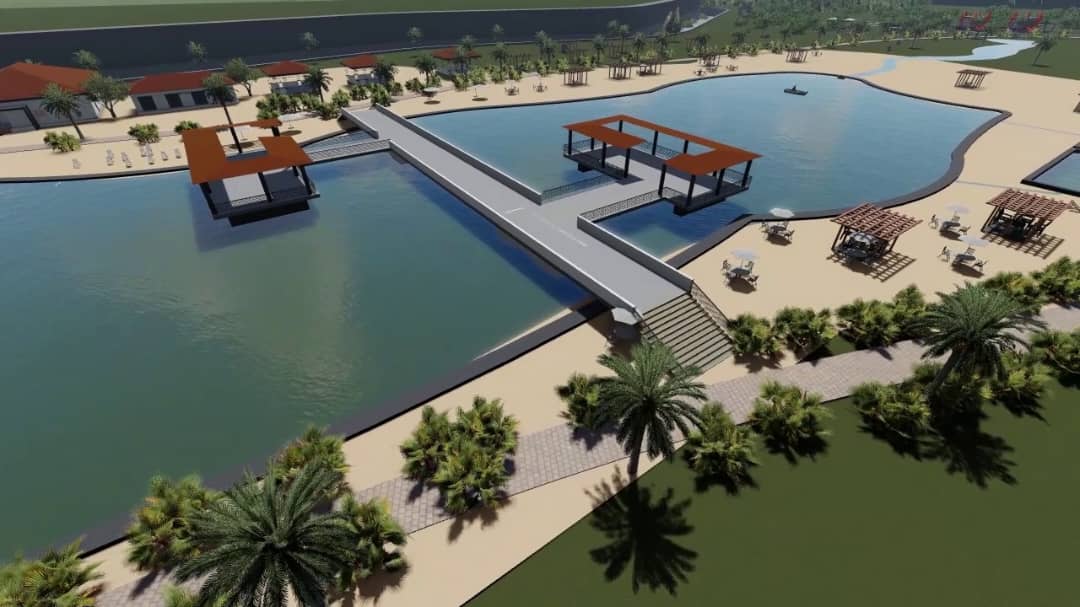
But the seaport “approval” was not the most fascinating aspect of the President’s visit. For me, that distinction belongs to ARISE Palm Resort.
As the presidential jet descended into Uyo, something shifted. It felt less like a working visit and more like a pilgrimage to an unexpected oasis. For one intoxicating moment, the centre of gravity of Nigerian politics slipped away from the thin, tense air of Abuja and settled softly into the tropical calm of Akwa Ibom.
Picture it. Ministers, senators, advisers and power brokers, people who usually live inside the federal bureaucracy, were caught strolling beneath the cool, whispering canopy of Uyo’s palms, basking in a peace, security and order that felt almost foreign in a country perpetually on edge.
Few people know that President Tinubu was so taken with the resort that he chose to stay the night there, in his own words, “to sleep and dream about his 2027 victory.”
I watched the early-morning video of the President stepping out of his suite. He wore the signature regalia of Rivers State, hat to match, en route to Port Harcourt. He looked rested, at peace, almost wistful. Beside him, attentive as ever, was Senator Oluremi Tinubu, whose grace, grit and quiet companionship I never fail to admire whenever she appears in public.
I found myself wondering about the night before. When the lights went out and the aides had retired, did the stillness of that place settle on the First Couple like a dove? Did he dream of 2027, as he promised? Did he even have time to dream?
The resort’s significance lies not merely in its architecture, landscaping or luxury. Its deeper significance is symbolic. ARISE Palm is, in many ways, the living antidote to the ghost of Tinapa. It took vision for Pastor Umo Eno to stand before a gully-erosion site and see a world-class hospitality hub, one that would make a sitting President ask to spend the night. When political rivals and federal heavyweights walk those manicured grounds, they must confront a quiet, undeniable truth: good governance is the only truly bipartisan language. You cannot spin a smooth road, a functioning international airport or a sanctuary of peace. Little wonder Mr. Peter Obi commended Asiwaju for spending the night in Uyo.
That calm was no accident. While much of Nigeria’s political landscape is consumed by civic strife and toxic rhetoric, Uyo has become a quiet demonstration of what is possible when the right leaders are entrusted with power. Through the ARISE Agenda, Governor Umo Eno has delivered a masterclass in governance, as if to validate the old Annang wisdom that the palm tree does not boast of the sweetness of its wine; it simply yields it to the brethren. So it is with Akwa Ibom’s transformation. Our state has been built not on loud platitudes but on tangible infrastructure, formidable security and intentional leadership. The pieces of the Akwa Ibom puzzle have begun to fit together so seamlessly that a President could not help but stop over for a night’s rest.
Was it the upgraded terminal of the Victor Attah International Airport? Or Ring Road 3? Or the breathtaking resort itself? And look ahead to the Ibom Convention Centre, the Ibom International Hotel and the Ikot Ekpene International Market.
It takes vision to turn dreams into reality, and courage to take a problem and make it an asset. My only worry for ARISE Palm is that it may not have enough rooms for the flood of demand coming its way. On my phone alone, dozens of people who read my accounts of the resort have written to say they are ready to experience it. A large hotel should be sited within the resort without delay, to build on what has been achieved.
As the sun set over Port Harcourt yesterday and the President hurtled toward the high-stakes theatre of 2027, the image of the City Boy sleeping in a resort built by a state government lingered. It poses a haunting lesson for the ruling class: the future belongs to those who quietly build places so functional, peaceful and enduring that the rest of the country cannot help but fly in just to catch its breath.
If Akwa Ibom can do that with a resort, it can do it with a seaport. And when the Ibom Deep Seaport is fully operational, nobody will wake up the next morning to say it was never approved by the President, as they did to Tinapa.
Let the construction begin.
Mel is a Fellow of the Chartered Institute of Bankers in Nigeria and Scotland. He writes from Abuja-FCT.