By Senator Ben Murray-Bruce
There is a scene I return to more often than I should.
Gilbert’s house in Beverly Hills. One of those evenings where the guest list is the story. Standing in front of my host, waiting patiently for a word, is a mayor of a city. And pressed to my host’s ear is a telephone, and on the other end of that telephone is the president of a country, calling not to exchange pleasantries but to ask a question. War was no longer theoretical. He wanted to know what Gilbert thought.
I remember watching this and understanding, with some force, that I was in the room with something rare.
Gilbert Chagoury was born in Lagos. So were his brothers, Ronald and Jack. They were educated in Nigeria, among us, alongside us, in the same classrooms and the same climate and the same country that produced ten million other boys with ambitions. That is the first thing anyone writing about them has to sit with. Nothing in the inputs explains the output.
It begins with Gilbert.
Suave, exact, and unbothered. Where Ronald sees the piece, Gilbert sees the puzzle, and, more importantly, sees how the pieces lock. He is the assembler. The one who understands that capital is the easy part, that the hard part is people, and sequence, and timing, and the patience to hold a thing together long enough for it to become inevitable.
He is also the reason the telephone rings. Presidents, prime ministers, cardinals and ministers of state have called that man for counsel on domestic policy, foreign policy and war. Not because he sought the access. Because over fifty years he became a person whose judgment was worth the call.
Then Ronald.
Ronald is the nerve. A businessman of ferocious intelligence and zero patience for decoration, the sort of mind that sees a balance sheet the way a chess master sees a board, several moves ahead and already bored with your opening. He is, and I mean this as the highest compliment available to me, a gambler. He rolls the dice. He commits. He has the temperament to contemplate numbers that would put most men off their dinner, and to put those numbers behind a piece of ground.
Bel Air. Beverly Hills. Eko Atlantic. Paris. Brazil. China. He does not invest in countries; he takes positions in futures. And in the four decades I have watched him do it, his instinct for what a place will become has been so reliably correct that it has stopped feeling like luck and started feeling like a sense the rest of us simply were not issued. I have never met anyone like him. I do not expect to again.
Then Jack.
Handsome in the effortless way that cannot be bought, charming without effort, and the detail everyone who knows him reaches for first, possessed of an almost structural inability to see badness in a person. He loves people. Not in the abstract, philanthropic, tax-deductible way that wealthy men often love people, but individually, one at a time, with attention. He gives you the benefit of a doubt you did not ask for and frequently do not deserve. A heart of gold is a cliché because there are so few of them; when you meet one, the phrase stops being lazy and becomes precise.
You can go to school. You can learn a profession, master it, rise through it, and retire from it with honour. Every one of those things can be taught, and the world has built a magnificent industry around teaching them.
Passion cannot be taught.
That is the whole of it. That is the one word that separates the Chagourys from the several billion decent, capable, hardworking people who will never build a city out of the Atlantic Ocean. It is not intelligence, intelligence is abundant and cheap. It is not education, half the world is better credentialed than the men who reshaped it. It is not even capital, which follows conviction rather than leading it.
It is the thing that makes a man unable to stop.
On chairs, and blue trousers.
Here is what nobody expects.
Ronald has not changed a chair in his living room in fifty years. Fifty. The same room, the same furniture, the same arrangement, while entire skylines he financed went up outside the window. Gilbert’s living room has looked essentially the same since 1975.
I was flying to Abuja with Ronald and Aliko some years ago, and Ronald was wearing a pair of blue trousers I had first seen on him many years earlier. Not a similar pair. The pair.
And Aliko Dangote, the richest man on a continent of one and a half billion people, will not redecorate his house and will not employ a driver.
This is not eccentricity and it is not performance. It is a tell. Men at this altitude are not motivated by comfort, because comfort is the first thing money solves and therefore the first thing that stops being interesting. They are not motivated by luxury, because luxury is a consumer good and they are not consumers. They are motivated by history, by the question of what will still be standing, and still be working, and still be employing people, in a hundred years.
Ask them about a handbag and watch the light go out of their eyes. Ask them about the most audacious project on earth and you will not get away for three hours.
They hate small talk the way a surgeon hates a dull blade.
The one I got wrong
I should confess something, because a portrait without a flaw is an advertisement.
One afternoon at Gilbert’s home in Beverly Hills, he offered me tickets to the Democratic National Convention, the one that would nominate Barack Obama.
I declined. Politely, and with total confidence. I did not believe the man could win.
Gilbert did.
I have thought about that afternoon many times since, and what strikes me is not that he was right about an election. It is that the same faculty was operating there that operates on a shoreline in Lagos or a parcel in Bel Air: the ability to see a thing before it has finished becoming itself, and to be entirely unembarrassed about saying so out loud while sensible people smile at you.
I was sensible. I was also wrong. It is, I promise you, an instructive combination.
An exclusive club, membership of two
Nigeria has produced traders, industrialists, tycoons, moguls and men of very considerable means. It has produced, by my count, exactly two forces of nature.
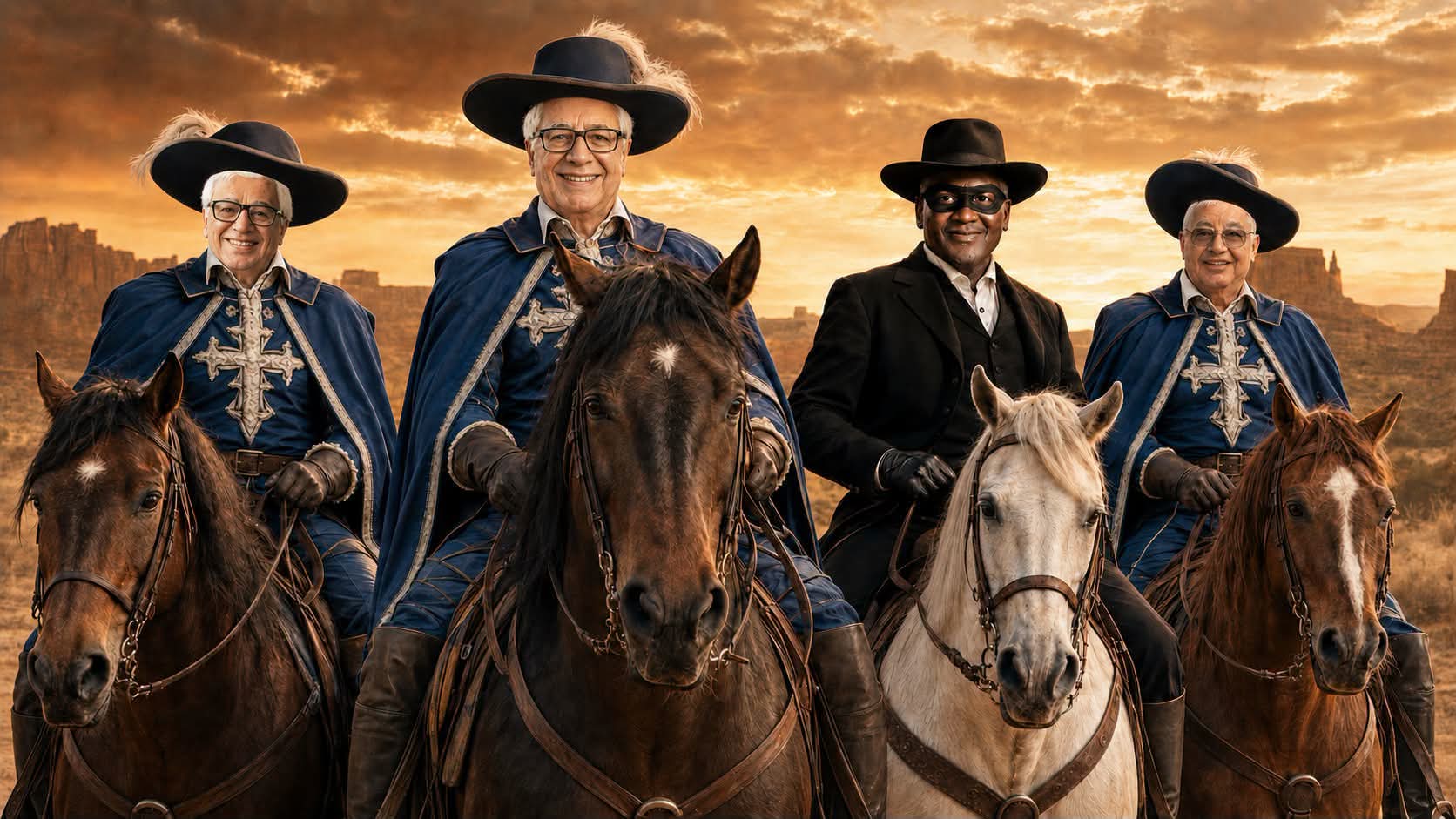
The Lone Ranger — Aliko Dangote. One man, one conviction, no driver, no committee, and a continent’s industrial base rearranged around his stubbornness.
The Three Musketeers — Gilbert, Ronald and Jack Chagoury. Three brothers, one shared nerve, and a habit of building the things other people call impossible until the day they open.
That is the club. It is not a long list and it will not be getting longer soon.
Five, globally.
Put five names on the table, the ones the world genuinely admires rather than merely recognises, and the family resemblance is immediate.
Steve Jobs, who had no patent on the technology and no monopoly on the talent, only an intolerance for things being worse than they could be.
Elon Musk, who does not appear to have a functioning sense of what constitutes a reasonable target.
Bill Gates, who won the century and then spent the next quarter of it on malaria.
Warren Buffett, still in the house in Omaha he bought in 1958, because the house was never the point.
Ratan Tata, who drove himself, lived plainly, bought Jaguar Land Rover, and was mourned by a nation that understood exactly what it had lost.
Five men. Different industries, different continents, different centuries of formation. Identical wiring. Every one of them obsessive, every one of them indifferent to the trappings, every one of them oriented not toward the quarter but toward the century.
Add the Lone Ranger. Add the Musketeers. The set is coherent.
Why the business schools should be paying attention.
Harvard teaches Ford. INSEAD teaches LVMH. Wharton teaches Amazon. Lagos Business School, Stanford, Saïd, IESE, all of them run cases on men who inherited stable institutions in stable economies and grew them competently.
Nobody is teaching the harder case.
How does a family from Lagos build across Nigeria, France, Brazil, China and California, in currencies that collapse and jurisdictions that change their minds, and remain solvent, and remain relevant, and end up on the phone with heads of state during a war scare? What is the actual, transferable mechanism? Where does risk appetite of that magnitude come from, and how is it disciplined so that it compounds instead of detonating?
Those are not flattering questions. They are real ones, and they have answers, and the answers would be worth more to a twenty-four-year-old in Nairobi or Jakarta or São Paulo than another semester on the Toyota Production System.
Those who criticise them, in the main, have not met them. I have. For most of my life. I would wish the acquaintance on the critics, not as a rebuke but as an education.
Murray-Bruce is a businessman and for Nigerian Senator