By Isaac Samuel
With official campaigns for the 2027 general election due to commence on August 19, the Abia State Government’s new billboard permit charges have already triggered one of the earliest debates over campaign finance and the cost of running for political offices in Nigeria.
Abia State, one of the key southeast states when it comes to political permutations has found itself at the centre of the controversy.
Indeed, the decision of the Abia State Structures for Signage and Advertising Agency (ABSSAA) to impose a N200 million permit fee on presidential candidates and N150 million on governorship candidates seeking to mount campaign billboards has divided opinion.
The policy was unveiled at ABSSAA’s 2026 Stakeholders’ Engagement Forum in Aba by the agency’s Director of Strategy and Innovation, Ndubuisi Nwogwugwu, who said the one-time payment would cover the entire campaign and election period.
House of Assembly candidates unable to pay the full fee could share campaign billboards with their party’s governorship candidate, according to the announcement.
ABSSAA warned that it would remove campaign billboards that failed to meet approval standards or pose risks to public safety. The agency said the policy applied equally to all political parties and was not intended to discriminate against any candidate.
Speaking at the event, the Director General of Abia State Bureau of Strategic Communication, Onyebuchi Ememanka, said the charges were not designed to stifle opposition parties, but would apply uniformly across the political spectrum.
While the government insists it is simply regulating outdoor advertising and raising legitimate revenue, opposition parties see something more sinister, a move capable of shutting less wealthy candidates out of the political space.
The controversy has also thrown up a bigger national question. If Abia succeeds with the policy and other states decide to emulate it, what happens to the campaign spending limits already prescribed by the Electoral Act 2026?
That concern explains why the announcement has attracted reactions beyond Abia.
AAC governorship candidate, Doris Ogala, was the first to openly challenge the policy, insisting she would not pay the N150 million demanded of governorship candidates.
She accused Governor Alex Otti of attempting to frustrate opposition parties and argued that the fee was beyond the reach of ordinary Nigerians seeking elective office.
APC and PDP in the state have also rejected the charges, describing them as excessive, punitive and inconsistent with the spirit of democratic competition.
Abia government, however, maintains that the policy is neither targeted at any candidate nor any political party. According to officials of ABSSAA, all registered political parties were invited to a stakeholders’ meeting before the fees were approved.
The government insists the charges are part of efforts to regulate political advertising, guarantee public safety and ensure orderly use of advertising spaces throughout the election period.
Ordinarily, there is nothing unusual about governments regulating outdoor advertising. Every state has agencies responsible for approving billboards and collecting fees. Outdoor advertising has become a major source of internally generated revenue across the country, particularly in states with thriving commercial activities.
What makes the Abia policy different is the amount involved.
Political campaign billboards are already expensive. Candidates pay advertising companies for the billboard locations, spend millions producing campaign materials and still bear the cost of installation and maintenance.
Those expenses are separate from the money spent on rallies, media campaigns, logistics, campaign offices, agents, transportation and mobilisation.
The permit fee announced by Abia therefore comes before the actual cost of putting a billboard on the road.
That is why many political observers believe the issue is beyond revenue generation.
The bigger fear is that Abia may inadvertently create a template other states could adopt. If governors across the federation discover that billboard permits can generate hundreds of millions of naira during election season, there will naturally be pressure to introduce similar charges.
Should that happen, campaign expenditure in Nigeria could rise significantly.
It is this possibility that brings the Electoral Act 2026 into the conversation.
Section 92 of the Act fixes the maximum amount candidates may spend during elections. A presidential candidate is not permitted to spend more than N10 billion, while governorship candidates are limited to N3 billion.
The ceiling for senatorial candidates is N500 million, House of Representatives candidates N250 million, while House of Assembly candidates are restricted to ₦100 million.
The same section provides that any candidate who knowingly exceeds the prescribed spending limit commits an offence and, upon conviction, is liable to a fine, imprisonment for a term not exceeding 12 months, or both.
The law was introduced to curb the growing influence of money in Nigerian politics. Ironically, critics argue that state-imposed billboard fees could have the opposite effect.
Take a House of Assembly candidate in Abia. Before printing a single poster or organising a campaign rally, such a candidate is expected to pay N20 million as permit fee. That amount represents one-fifth of the total N100 million the law permits the candidate to spend throughout the election.
For a House of Representatives candidate, the N50 million permit takes up 20 per cent of the statutory spending limit, while a senatorial candidate would part with N100 million from a ceiling of N500 million.
Although these figures do not amount to a breach of the Electoral Act on their own, they substantially reduce the financial room available to candidates for actual campaigning.
The argument becomes even stronger if the policy is replicated elsewhere.
The PDP calculates that if all 36 states and the Federal Capital Territory imposed a N200 million billboard permit on presidential candidates, a presidential aspirant would spend about N7.4 billion on permits alone. That would leave less than N3 billion from the N10 billion spending ceiling for every other campaign activity nationwide.
Whether or not that calculation eventually becomes reality, it exposes an issue INEC may have to confront as campaigns draw nearer.
The electoral commission is responsible for monitoring campaign finance. While billboard regulation falls within the powers of state governments, questions may arise where such charges substantially affect compliance with the spending limits established by federal law.
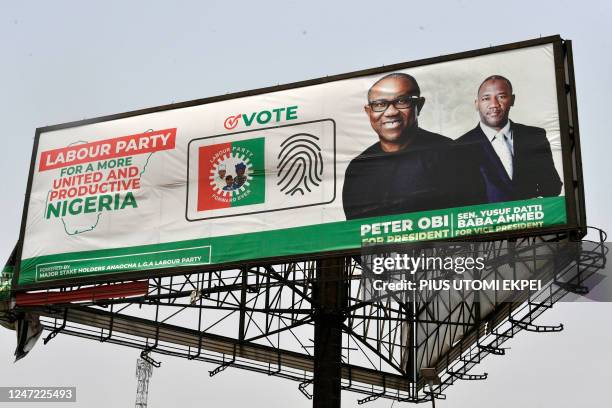
Beyond the legal arguments is the politics. Abia is widely regarded as one of the strongest political bases of Peter Obi, the presidential candidates of the Nigeria Democratic Congress (NDC).
Naturally, any policy affecting political campaigns in the state is likely to be viewed through a political lens.
Opposition parties have already suggested that the charges could discourage vigorous campaigns in one of Nigeria’s most politically strategic states.
Supporters of Governor Otti disagree.
Political commentator Chinedum Okpalanma argues that billboard advertising is a commercial enterprise everywhere in the world and governments are entitled to regulate it and earn revenue from it.
He maintains that elections are not won through billboards, pointing out that candidates remain free to campaign through rallies, radio, television, social media and direct engagement with voters.
That argument also has merit.
In recent elections, social media has become a far more influential campaign tool than roadside billboards, particularly among younger voters.
Even so, billboards remain important because they project visibility, reinforce campaign messaging and create the impression of political strength.
There is another side to the debate that has received little attention.
Election seasons often leave Nigerian cities littered with campaign billboards.
Many are abandoned months after elections, while others obstruct traffic signs or become safety hazards after falling into disrepair.
If the high permit fees discourage indiscriminate erection of campaign billboards, Abia may inadvertently achieve what successive governments have struggled to accomplish.
In that sense, the policy could double as an environmental management strategy.
Yet that benefit may come at a political cost if candidates conclude that billboard advertising has become too expensive.
Ultimately, the Abia controversy is no longer just about signage permits. It has opened a fresh conversation about the rising cost of politics, the limits of state regulatory powers and whether governments, in pursuit of revenue, can inadvertently make elections more expensive than the Electoral Act itself anticipated.