Isaac Samuel
Leaders of Nigeria’s major opposition parties have agreed to present a single presidential candidate for the 2027 general election, in a calculated attempt to boost their chances against President Bola Ahmed Tinubu and avoid a repeat of past electoral fragmentation.
The decision was reached at a national summit of opposition leaders held in Ibadan, Oyo State, where key stakeholders from the Peoples Democratic Party (PDP), African Democratic Congress (ADC), New Nigeria Peoples Party (NNPP), and other political blocs gathered to chart a common political direction.
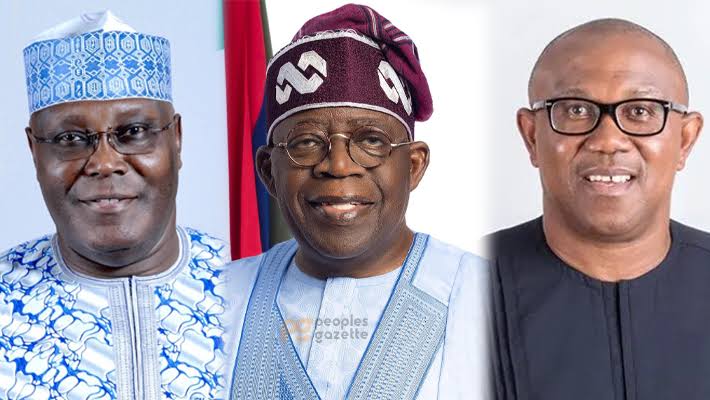
The meeting, hosted by Oyo State Governor Seyi Makinde, drew prominent figures including former Vice President Atiku Abubakar, Labour Party’s 2023 presidential candidate Peter Obi, and former Kano State governor Rabiu Musa Kwankwaso, former governor of Osun state, Rauf Aregbesola.
Former governors Rotimi Amaechi, Aminu Tambuwal, and Babangida Aliyu were also present.
Former President Olusegun Obasanjo, who was billed to chair the event was absent.
Reading the summit’s communique, PDP chieftain Kabiru Tanimu Turaki said the decision to field a single candidate was driven by the need to consolidate opposition votes and improve electoral competitiveness.
According to him, opposition parties believe that multiple candidates in previous elections weakened their chances, effectively benefiting the ruling All Progressives Congress (APC).
He added that the coalition was also a response to what the opposition described as moves within the APC to position President Tinubu as its sole candidate in 2027.
“We shall work towards fielding one presidential candidate for the 2027 elections… to rescue our nation and our long-suffering masses,” Turaki said.
He warned that the survival of the nation’s multi-party system depends on the opposition’s ability to act with urgency, honour, and shared principles.
The PDP chairman levelled heavy allegations against the ruling party, accusing the APC of actively engineering the internal crises currently plaguing various opposition groups.
He claimed that the APC has moved beyond governance failures to active political sabotage, allegedly sponsoring moles and dissidents within rival parties to trigger destabilising wranglings.
”The ruling party has been sponsoring members of opposition parties to cause troubles capable of destabilising the opposition,” Turaki alleged.
The strategic alliance, he argued, is the only viable shield against the APC’s perceived attempts to stifle political competition and consolidate absolute power.
Turaki explained that the objective is to create a formidable, and united front, capable of unseating the “non-performing” APC. He also called for a focused, multi-year strategy leading up to the 2027 general elections.
Reflecting on the socio-economic climate under the current administration, Turaki offered a grim assessment of the country’s trajectory. He noted that despite government rhetoric of progress, the reality for most Nigerians is a steady decline in quality of life and democratic freedom.
Turaki emphasised that the opposition’s primary duty is to halt the decline and provide a credible alternative to the status quo.
However, Governor Makinde sought to douse tensions around the summit, insisting that the gathering was not targeted at any individual or driven by personal ambition.
“It is not a gang-up against one man, and it is not about individual ambitions to be president. It is about the collective ambition of the Nigerian people to have a democracy properly defined,” he said.
Makinde explained that the core objective of the meeting was to strengthen Nigeria’s democratic system and prevent any drift toward a one-party state.
According to him, a vibrant opposition is essential for accountability and good governance.
“Democracy without opposition is not democracy; it is a slow drift toward a one-party state, and Nigeria must not make that drift,” he warned.
Beyond the plan for a joint candidate, opposition leaders also raised concerns about the credibility of the electoral process, calling for the resignation of the Chairman of the Independent National Electoral Commission (INEC), Joash Ojo Amupitan.
They accused him of alleged bias in favour of the ruling party, warning that his continued stay in office could erode public trust and heighten political tensions ahead of the polls.
But the APC National Secretary, Senator Ajibola Basiru in an interview, described the Ibadan summit as a ruse, saying it was an assemblage of individuals, not ten political parties.
“For parties to meet, there must be prior authorisation from their NWC or NEC. Without that, it is simply a gathering of individuals.
“If they now claim that ten political parties met to gang up against one party, it contradicts their earlier narrative. It shows that the political space remains open, but they lack the strength to compete individually”, he said.
Former Kaduna Central senator Shehu Sani described the Ibadan summit as a “good talk shop,” acknowledging its significance but questioning the political realities surrounding such a gathering.
He noted that under former President Muhammadu Buhari’s first term, it would have been difficult for governors—particularly in the North—to host a similar opposition convergence aimed at unseating the incumbent.
His remarks highlight both the openness of the current political space and the lingering doubts about whether the opposition can translate dialogue into concrete electoral success.
While the agreement to field a single candidate signals a renewed push for opposition unity, analysts say the bigger challenge lies in implementation particularly in resolving competing ambitions among leading figures.
Negotiating zoning arrangements, agreeing on a consensus candidate, and sustaining unity across party lines are expected to be critical hurdles.
Still, the Ibadan summit marks one of the most coordinated efforts in recent years by opposition forces to present a united front, amid growing concerns over economic hardship, insecurity, and governance.