Isaac Samuel
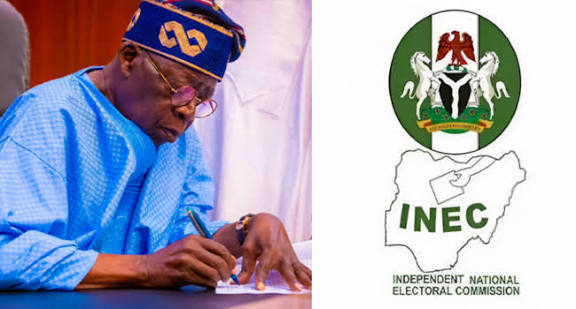
President Bola Tinubu on Wednesday formally signed the Electoral Act 2026 (Amendment) into law, just days after the Independent National Electoral Commission (INEC) released the timetable for the 2027 general elections.
The ceremony took place at the Presidential Villa, Abuja, around 5:00 pm, with principal officers of the National Assembly in attendance.
The National Assembly had passed the bill only a day earlier which signalled the final step in a legislative process that has drawn national attention, particularly on the contentious issue of electronic transmission of election results.
Civil society groups and some opposition figures have long pushed for real-time transmission of results from polling units to INEC’s central server, arguing it would curb manipulation and strengthen credibility.
Protesters had last week disrupted the National Assembly complex to demand live transmission, citing failures during the 2023 elections when INEC’s Results Viewing Portal collapsed, triggering widespread allegations of rigging.
While the ruling All Progressives Congress supports technology adoption, some stakeholders argue that areas with poor telecommunications infrastructure require a phased or hybrid approach, allowing manual collation where electronic systems fail.
The 2027 general elections are scheduled to hold on February 20 for Presidential and National Assembly elections and March 6 for Governorship & State Houses of Assembly Elections.
Key Changes in the 2026 Electoral Act
The new law introduces several significant amendments to the 2022 Electoral Act, aimed at streamlining election processes, tightening timelines, and strengthening technological integration in voting and result collation.
1. Electronic Transmission of Results
Section 60(3) now mandates that the Presiding Officer shall electronically transmit results from each polling unit to the IREV portal, after signing and stamping Form EC8A, which may also be countersigned by candidates or polling agents where available.
However, the law also provides a fallback mechanism:
Section 60 (3) reads : The section now reads: “The Presiding Officer shall electronically transmit the results from each polling unit to IREV portal and such transmission shall be done after the prescribed Form EC8A has been signed and stamped by the Presiding officer and/or countersigned by the candidates or Polling agents where available at the Polling Unit.
“Provided that if the electronic transmission of the result fails as a result of communication failure and it becomes impossible to transmit the result contained in form EC8A signed and stamped by the Presiding Officer and countersigned by the candidates or polling agents where available at the polling unit, the form EC8A shall remain the primary source of collation and declaration of the result”
2. Shorter Election Timelines
The law reduces the notice period for elections. Section 28(1) now requires that INEC publish notice of election 300 days before the election date, down from 360 days under the 2022 Act.
Similarly, political parties must submit the list of candidates and their affidavits 120 days before elections, a reduction from 180 days.
3. Nomination and Primaries
A major shift comes in the method of candidate selection.
Political parties are now required to nominate candidates through direct primaries or consensus, effectively removing indirect primaries that were previously allowed under Section 84(2) of the 2022 Act.
4. Voter Accreditation and Technological Oversight
Sections 47(1) and 47(2) strengthen the use of technology in voting. Voters must be accredited using the Bimodal Voter Accreditation System (BVAS) or other prescribed technological devices. Where accreditation devices fail, and no replacement is available, elections in that unit shall be cancelled and rescheduled within 24 hours if the result could materially affect the overall outcome.
Sections 47(1) says:
“To vote, the Presiding Officer shall use a Bimodal Voter Accreditation System or any other technological device that may be prescribed by the Commission, for the accreditation of voters, to verify, confirm or authenticate the particulars of the intending voter in the manner prescribed by the Commission.”
Section 47(2) says: “Where a Bimodal Voter Accreditation System or any other technological device deployed for accreditation of voters fails to function in any unit and a fresh card reader or technological device is not deployed, the election in that unit shall be cancelled and another election shall be scheduled within 24 hours if the Commission is satisfied that the result of the election in that polling unit will substantially affect the final result of the whole election and declaration of a winner in the constituency concerned.”
5. Submission of Candidate Lists.
In the 2022 Electoral Act, the deadline for submission of candidate lists is 180 days to the date of the general elections. But the new act reduces it 120 days.
Section 29 now reads:
“Every political party shall, not later than 120 days before the date appointed for a general election under this Bill, submit to the Commission, in the prescribed Forms, the list of the candidates the party proposes to sponsor at the elections, who shall have emerged from valid primaries conducted by the political party.”
6. Publication of Nominations
The Commission is now required to publish candidate lists at least 60 days before elections, a significant reduction from the 150 days stipulated in the previous law.
“The Commission shall, at least 60 days before the day of the election, publish by displaying or causing to be displayed at the relevant office or offices of the Commission and on the Commission’s website, a statement of the full names and addresses of all candidates standing nominated.”
This is expected to give political parties and the electorate more flexibility while keeping the process transparent.
Implications and Outlook
The signing of the Electoral Act 2026 marks a decisive step in Nigeria’s electoral reform journey. Analysts believe that the amendments will speed up election processes, enhance technological oversight, and reduce legal ambiguities surrounding party primaries.
However, debates over the electronic transmission of results are likely to persist, with opposition parties and civil society groups closely monitoring implementation to ensure that technology strengthens, rather than undermines, credibility.
With the INEC timetable for 2027 elections already released, INEC now has a clear legal framework to guide preparations for campaigns, primaries, and voter engagement.