Isaac Samuel
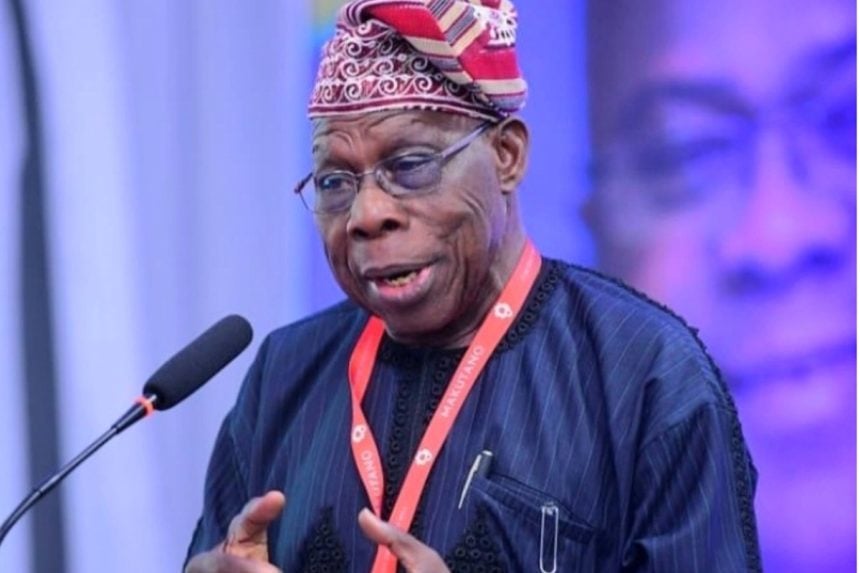
Former President Olusegun Obasanjo has criticised President Bola Tinubu over his administration’s borrowing policy, describing the President’s defence of loans as absolute nonsense and warning that excessive borrowing could burden generations of Nigerians yet unborn.
Obasanjo said the consequences of mounting public debt extended beyond the government accumulating the loans, insisting that future generations would bear the cost.
The former president spoke on Friday at the third Ajibosin Annual Symposium, held at the amphitheatre of the Olusegun Obasanjo Presidential Library in Abeokuta, Ogun State. The symposium was themed, “Leveraging Artificial Intelligence to Solve Grassroots Problems and Accelerate National Development”.
He was reacting to Tinubu’s earlier defence of his administration’s borrowing policy, in which the President maintained that borrowing was not inherently harmful if the government could generate sufficient revenue to repay its obligations.
Speaking in April during a meeting with Plateau State leaders at the State House, Abuja, Tinubu had said: “If we have to borrow, we borrow. Borrowing is not leprosy; we just have to work hard to be able to pay for it.”
But Obasanjo rejected the President’s comparison, arguing that excessive debt could have far-reaching consequences for the country and generations that had no part in accumulating the loans.
“And for anybody to say debt is no leprosy is absolute nonsense. Debt is worse than leprosy, because leprosy destroys only one person. Debt destroys generations,” he said.
His criticism came days after Tinubu sought the approval of the National Assembly to proceed with the processing of fresh external loans worth $20.52 billion and €1.045 billion under the Federal Government’s 2026–2027 Supplementary External Borrowing Plan.
The request, conveyed in a letter read by Senate President Godswill Akpabio during plenary on Tuesday, covers financing for projects and programmes in power, transportation, healthcare, education, agriculture, water supply, security, job creation and financial management reforms.
The President said the proposed borrowing was necessary to address the country’s infrastructure deficit and bridge funding gaps affecting critical development projects. The request was referred to the Senate Committee on Local and Foreign Debts for consideration.
Tinubu has also defended his administration’s infrastructure investment strategy, arguing that the focus should not be solely on the volume of loans but on the projects executed and economic value generated from the borrowed funds.
In an essay titled, “From Reforms to Delivery: Our Infrastructure Investment and Growth Strategy”, the President said: “The real question is not how much we borrow, but what we build, what value we create and what future we leave behind.”
However, Obasanjo questioned Nigeria’s economic performance over the past 47 years, particularly the persistent depreciation of the naira against the dollar.
Recalling when he established his farm about 47 years ago, the former President said the naira exchanged at approximately N1 to $1.85 at the time, contrasting the rate with the current exchange rate of about N1,500 to the dollar.
“When I started my farm, 47 years ago, naira to the dollar was one naira to $1.85. Forty-seven years ago. What has Nigeria done in 47 years that we now have N1,500 to a dollar? What have we done?” he asked.
He also questioned the capacity of Nigeria’s political leadership to translate knowledge and policy decisions into improved living conditions for citizens.
“What do our leaders know, and what do they not know? And from what they know, what can they do for us?” he asked.
The former President further criticised Nigeria’s dependence on the World Bank and the International Monetary Fund (IMF), arguing that the institutions were established before Nigeria’s independence and that their economic prescriptions might not adequately reflect the country’s peculiar circumstances.
“World Bank and IMF were not designed for us. They were not built by us. They were built before we became independent. And that’s the people who will determine what we do,” he said.
Obasanjo also recalled how Nigeria and other developing countries were discouraged from subsidising agriculture, despite support provided to farmers in developed economies.
He cited an encounter with former British Prime Minister James Callaghan, who, according to him, received financial support for sheep farming, while developing countries were warned against agricultural subsidies if they wanted access to financing from international institutions.
The former President questioned why Nigeria continued to adopt economic prescriptions from foreign institutions without sufficiently considering local conditions and development priorities.
He warned against accepting external policy recommendations without examining whether they would serve the country’s long-term economic interests.
The symposium also examined the implications of artificial intelligence for Africa’s development, with speakers raising concerns about the continent’s control over its data, technology infrastructure and intellectual property.
Obasanjo, in his remarks, also cautioned against embracing artificial intelligence without understanding its potential implications, saying technology that was not under a country’s control could be abused against it.
“I don’t know too much technically about AI. But I know that anything that is not in your control can be abused against you,” he said.