By Prof Emmanuel Onwioduokit
An objective evaluation of President Bola Ahmed Tinubu’s speech at the All Progressives Congress (APC) presidential campaign flag-off in Kaduna must go beyond party loyalty, political rhetoric and the applause of supporters. It should examine the speech against five fundamental criteria: factual accuracy, economic reality, consistency of leadership, policy credibility, and responsiveness to the suffering of Nigerians.
The central question is not simply whether the President delivered an effective political speech. It is whether his message accurately reflected the conditions facing Nigerians, acknowledged the consequences of his administration’s policies, and offered credible reasons for voters to support his re-election bid in 2027.
Because the precise wording and context of the Kaduna remarks matter, the evaluation must distinguish between what the President actually said, what his statements imply, and what the available economic evidence can substantiate.
1. What did Tinubu actually say?
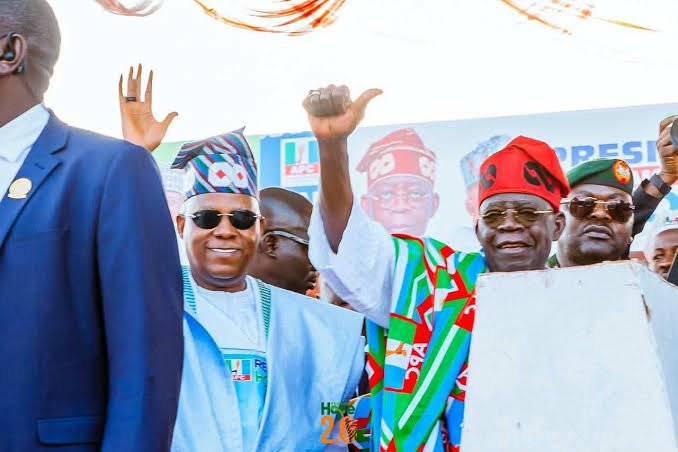
At the APC campaign flag-off in Kaduna on 24 October 2026, President Tinubu made several important statements. The most controversial was his response to opposition criticism of hunger and poverty:
“I have an argument. I hear my opponents talking about hunger, poverty. Who created it? They did! They created the hunger, they created the poverty, we are trying to eradicate it.”
He also defended the removal of the petrol subsidy, declaring that the subsidy regime belonged to the past and associating it with corruption, falsified invoices and fuel smuggling. He praised the regular payment of salaries, commended APC governors for their development efforts, and promised prosperity, continuity and progress if re-elected.
These statements provide the basis for an objective assessment. The President’s speech should not be judged solely by its most controversial sentence; equally, the broader campaign message should not be allowed to obscure the implications of that sentence.
2. Evaluation against six critical criteria
A. Attribution of hunger and poverty: Is the President’s claim defensible?
Assessment: The claim is politically forceful but economically overstated and insufficiently substantiated.
Tinubu is entitled to argue that previous administrations contributed to Nigeria’s structural economic problems. The country’s difficulties predate his inauguration in May 2023. They include weak productivity, inadequate infrastructure, persistent insecurity, low industrial capacity, unemployment, dependence on oil revenues and longstanding weaknesses in public expenditure management.
His argument therefore has a legitimate historical dimension: no serious assessment of Nigeria’s economic distress should begin and end with the current administration.
However, the assertion that opposition politicians created hunger and poverty is a sweeping attribution of responsibility. It does not distinguish between the historical causes of deprivation, the immediate causes of recent hardship, and the policy decisions that have influenced living conditions since May 2023.
The distinction is essential. A government inherits an economy, but its policies alter the conditions under which citizens live. Removing fuel subsidies, changing the foreign-exchange regime and adjusting monetary policy can have long-term objectives while also generating significant short-term costs.
Admittedly, Tinubu’s reforms have improved aspects of public finances, foreign reserves and investor confidence, while also contributing to severe cost-of-living pressures.
The evidence supports a more nuanced conclusion than the President’s categorical accusation.
Previous governments may bear responsibility for inherited vulnerabilities. The present administration must nevertheless accept responsibility for the design, sequencing, implementation and mitigation of its own policies.
The decisive point: It is not enough to ask who created Nigeria’s historical poverty. The electorate is entitled to ask what the incumbent government has done to reduce it, how much progress it has achieved, and whether the costs imposed on households were necessary or avoidable.
B. The economic reforms: Sound objectives, but what about their consequences?
Assessment: The reforms have a defensible economic rationale, but their success must be measured by outcomes rather than declarations of courage.
The removal of the petrol subsidy and changes to foreign-exchange management were intended to address fiscal pressures, market distortions and longstanding weaknesses in economic management. Such objectives are not inherently misguided.
A subsidy system that is poorly targeted, vulnerable to diversion or disproportionately benefits higher-consuming households can be expensive and inequitable. Similarly, a fragmented foreign-exchange system can encourage arbitrage and weaken confidence in the economy.
But recognising these problems does not automatically validate every aspect of the reforms or their implementation.
The relevant questions include:
Were adequate social-protection measures in place before the costs of reform were transferred to households?
Were savings from subsidy removal transparently accounted for and effectively used?
Did the government adequately anticipate the effects of higher transport and production costs on food prices?
Have real wages and household purchasing power recovered sufficiently?
Are improvements in public finances translating into better healthcare, education, infrastructure and employment?
These are not arguments for returning automatically to the old subsidy system. They are tests of whether the new policy framework is delivering its promised benefits.
Tinubu’s declaration that there should be no return to the former subsidy regime communicates policy continuity. However, policy continuity is not itself proof of policy success.
A government can defend a reform while acknowledging implementation failures, adjusting complementary policies and introducing more effective protection for vulnerable households. Indeed, such adjustments may be necessary to make the reform economically and politically sustainable.
C. The claim that the government is working to eradicate hunger and poverty
Assessment: A legitimate statement of intention, but not evidence of achievement.
The President said his administration was trying to eliminate hunger and poverty. That is a legitimate governmental objective. Yet an intention must be distinguished from a measurable result.
To evaluate this claim properly, the government should publish and regularly update evidence on:
Real household income and purchasing power.
Food inflation and the affordability of a representative food basket.
Employment, underemployment and the quality of jobs created.
Poverty rates and the depth of poverty among vulnerable households.
The coverage, adequacy and effectiveness of cash transfers and other safety-net programmes.
Changes in household consumption, nutrition and access to essential services.
These indicators should be compared across time, with attention to differences between states, income groups and rural and urban households.
There is also an important distinction between reducing the rate of inflation and reducing the price level. If food prices rise more slowly, households may still face serious hardship because the prices of essential goods remain substantially above their previous levels.
Consequently, an improvement in a headline economic indicator does not necessarily mean that families can afford more food, transport, rent or medicines.
The President’s claim should therefore be treated as a promise requiring verification, not a conclusion that can be accepted solely because it was delivered at a campaign rally.
D. Regular payment of salaries: A necessary but limited defence
Tinubu cited regular salary payments and praised APC governors for their development efforts.
Regular payment of salaries is important. It supports household consumption, helps workers meet financial obligations and demonstrates a basic responsibility of government.
Nevertheless, regular nominal salary payments do not necessarily translate into improved welfare.
If salaries remain unchanged while food, transport, electricity, housing and healthcare become more expensive, the real purchasing power of workers falls. A public servant receiving the same nominal salary may be worse off even when every payment arrives on time.
The relevant economic concept is the real wage: the quantity of goods and services a salary can actually purchase.
A robust evaluation should therefore examine salary regularity alongside real wages, minimum-wage adequacy, pension payments, job creation and the affordability of essential goods.
Furthermore, the President’s reference to the performance of APC governors does not remove the need to assess the federal government’s own responsibilities. Federal and state governments have different but interconnected duties, and both should be judged by measurable outcomes.
E. Political accountability: Can the incumbent shift responsibility to the opposition?
Assessment: No—not for the performance of his own administration.
The President’s statement is understandable as campaign rhetoric. Opposition parties criticise the government, and the governing party seeks to discredit their criticism by pointing to the policies or records of previous administrations.
However, the institutional position of an incumbent president is different from that of an opposition candidate.
Tinubu assumed executive responsibility for the federal government in May 2023. His administration consequently has a duty to explain the consequences of its decisions, the progress of its programmes and the results achieved during its tenure.
That duty does not disappear because opposition figures previously held public office.
Nor does the opposition’s responsibility for historical failures automatically absolve the incumbent of responsibility for present conditions.
A sound political argument would identify particular decisions made by previous governments, demonstrate their effects and explain how the current administration is correcting them. A blanket assertion that the opposition created hunger and poverty does not provide that level of evidence.
It is also important to distinguish political blame from economic causation. Hunger can arise from multiple interacting factors, including food supply constraints, insecurity, exchange-rate movements, energy costs, transport expenses, climate shocks and household income weakness. Assigning responsibility requires evidence about the relative contribution of these factors, not simply the identity of political opponents.
The President’s argument would be stronger if it specified which inherited failures he had corrected, which problems remain unresolved and what measurable improvements citizens should expect.
F. The Kaduna highway inauguration: Infrastructure as evidence of performance
The Kaduna event also featured the inauguration of an 81-kilometre section of the Abuja–Kaduna–Zaria–Kano dual carriageway. The State House described the project as an 81-kilometre section, not the completion of the entire corridor.
This is relevant because infrastructure investment can lower transport costs, improve connectivity, support trade and strengthen regional integration. For Kaduna and the wider North-West, a better road network can have substantial economic value.
However, an inauguration is an event, while development is a process.
An objective assessment should establish the length actually completed, the quality and safety of the road, the cost and financing arrangements, the delivery timeline, the condition of remaining sections and the extent to which the project reduces travel time and transport costs.
It should also distinguish work completed by the current administration from work initiated or substantially advanced by previous administrations.
That distinction is not intended to deny the current government credit where it is due. Rather, it ensures that public infrastructure is evaluated accurately and that the contributions of successive administrations are properly recognised.
Infrastructure achievements deserve credit, but they cannot, by themselves, settle the question of whether the overall economic programme is improving the welfare of ordinary Nigerians.
3. A balanced scorecard of the speech
The following assessment separates the merits of the administration’s policy arguments from the weaknesses in its political communication.
Criterion Objective assessment
Recognition of inherited economic problems: Valid: Nigeria’s structural challenges predate Tinubu.
Attribution of hunger exclusively to opponents: Weak: the claim is too sweeping to establish causation.
Defence of subsidy removal: Economically arguable, but requires evidence of net benefits and effective safeguards.
Claim of eradicating poverty: An appropriate objective, but requires measurable results.
Regular payment of salaries: A positive governance responsibility, but insufficient to demonstrate improved welfare.
Infrastructure achievements: Potentially significant; credit should reflect verified completion, quality and economic benefits.
Accountability to citizens: Inadequately addressed by blaming opponents instead of presenting a comprehensive performance assessment.
Promise of prosperity and continuity: Politically clear, but its credibility depends on demonstrable improvements in living standards.
4. What was missing from the President’s argument?
Three elements would have made the speech more persuasive and more responsive to the public interest.
Number one, an unambiguous acknowledgement of present hardship. The President could have recognised that Nigerians are experiencing serious financial pressure while explaining why the reforms were considered necessary. Acknowledging hardship does not mean admitting that every criticism is correct; it demonstrates an understanding of citizens’ lived experiences.
Number two, evidence of measurable progress. Rather than relying principally on assurances of prosperity, the President could have presented comparable figures showing changes in real household incomes, food affordability, employment, poverty and the effectiveness of relief programmes.
Number three, a credible timetable for delivering the benefits of reform. Citizens deserve to know what improvements are expected, when they should materialise, how progress will be measured and what corrective measures will follow if targets are missed.
These elements would transform the speech from a defence of the administration into a more convincing account of its economic programme.
5. What does the speech reveal about Tinubu’s campaign strategy?
The Kaduna speech appears to pursue three political objectives.
First, it seeks to shift the debate from the hardship experienced under the current administration to the historical responsibility of previous governments and opposition politicians.
Second, it presents the reforms as necessary sacrifices whose eventual benefits justify continuity in government.
Third, it uses party unity, infrastructure projects and the support of APC governors to demonstrate political strength and governing capacity.
These are recognisable campaign strategies. Their effectiveness, however, depends on whether voters accept the government’s account of the past and believe its promises about the future.
A crowded stadium, enthusiastic supporters and endorsements from political leaders can demonstrate mobilisation capacity. They cannot independently establish national approval, economic recovery or the likely outcome of an election.
Similarly, opposition criticism should not be accepted uncritically. Opposition parties must also explain how their proposed policies would address fiscal constraints, food insecurity, employment and the costs of government. Their historical records deserve scrutiny where relevant.
An objective assessment must apply the same standard to both sides: claims about economic performance require evidence, and promises require credible implementation plans.
6. Final verdict: Was the speech convincing?
My assessment is that the speech was politically assertive but economically incomplete.
Tinubu has legitimate grounds to defend the long-term objectives of fiscal reform, improved foreign-exchange management and infrastructure development. Nigeria’s structural problems cannot fairly be attributed to one administration, and the previous subsidy framework should not be exempt from scrutiny.
Nevertheless, the President’s claim that his opponents created hunger and poverty is too categorical to serve as a satisfactory explanation of Nigeria’s present economic difficulties. It fails to distinguish inherited problems from the consequences of policies adopted during his own administration.
The more serious weakness is the gap between the promise of prosperity and the evidence required to demonstrate that prosperity is reaching households. Improved public finances, foreign reserves and infrastructure may be important achievements, but they must ultimately be assessed alongside food affordability, real wages, employment and poverty reduction.
The President also has a legitimate right to seek re-election. But seeking another mandate creates an obligation to explain what has been achieved during the current term, what remains unfinished and why another four years would produce better results.
The appropriate test is not whether Tinubu can convincingly blame the past. It is whether he can demonstrate that his policies are producing a better present and a credible future.
My categorical conclusion
A president cannot reasonably claim full credit for the successes of his administration while assigning the responsibility for its failures entirely to his predecessors and political opponents. Historical responsibility can be shared across administrations, but executive accountability belongs to the government in office for the decisions it makes and the results it delivers.
The fairest verdict is neither that Tinubu created all of Nigeria’s hunger nor that he bears no responsibility for it. Both positions oversimplify a complex economic problem. His administration inherited serious weaknesses, but its policies have also shaped the economic conditions Nigerians now experience.
Ultimately, the 2027 electorate should evaluate the President against verifiable economic and social outcomes, just as it should evaluate his opponents against realistic alternatives.
The most important question arising from Kaduna is therefore not simply, “Who created the hunger?” It is this:
What has the government done to reduce hunger, how much has it achieved, what has it cost Nigerians, and why should citizens believe that another term will deliver better results?
Those are the questions a serious presidential campaign should answer.
Prof Onwioduokit is a professor of Economics at the University of Uyo