By Isaac Samuel
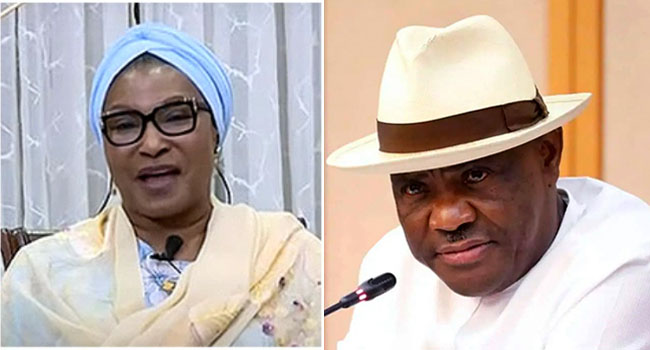
The controversy over loans obtained by the Federal Capital Territory (FCT) Administration took a fresh turn recently with Senator Ireti Kingibe challenging Minister Nyesom Wike to produce evidence of the National Assembly’s approval for the facilities.
Kingibe, who represents the FCT in the Senate, said the loans were never brought before the Senate for approval, insisting that the minister should publish the Votes and Proceedings of the day the purported approval was given.
Her latest statement came amid the growing war of words between her and Wike over the management of the FCT, including the minister’s comments on her political future ahead of the 2027 elections.
Wike, on the other hand, has dismissed the allegation, insisting that there is no way the FCT could obtain loans without legislative approval because such borrowing forms part of the budgetary process.
The dispute has consequently placed the National Assembly at the centre of an issue that goes beyond the increasingly personal exchanges between the minister and senator.
Kingibe, in her latest statement issued two days ago, challenged Wike to produce the parliamentary records supporting his position that the loans were approved.
Her words: “As for not getting approval for the loans, I dare the FCT Minister to show the people of the FCT, and all, who have asked, the Votes and Proceedings of the day the approval was given.
“I cannot speak for the House of Representatives but I know that it was NEVER brought before the Senate.”
She argued that her intervention was part of her constitutional responsibility as a senator representing the FCT.
“My responsibility as a Senator representing the people of the Federal Capital Territory is to ask questions, demand accountability, and defend the constitutional principles upon which our democracy stands.”
Kingibe’s position is that the existence of FCT debt does not merely concern the executive branch.
She is challenging the process through which the liabilities were incurred and insisting that the legislative record should establish the approval relied upon by the FCT Administration.
Her argument also rests on the peculiar constitutional arrangement governing Abuja.
Section 299 of the Constitution of the Federal Republic of Nigeria, 1999, as amended, provides:
“299. The provisions of this Constitution shall apply to the Federal Capital Territory, Abuja as if it were one of the States of the Federation; and accordingly
“(a) all the legislative powers, the executive powers and the judicial powers vested in the House of Assembly, the Governor of a State and in the courts of a State shall, respectively, vest in the National Assembly, the President of the Federation and in the courts which by virtue of the foregoing provisions are courts established for the Federal Capital Territory, Abuja;
(b) all the powers referred to in paragraph (a) of this section shall be exercised in accordance with the provisions of this Constitution; and
“(c) the provisions of this Constitution pertaining to the matters aforesaid shall be read with such modifications and adaptations as may be reasonably necessary to bring them into conformity with the provisions of this section.”
The provision gives the National Assembly the legislative powers that would ordinarily belong to a state House of Assembly in relation to the FCT.
This constitutional arrangement is significant because Abuja has no elected House of Assembly. The National Assembly consequently occupies the legislative space that a state assembly occupies in the 36 states.
Section 299, however, does not itself state in those exact words that every FCT loan must receive a separate National Assembly resolution.
The specific requirements governing borrowing are contained in Nigeria’s wider fiscal and debt-management laws and regulations.
The Fiscal Responsibility Act requires borrowing to be authorised through an Appropriation or other Act or Law for the purpose for which the borrowing is to be used.
The Debt Management Office’s borrowing guidelines also prescribe documentation for FCT borrowing.
Under the Revised External and Domestic Borrowing Guidelines for the Federal Government, State Governments, FCT and their Agencies, documentation for FCT borrowing includes a National Assembly resolution, alongside other approvals required under the applicable framework.
That provision gives substance to Kingibe’s demand for documentary evidence rather than leaving the controversy at the level of political claims.
Kingibe has consistently argued that the FCT’s growing debt profile requires legislative scrutiny.
Her latest statement went beyond the accusation of non-approval. She framed the dispute as an issue of legislative accountability and constitutional responsibility, saying no minister was above scrutiny.
“No Minister, no matter how powerful, is above the law. No public office holder is above scrutiny”, she stated.
She also rejected Wike’s intervention in the question of who should represent the FCT in 2027, saying no individual could determine the outcome of an election.
Kingibe’s position therefore has two distinct elements. That is, the legality and transparency of FCT borrowing, and the political dispute that followed her criticism of the minister.
On borrowing, her demand has remained specific. She wants the relevant Votes and Proceedings and other legislative records showing the approval she says was never brought before the Senate.
That places the matter in an area where documentary evidence should be available if the approvals occurred.
But Wike rejected the senator’s allegations and maintained that the FCT Administration operates within the legislative framework.
His argument is that borrowing cannot simply be undertaken outside the budgetary process because the financing requirement is captured in the budget submitted to and considered by the National Assembly.
“There is no way you can go and take a loan without the approval of the National Assembly,” Wike said, arguing that borrowing is included in the budget and therefore subjected to legislative approval.
The minister’s position is therefore not that the FCT is exempt from legislative oversight. Rather, he maintains that the existing budgetary and legislative process provides the necessary authorisation.
A senior member of the House of Representatives has also defended the minister.
Deputy Spokesperson Philip Agbese said Wike committed no borrowing infraction in the execution of FCT projects and rejected the suggestion that the minister had borrowed outside the knowledge of the National Assembly.
The legality of each facility depends on the approvals, authorisations and procedures applicable to that transaction.
Indeed, over the years, FCT debt has risen sharply.
Available DMO figures show a substantial increase in the FCT’s domestic debt during Wike’s tenure.
The FCT’s domestic debt was about N88.51 billion in September 2023. By March 31, 2026, it had risen to N389.88 billion.
The increase has become one of the principal pieces of evidence cited in the public debate over the FCT’s borrowing.
But debt figures alone do not establish the circumstances surrounding individual facilities. The DMO figures show the stock of debt; they do not, without the accompanying transaction documents, establish the approval process for each loan.
Furthermore, the National Assembly is not a peripheral institution in this controversy.
Under Section 299, it exercises the legislative powers vested in a state House of Assembly in relation to the FCT. The National Assembly also considers and passes the FCT’s annual budget.
Consequently, where borrowing arrangements require legislative approval, the relevant parliamentary records form an important part of the accountability trail.
Kingibe has said the Senate did not approve the loans in question. Wike says legislative approval is part of the budgetary process. The House leadership has also defended the minister against allegations of borrowing outside legislative oversight.
The parliamentary record can establish which borrowing proposals were presented, the instruments under which they were authorised, the amounts involved and the dates on which the approvals were given.
That evidence is important because the dispute involves public debt rather than a private disagreement between two politicians.
It should be noted that the most consequential aspect of the controversy is therefore not the exchange of political attacks between the minister and senator but the transparency of the borrowing process.
Indeed, the constitutional arrangement is clear: under Section 299, the National Assembly exercises legislative powers over the FCT. The borrowing framework is also documented in Nigeria’s fiscal and debt-management regime.
The outstanding issue is therefore the application of those rules to the individual FCT borrowing facilities incurred during the period under review.
For a matter involving hundreds of billions of naira in public debt, the strongest evidence will ultimately be found not in the political exchanges between Wike and Kingibe, but in the appropriation laws, National Assembly resolutions, Votes and Proceedings as demanded by Kingibe.
The National Assembly should therefore come out clean on the matter so that Nigerians and FCT people in particular will know how their money is being expanded and borrowing decisions taken by those who are entrusted with authority to lead them.