Isaac Samuel
What started as Nyesom
Wike’s effort to mobilise politicians across party lines for President Bola Tinubu’s re-election is fast turning into a struggle over the control the political machinery around the President ahead of 2027.
The former Rivers governor has made it clear that he is prepared to support Tinubu for another term while retaining his freedom to support other candidates in the PDP.
The APC governors, on the other hand, are insisting that there can be no such separation: their loyalty is to Tinubu and the APC candidates at all levels.
Indeed, the difference may look like a technical argument over political alliances, but it goes to the heart of how the 2027 election will be fought.
While Wike is attempting to build a coalition that cuts across party boundaries, the APC governors are defending the authority of the ruling party’s existing structure.
What many political observers are looking at is the question of whether Tinubu’s re-election can be pursued with two parallel political arrangements operating at the same time. That is, one controlled by the APC and another driven by politicians from different parties.
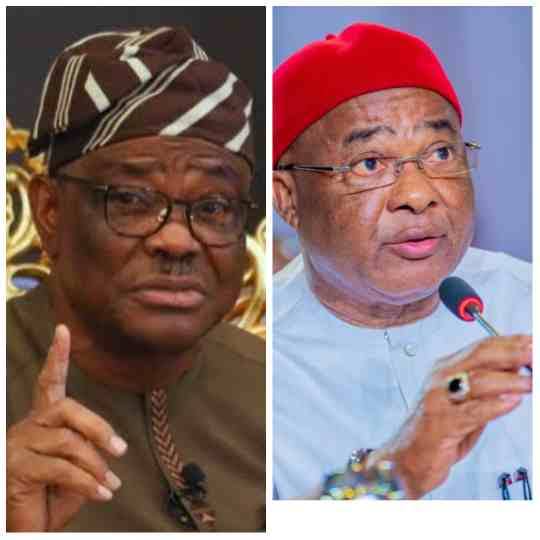
Uzodinma drew the battle line on Monday when, after the APC governors’ meeting in Abuja, he declared that the governors would not participate in or support any alliance capable of weakening the APC, undermining Tinubu’s re-election or adversely affecting APC candidates.
More importantly, he said the governors’ campaign commitment would be exclusively to APC candidates.
Barely hours after that declaration which happened at one of the governors’ lodge in Abuja, Wike responded.
His Senior Special Assistant on Public Communications and Social Media, Lere Olayinka, said Wike’s support was strictly for the re-election of President Bola Tinubu and did not amount to an agreement to support APC candidates in other elections
The Rainbow Coalition, he said, was not an APC arrangement and was never presented to the governors for approval.
It is his own platform for bringing politicians from different parties together to support Tinubu. He also maintained that he never promised anybody that the PDP would abandon the 2027 governorship, National Assembly and state assembly contests.
Perhaps, this is where Wike’s argument becomes politically interesting. His position is that presidential politics and local politics do not necessarily have to travel together.
According to him, a politician can support Tinubu in the presidential election and still contest against an APC candidate for governor or senator.
Wike has pointed to the 2023 elections as evidence that Nigerian voters already understand this kind of split-ticket voting.
He cited Imo, Abia, Enugu and Ebonyi, where, according to him, voters supported different parties in presidential and National Assembly contests.
His question to the APC governors was simple: if voters did it in 2023, why should they suddenly be regarded as confused in 2027?
But that argument is precisely what makes the governors uncomfortable. Their concern is not necessarily that Wike supports Tinubu. Indeed, having a prominent PDP figure campaigning for an APC president could be useful to Tinubu. Their concern is that the same network could mobilise voters for Tinubu at the top of the ballot while mobilising against APC candidates further down the ballot.
In effect, the President could benefit from a coalition that weakens the party that produced his candidacy.
That is why the APC governors are talking about parallel structures. They are defending not simply the party’s candidates but the party’s control over the campaign machinery.
Their position is that if the objective is Tinubu’s re-election, the official APC structure should remain the principal vehicle for delivering it.
Wike, however, appears to be betting on something different. He is probably using his political relationships rather than party labels.
His strength has always been his ability to build relationships beyond the formal boundaries of the PDP. The same political style was evident in the G5 crisis before the 2023 election, when he and four other PDP governors openly challenged the leadership of their party and eventually backed Tinubu.
Wike is now trying to turn that experience into a broader political arrangement for 2027. And that explains why the APC governors are taking the Rainbow Coalition seriously.
The irony is that Wike is not necessarily presenting himself as an opponent of Tinubu. On the contrary, he repeatedly describes his support for the President as sacrosanct.
His quarrel, perhaps, might be attempt to translate that presidential support into an obligation to support every APC candidate.
He has told the governors, in effect, that they should solve their own political problems in their states rather than use Tinubu’s re-election as leverage.
That argument has now become personal. Wike accused the APC governors of being politically lazy, while taking particular aim at Uzodimma and Kwara Governor AbdulRahman AbdulRazaq.
His reference to Uzodimma’s political journey was especially pointed. Wike questioned how APC could win two Senate seats in Imo in 2023 when Tinubu received less than 15 per cent of the presidential vote in the state, asking whether the Rainbow Coalition was responsible for that split.
What Wike is doing many analysts believe is challenging the governors’ claim to be the indispensable custodians of Tinubu’s votes. He is saying, essentially, that Nigerian voters are not automatons who will necessarily vote the same way because a governor tells them to.
If that is correct, then the APC governors may have less control over the 2027 ballot than the formal party structure suggests.
But there is another side to it. The governors control something Wike does not. That is the machinery of government and the formal APC structure in their respective states. They have party structures, political appointees, local networks and access to the enormous resources of incumbency.
Wike may have relationships across parties, but relationships are not automatically votes. The real test will be whether the Rainbow Coalition can translate its political reach into polling-unit mobilisation.
This is why former Ekiti governor Ayo Fayose’s reaction is worth noting. Fayose has downplayed the argument over who is winning the political quarrel, saying the more important issue is whether the coalition can actually deliver votes for Tinubu, particularly in Rivers.
That observation cuts through much of the noise surrounding the dispute
There is also an important warning from within the Tinubu camp. The dispute has become sufficiently uncomfortable that some supporters of the President have called for the two sides to stop their public exchanges and concentrate on mobilisation.
The concern is understandable. A coalition intended to expand Tinubu’s support base could become a source of division within the very political camp it is supposed to strengthen.
For the PDP, meanwhile, the quarrel presents an opportunity. The party can accept Wike’s support for Tinubu while maintaining its right to field candidates against APC politicians elsewhere.
Keen political observers suggest that might allow the PDP to retain an electoral identity even as one of its most influential figures works for the re-election of an APC president. The PDP’s response to the governors has therefore been that Wike’s support for Tinubu should not be interpreted as the death of opposition politics.
The issue, however, goes beyond Wike and Uzodimma. It is about the balance of power around Tinubu himself.
While Tinubu needs the APC governors because they control the party structure and government machinery in their respective states, his relationship with Wike also offers him something the governors cannot provide on their own, which is access to a network of opposition politicians.
That was demonstrated in 2023 when Wike, after falling out with Atiku Abubakar over the PDP presidential ticket and the party’s leadership, refused to support the PDP candidate and instead worked with the other members of the G5 governors.
The group openly opposed Atiku’s presidential campaign, insisting that the PDP should first resolve its internal crisis. Wike and his allies subsequently backed Tinubu, helping to fracture the opposition vote in states where the PDP had expected to remain competitive.
Wike himself has since claimed that he and his allies deliberately worked to undermine the presidential ambitions of Atiku and Peter Obi in 2023, contributing to Tinubu’s emergence as president
The irony, therefore, is that the same political independence that makes Wike useful to Tinubu is also what makes him uncomfortable for the APC governors. In 2023, Wike’s refusal to fall in line with Atiku demonstrated the value of a politician who could mobilise outside his party’s official position.
In 2027, however, that same independence is creating friction with the APC governors, who want Tinubu’s presidential campaign to reinforce the party’s candidates rather than create a separate political network capable of working across party lines.
Maybe then, the 2027 election will eventually test which of these two approaches works better on the ground.
But the significance of the current fight is already clear, Wike is not challenging Tinubu, he is challenging the idea that supporting Tinubu requires submitting to the APC’s political agenda in every other contest.
The APC governors, in turn, are resisting the emergence of a parallel coalition that could give Wike and his allies influence outside the party’s formal chain of command.
The real question that many supporters of the President are asking then is that who will control the political machinery around Tinubu when the campaign moves from presidential rallies to the wards and polling units?
Perhaps, that is the battle that has just begun.