Isaac Samuel
What happened to Peter Obi, the presidential candidate of the Nigeria Democratic Congress (NDC) in Benue last week Tuesday may prove to be more than another confrontation between an opposition politician and a state government.
The development has exposed one of the difficult questions that Nigeria must confront before the 2027 elections and this is how far can political rivalry go before it begins to threaten the space in which opponents are allowed to operate?
With the 2027 general elections approaching so fast, the incident has brought into focus as observers are asking that how much political space will opposition politicians have to organise, campaign and engage voters in states controlled by rival parties.
Obi had travelled to Benue to visit Yelwata, the community where scores of people were killed in a June 2025 attack.
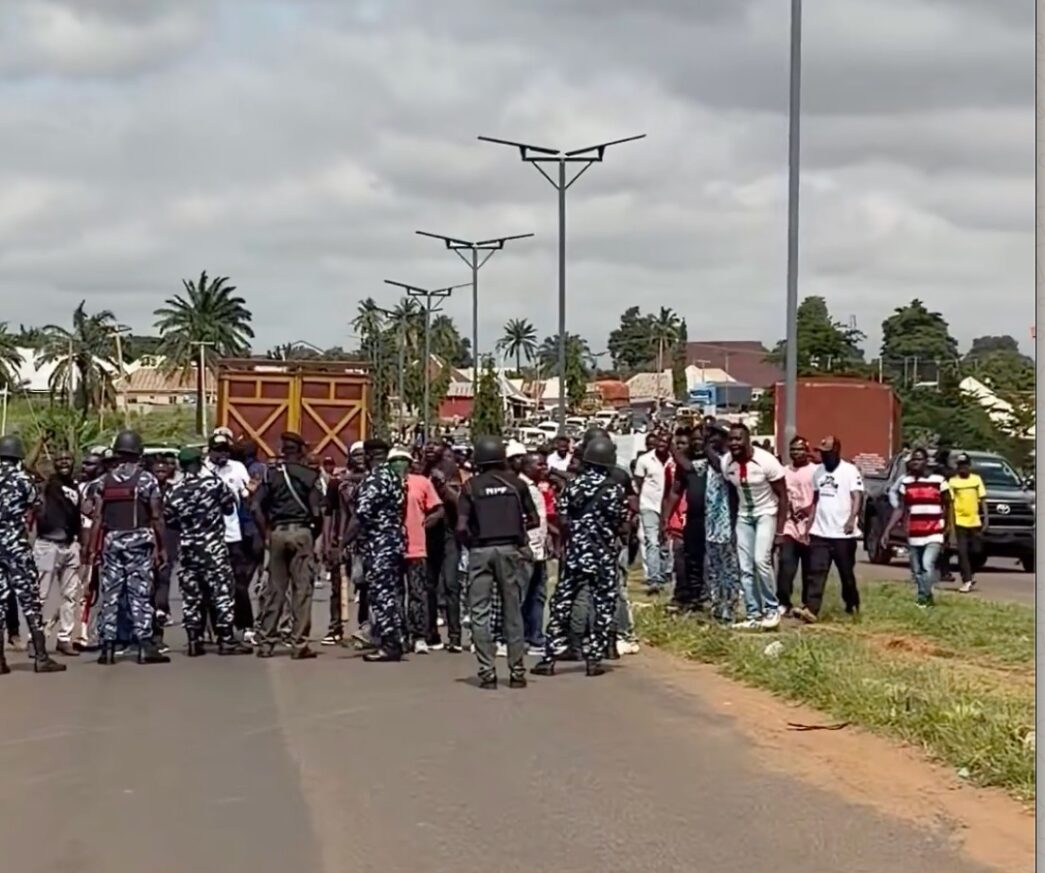
His convoy was, however, stopped along the Makurdi-Gboko road before he could reach the community. The incident which generated controversy has produced competing accounts from Obi’s camp and the Benue State Government.
But beneath the competing narratives lies a bigger political reality which means Benue, located in the North Central might gradually be becoming an important battleground as politicians position themselves for 2027.
One of the most consequential development in the controversy is the disagreement over whether authorities knew Obi was coming.
The Benue Government maintained that the governor was not officially informed of the visit and questioned why Obi would enter the state for such a high-profile engagement without following the appropriate protocol.
The police account, however, introduces another dimension.
The Benue Police Command says it was informed ahead of the visit and had deployed security personnel, including an Assistant Commissioner of Police, to accompany Obi’s entourage.
The command also said it arrested 46 people in connection with the obstruction of the convoy.
Indeed, If the police knew about the visit and security personnel had been deployed, why was a presidential candidate’s convoy still stopped by a crowd on the road?
But it does make the circumstances deserving of a thorough investigation.
And that investigation matters because the incident occurred not in an ordinary political season, but barely months before a presidential election in which political actors are already testing their strength across the country.
One area many analysts are yet to look at when explaining the situation is that of Benue’s importance to the 2027 contest which in a long way goes beyond its number of voters.
The state sits at the heart of the country’s Middle Belt and has become one of the major theatres of Nigeria’s prolonged security crisis.
The Yelwata killings, which Obi was seeking to address during his visit, have remained emblematic of the violence affecting farming communities.
Which makes security and the government’s handling of insecurity potentially powerful electoral issues.
Obi’s decision to visit Yelwata therefore had an obvious political dimension even if he admitted that his purpose was humanitarian.
For an opposition candidate seeking to challenge President Bola Tinubu, visiting communities affected by insecurity provides an opportunity to speak directly to voters about the performance of government.
For a sitting governor seeking another term, however, the presence of a major opposition presidential candidate in the state inevitably carries political implications. The Benue state governor is ranking member of the All Progressive Congress.
Governor Alia is himself preparing for a 2027 contest. His administration has already faced political manoeuvring around his second-term bid, with supporters publicly portraying attempts to stop his re-election as part of a political struggle.
That means the governor has an obvious interesin maintaining his political structure across the state.
However, keen political watchers feel there is a delicate line between maintaining political control and restricting the political activities of opponents.
It is true that governors are enormously influential in Nigerian elections. They control significant political machinery due to the resources they command which in turn influence local structures and often play central roles in determining the atmosphere in which opposition parties operate..
Recall that Obi, who arrived in Makurdi at about 9 a.m. on Tuesday, said he was on his way to Yelwata to console families affected by the 2025 killings when his convoy encountered youths who blocked the road and repeatedly chanted, “Peter Obi, go back.
He said he deliberately refused to confront the protesters because doing so could have resulted in violence and endangered other people.
“I was wondering: are we still in Nigeria?” Obi said, describing the incident as “very, very worrisome.”
The former Anambra State governor said his visit was not primarily about campaign activities but about showing solidarity with people who had lost loved ones in the Yelwata massacre.
He, however, alleged that the youths were not acting spontaneously, claiming that an aide to Governor Alia was at the scene and was involved in mobilising them.
The NDC subsequently repeated the allegation, describing those who obstructed Obi as suspected hired thugs and alleging that they were led by an aide to the governor. The party called for an investigation into the incident.
The Benue State Government has rejected the allegation outright.
Through the governor’s Chief Press Secretary, Tersoo Kula, the administration said it had no knowledge of Obi’s visit and denied deploying thugs to stop him.
The government argued that if it wanted to prevent Obi from moving around the state, it would not resort to thugs, insisting that recognised security agencies were available to address any genuine security concern.
It also questioned why Obi did not formally notify the state government of the visit and suggested that the incident could have arisen from an internal political matter within the NDC rather than from the state governent.
But the Benue Police Command said it was notified of Obi’s visit at about 5:30 p.m. on Monday, a day before the incident.
According to Commissioner of Police Cletus Nwadiogbu, the command subsequently deployed security personnel, including three police escort vehicles led by an Assistant Commissioner of Police, to provide security for Obi’s movement.
Former Deputy Senate President Ovie Omo-Agege and NDC candidate for Delta Central demanded a full investigation, while APM presidential candidate Seyi Makinde accused the APC of being behind the incident.
Whatever explanation they may be provided to justify the act, the incident is even more troubling because it occurred against the backdrop of the peace accord recently signed by presidential candidates ahead of the 2027 elections, in which political actors committed themselves to peaceful, free and credible electoral competition.
The spirit of such an accord should extend beyond election day to the period leading to it, when parties and candidates are already moving across the country, building structures and engaging voters.
Due to the Benue episode, Nigerians are worried about whether the commitments made in the peace accord will translate into restraint and tolerance on the ground as political activities intensify
Political analyst Sir Ifeanyi Ejiofor, on his part, warned that political intolerance, intimidation and organised thuggery appearing this early in the electioneering cycle could become a dangerous precedent ahead of 2027.
According to him, the road to the election should be defined by ideas, tolerance and democratic competition rather than obstruction and violence. He urged President Bola Tinubu to rein in political actors he described as “overzealous”, warning that what is tolerated as an exception could eventually become a political culture.
Another Benue-based political analyst, Daniel Ejembi, expressed concern that young people who should be contributing to the development of the state were becoming instruments of political violence, warning that the recruitment of youths for political thuggery could mortgage the future of an entire generation.
What this means it that for Obi, the incident may become another issue with which to question the political environment ahead of 2027.
On his own part, it is an opportunity for Alia to demonstrate that his administration has no hand in the obstruction and that opposition politicians are free to operate in the state. But beyond both men, what happened in Benue should concern everyone interested in the survival of democracy.
The election should be a contest over votes, ideas and records, not a contest over who can prevent an opponent from reaching the people.
And as the road to 2027 becomes crowded with politicians seeking the support of Nigerians, the events in Benue may well be remembered as one of the early signs of how fierce that contest could become.