By Yusuf Bangura
May 23, 2026
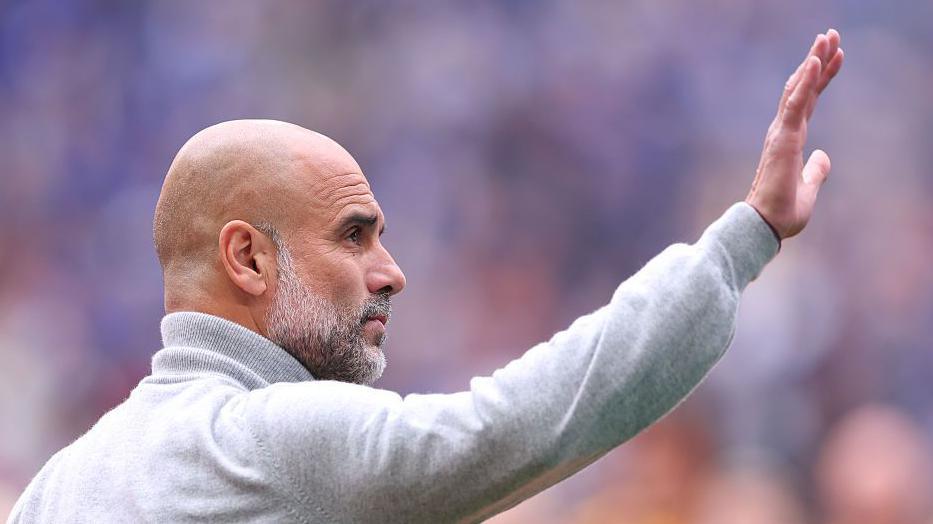
Pep Guardiola, Manchester City’s multiple trophy-winning manager, sadly stepped down yesterday after ten record-breaking years in the English Premier League. TV pundits and YouTube fan channels had already been abuzz with news of his exit over the last two days, so the official announcement of his departure did not come as a shock.
Although he had a remarkable career as a defensive midfielder for Barcelona, it was his managerial career, football ideas, and style of play that transformed him into a household name. These traits made me a devoted follower of the three teams he coached over the last seventeen years: Barcelona, Bayern Munich, and Manchester City.
Since my childhood days, I’ve never been a loyal football fan because of my dislike for the tribal culture of fandom. I love the game deeply, but I shift my loyalties according to how teams play and entertain me. Pep’s arrival and cerebral approach to the game made it easy for me to stick with his teams, although I did so critically. Looking back, it was actually Pep who I was a fan of, rather than the clubs themselves!
Pep’s Great Rivalries
I don’t really care about the club badges or the tribalism; I care most about the art of the game, and Pep was the ultimate artist. The way he demolished the legendary Alex Ferguson’s Manchester United in two Champions League finals—when he was a rookie manager with only three years of experience at Barcelona—to this day, defines how I rate Ferguson in the pantheon of global football. Pep was simply too good for him. Ferguson even confessed that Pep’s team had given his Manchester United team a hiding—it was the best team he had ever faced.
Another managerial icon I admired before Pep was Arsenal’s Arsène Wenger, who played a similar type of attacking football. But Pep’s innovative ideas on tactical positioning, one-two passes in triangles (or tiki-taka), finding openings in tight spaces, and counter-pressing when the ball is lost, clearly placed him a peg above Wenger’s football. Pep applied what looked like mathematical rigour to Wenger’s free-flowing and under-coached play.
Under Pep, the pitch is divided into a strict grid. Players don’t just pass the ball freely; they occupy specific zones to constantly form passing triangles—creating a suffocating system that forces opposing teams to open up spaces rather than relying on luck. In a Champions League match between Arsenal and Barcelona in 2010, Arsenal suffered a massive 4-1 defeat, forcing Wenger to describe Barcelona’s talisman, Lionel Messi, as a PlayStation player who ‘can take advantage of every mistake we make’.
Only three managers—Jose Mourinho, Jurgen Klopp, and Thomas Tuchel—who played an aggressive style of football, were competitive against Pep. Mourinho—the so-called Special One—was the dominant force in club football when Pep entered the managerial scene. He had won a Champions League title with unfancied Porto and two back-to-back Premier League titles with Chelsea, consistently beating and berating Wenger and his Arsenal team, and signalling to Ferguson that he was the new kid on the block in the English Premier League.
Real Madrid later employed him to check a rampant Barcelona, which had in Pep an apparent cheat code to win La Liga and UCL titles with a mesmerising style of play. Along with Wenger, I admired Mourinho a lot for his panache and supreme command of the game in his first outing at Chelsea. He didn’t have a clear philosophical approach, but he possessed a style of play that was incredibly difficult to beat and produced a mountain of goals. His players were also ultra-loyal to him.
However, it was becoming clear to the football world and perhaps secretly to Mourinho himself that Pep was the defining genius of this era. At Madrid, Mourinho employed ultra-defensive methods of play and psychological warfare to get into Pep’s head. His approach frequently earned his teams the moniker “park the bus” among football pundits. He also too often questioned refereeing decisions and even threatened referees and opposing managers, which I believed undermined the integrity of the game. Although he had famously beaten Barcelona with Inter Milan on the way to his second Champions League title, and managed to snatch one La Liga title during Pep’s Barcelona tenure, his bitter on-and-off-the-pitch antics completely alienated me. Across all Spanish competitions, Pep won 5, Mourinho won 2, and they drew 4. Pep was clearly the better manager.
Tuchel maintained a healthy, mutually respectful competition with Pep. While Pep dominated proceedings against him in Germany—winning four of their five head-to-head matches and drawing one—Tuchel famously inflicted a trifecta of defeats against Pep’s Manchester City across three different competitions in England, culminating in a Champions League final victory. However, Pep restored his dominance in their last two Premier League encounters and subsequently masterminded a comprehensive elimination of Tuchel’s Bayern Munich side in the Champions League.
Pep’s best rivalry for me was with Klopp. While Mourinho and Tuchel were largely pragmatic tacticians in challenging Pep, Klopp showed that a well-drilled team can play expansive, attacking football and still be fiercely competitive against him. Klopp unleashed a fast, intense, and deeply emotional brand of football—what he himself described as ‘heavy metal football’. It was exhilarating to watch the contrasting styles of Pep’s waltz football, with its careful caressing of the ball and intricate movements, side-by-side with Klopp’s heavy metal, counter-pressing, and lightning-fast transitions. Ultimately, I think this high-octane style took a heavy toll on both the players and Klopp himself, which likely explains the tendency for Liverpool to experience sharp dips in form across his nine years at the club.
The rivalry was truly first-rate, with both teams playing at their absolute peak. During their highly intense competition, Pep’s Manchester City and Klopp’s Liverpool hit the 90-point mark a combined 5 times. Remarkably, they both did it twice in the exact same season, pushing each other to heights never before seen in English football history. Before their arrival, hitting 90 points practically guaranteed a club the Premier League trophy. Incredibly, Klopp earned 189 points across two separate campaigns (97 in 2018/19 and 92 in 2021/22) and ended up with zero titles for those seasons. Even though Pep clearly outperformed Klopp in total silverware won, their head-to-head was fiercely competitive: there were 8 wins for Klopp, 7 for Pep, and 7 draws. Unlike Pep’s toxic rivalry with Mourinho, his rivalry with Klopp was based on mutual respect and admiration. They refrained from attacking each other or playing mind games to gain a psychological edge.
Pep’s Ultimate Legacy
Pep doesn’t just play beautiful football; he’s also laser-focused on winning titles. When he first arrived in England, most pundits mocked him, claiming that his style of play was unsuitable for the physical demands of the Premier League—especially after he failed to win a single trophy in his first year, which was a first in his career.
After ten years, he is exiting the scene with 20 major titles—including 6 Premier League titles, 1 Champions League, 3 FA Cups, 5 League Cups, 1 Club World Cup, 1 Super Cup, and 3 Community Shields. He’s the only manager who has, in a single season, won 100 points, scored the most goals, and recorded the most wins. He’s also the only manager to win four Premier League titles in a row, and the only one to equal Ferguson’s record of winning the classic treble: the Premier League, Champions League, and FA Cup in one season. In fact, he is the only manager in Europe to achieve a continental treble twice, having also done so at Barcelona. He has three Champions League titles under his belt—a feat achieved by only two other managers, with Carlo Ancelotti leading at five.
Pep’s trophy haul across the three clubs he’s managed stands at 41, making him the second most successful manager in football history in terms of trophies won—just behind Alex Ferguson with 49. However, if we measure greatness by the absolute density of success per year on the job, Pep is entirely in a league of his own. Ferguson won his 49 trophies over a 39-year career, while Pep won his 41 trophies in just 17 years. In terms of sheer efficiency, Pep’s record is out of this world: he has averaged 2.41 trophies every year compared to Ferguson’s 1.26.
Perhaps Pep’s ultimate legacy is the way he’s changed how the game is played in the Premier League, which traditionally relied on long balls, physicality, and set pieces. Many teams now want to play the Pep way—developing attacks from the back, utilising a sweeper-keeper who is good with his feet, and experimenting with inverted full-backs and a False 9 rather than a bona fide centre-forward. Some of his most notable protégés include Arsenal’s Mikel Arteta, Enzo Maresca—who has just been named his successor at Manchester City—Vincent Kompany of Bayern Munich, and Luis Enrique at PSG. Unfortunately, most teams don’t have the right managers, squad depth, or skillset for this intricate style of play, which sometimes makes the Premier League boring to watch.
The Premier League has definitely lost a colossus, and the league will be poorer for it. There has been plenty of speculation about what he’ll do after his sabbatical, with many pundits believing he might move into international management. However, it’s difficult to see a deeply passionate, day-to-day coach like Pep being happy interacting with players he’ll only see during brief international breaks.
Will he ever return to club coaching? The options are remarkably limited. He is unlikely to coach a rival team in England or Germany, the Italian league has lost its competitive edge, and France is entirely dominated by PSG. A romantic return to Barcelona is off the table too, as Hansi Flick is doing a phenomenal job there. All of this suggests we may truly have seen the end of Pep Guardiola on a football touchline. He famously loves golf and once mused that he wouldn’t be coaching into his old age. Whatever his final decision, he has given the footballing world a lifetime of memories to cherish. We can only wish him a glorious rest as he plots his next move.