Isaac Samuel
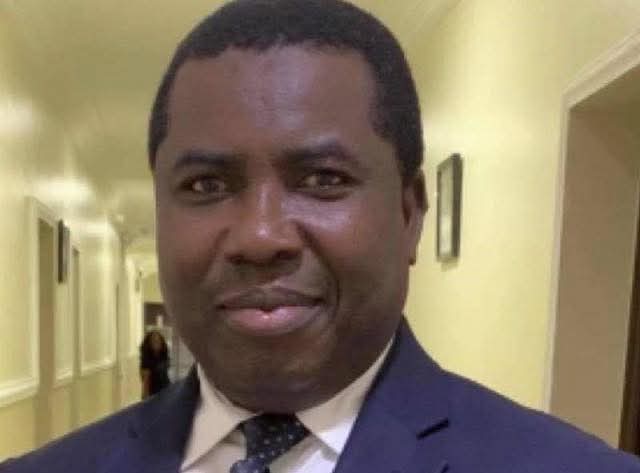
The Independent National Electoral Commission (INEC) has uncovered what it described as a coordinated disinformation campaign involving a fabricated X (formerly Twitter) account falsely linked to the Chairman’s aide, Prof. Joash Amupitan (SAN).
The commission declared that the alleged posts attributed to him are entirely fraudulent and technically impossible.
In a detailed public statement issued on Monday, and signed by the Chief Press Secretary to the INEC chairman, Adedayo Oketola, the commission said findings from a multi-layered forensic investigation have conclusively established that Amupitan does not own or operate any X account, contrary to claims widely circulated on social media.
The controversy began on April 10, 2026, when screenshots surfaced online alleging that Amupitan operated an account under the handle @joashamupitan and had posted a partisan message reading “Victory is sure” in response to another user, @dayoisrael.
The claims were amplified with purported evidence, including email records, phone numbers, and bank verification data, presented as proof of ownership.
However, INEC said an independent forensic cybersecurity investigation it commissioned found no verifiable link between the account and Amupitan, describing the entire narrative as a “coordinated digital impersonation and disinformation campaign.”
According to the Commission, technical analysis revealed that the disputed account, created in September 2022, had no connection to Amupitan’s known email addresses or phone numbers.
It said attempts to link the account to his verified email through X’s password recovery system failed, while similar checks using his phone number yielded no results.
INEC also dismissed claims based on Bank Verification Number (BVN) and OPay data, noting that while such records may confirm ownership of a phone number, they do not establish any connection to a social media account.
More striking, the Commission said timestamp analysis exposed a fundamental flaw in the viral claim. The alleged reply attributed to Amupitan was shown as being posted 13 minutes before the original tweet it purportedly responded to — an impossibility on any digital platform.
“This is not a minor discrepancy or a time zone issue. It is definitive proof that the screenshot was fabricated,” the report stated.
The commission said forensic checks using the Internet Archive’s Wayback Machine found no record of the alleged account or any related posts prior to April 2026, undermining claims that the account had been active earlier.
INEC added that on the same day the screenshots went viral, the account in question was abruptly renamed to @sundayvibe00, switched to private mode, and labelled as a parody account.
The pattern the Commission said is consistent with attempts to erase digital footprints and evade scrutiny.
The investigation also uncovered a broader pattern of impersonation, identifying at least seven fake Facebook accounts and an Instagram profile using Amupitan’s name and photographs, suggesting a sustained effort to mislead the public across multiple platforms
.
The Commission cautioned against relying on data breach records or aggregated open-source intelligence as proof of social media ownership, stressing that such datasets are often non-specific and incapable of establishing direct control of any account.
“A phone number appearing in a BVN record cannot be used to establish social media ownership. The conclusion drawn by some actors is a logical fallacy, not forensic proof,” INEC said.
It further confirmed that a live verification of the X platform showed no trace of the alleged reply, adding that exhaustive searches returned zero results for the disputed content.
INEC warned that the rise of artificial intelligence and digital manipulation tools has made it increasingly easy to fabricate convincing screenshots, urging the public and media organisations to prioritise verification over speed.
“Accuracy, not virality, must guide reporting, especially where public officials and institutional credibility are concerned,” the statement added.
The Commission said the forensic report has been forwarded to law enforcement agencies for further action, including identifying and prosecuting those behind the impersonation under the Cybercrimes (Prohibition, Prevention, etc.) Act.
INEC reiterated that all official communications are issued only through its verified channels, including its website, official X account, Facebook page, and authorised press statements.
It urged the public to treat any social media account claiming to represent Prof. Amupitan as fraudulent unless formally verified.