Tinubu allocates N1.01 trillion to INEC ahead of 2027 election

Tinubu allocates N1.01 trillion to INEC ahead of 2027 election

Isaac Samuel

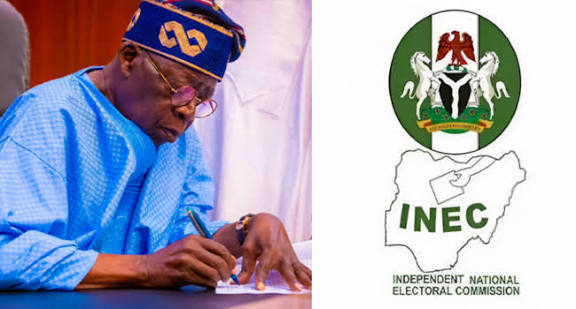
The Independent National Electoral Commission (INEC) has been allocated a staggering N1,013,778,401,602 in the 2026 budget presented to the National Assembly by President Bola Ahmed Tinubu.

The allocation, one of the largest in the commission’s history, comes as Nigeria prepares for the 2027 general elections.

This is contained in the details of the 2026 Appropriation Bill released by the Budget Office of the Federation.

President Tinubu had presented a 2026 Appropriation Bill of N58.18 trillion to the National Assembly.

The proposed budget, tagged, “Budget of Consolidation, Renewed Resilience and Shared Prosperity,” projected total revenue of N34.33 trillion and total expenditure of N58.18 trillion, including N15.52 trillion for debt service.

While INEC has consistently cited the need for adequate funding to ensure credible elections, observers noted that the new allocation will be tested by logistical demands, including procurement of technology, voter education, and nationwide staff deployment.

Section 3(3) of the Electoral Act 2022 requires election funds to be released at least one year before the polls.

ALSO READ  2027: INEC to implement inmate voting

“The election funds due to the Commission for any general elections are to be released to the Commission not later than one year before the next general election”, the section said.

In 2025, the National Assembly approved an upward review of the budget for INEC, increasing it to N140 billion from N40 billion initially proposed by the Federal Government.

The commission spent N313.4 billion for the conduct of the 2023 general elections.

But the commission in its 2023 General Election Report, said that out of the N355 billion approved for the conduct of the elections, the sum of N313.4 billion was only released as of September 2023.

For the 2019 election, the National Assembly approved N143 billion for the commission.

Furthermore, checks revealed that Nigeria spent about N108.8 billion to conduct the 2015 general elections.

Professor Bolade Eyinla, immediate past Chief Technical Adviser to the INEC Chairman, Prof. Mahmood Yakubu had in October projected that the commission may spend about N870 billion ($600 million) to conduct the 2027 general election.

ALSO READ  ADC woos Jonathan as Mark, Atiku insist on primaries Isaac Samuel The race to the 2027 presidency took a dramatic turn this week as the African Democratic Congress (ADC) intensified efforts to lure former President Goodluck Jonathan into its fold. Jonathan, it was gathered is also taking decisive moves to reset opposition strategy and mount a formidable challenge against President Bola Tinubu. The former President held a closed-door meeting held in Abuja on Thursday with ADC National Chairman, Senator David Mark. Jonathan, who publicly met with politicians and party leaders for the first time since his rumoured bid to return to power, met the ADC stakeholders at the home of Mark. Seen in a viral video as he walked into the expansive residence of the former Senate President in Abuja, others with Mark were former Minister of Sports and ADC spokesperson, Malam Bolaji Abdullahi as well as a former National Publicity Secretary of the Peoples Democratic Party (PDP), Mr. Kola Ologbondiyan, among others. Sources claimed the former president has begun consultations ahead of the 2027 polls following increasing pressure to get in the ring and ‘save’ the nation. But it was learnt that the former President's bid to return to Aso Rock on the platform of the opposition coalition may have hit an early stumbling block. At Thursday’s meeting, Mark was said to have told the former president in clear terms that the only path to the party’s presidential ticket was through the front door by formally joining the party and submitting himself to a transparent primary election. Unable to secure any guarantees, Jonathan and Mark agreed to meet again soon to review the situation. It was learnt that the ADC is moving to draft Jonathan into the race beccause he is seen as a compromise candidate, but his strong base used to be the South-East which is now the political fortress of Obi. But Jonathan is not alone in seeking assurances. Both former Vice President Atiku Abubakar and Labour Party’s 2023 presidential candidate, Peter Obi, are also pressing the ADC leadership for firm commitments before they take the plunge. The party’s new leadership, however, has refused to make such promises, a development that explains why all three leading contenders are still holding back from declaring for the party. For them, early commitment without certainty could prove politically fatal. Aligning with the ADC and then losing its ticket could leave any of the trio stranded and without a viable political vehicle ahead of 2027. Obi has consistently insisted that power must remain in the South for equity, even pledging to serve a single term if elected. But his camp remains opposed to any vice-presidential offer, warning that such a move would be politically suicidal after his strong showing in 2023. For Atiku, who resigned from the PDP in July, the plan is to complete ongoing grassroots mobilisation before formally collecting his ADC membership card in Adamawa. While Atiku insists he is ready for an open primary, his increasing influence within ADC backed by significant political investments is fuelling fears that the presidential ticket may already be tilted in his favour. That dynamic, party figures say, could force Jonathan and Obi to reconsider their strategies. Meanwhile, the ADC leadership is trying to project unity. After a caucus meeting in Abuja attended by Mark, Atiku, former governors Nasir El-Rufai, Aminu Tambuwal and Rotimi Amaechi, the party directed all undecided members to resign from their existing parties. Peter Obi, a member of the coalition party, had yet to disclaim his membership of Labour Party (LP). Atiku is also yet to get his ADC membership even though he has resigned from PDP. National Publicity Secretary of ADC, Bolaji Abdullahi, disclosed the new directive while addressing journalists in Abuja, after a caucus meeting attended by top party leaders and political figures. Abdullahi said, “Though final order has been given to all members to resign membership of other political parties, the caucus was silent on the timeline.” The caucus also announced that all issues concerning African Democratic Association (ADA) had been concluded. According to Abdullahi, “The coalition has rested everything concerning the ADA. That means they are not interested in the registration or otherwise of the association.” On the 2027 presidential race, Abdullahi said ADC’s presidential aspirants had agreed to back whoever emerged winner of the primaries. “All the presidential aspirants have agreed to support whoever wins the primaries election,” he stated. The ADC spokesman further revealed that the party’s National Working Committee (NWC) would soon announce dates for primaries in Osun and Ekiti states ahead of the off-cycle governorship elections in both states. Those present at the meeting included National Chairman, David Mark; former Vice President Atiku Abubakar; National Secretary, Ogbeni Rauf Aregbesola; former Kaduna State Governor, Mallam Nasir el-Rufai; former Sokoto State Governor, Senator Aminu Tambuwal; and former Rivers State Governor, Chibuike Amaechi.

Speaking at a Yiaga Africa 2027 Elections Scenarios and Election Manipulation Risk Index (EMRI) Retreat in Abuja, Eyinla noted that Nigeria’s elections are among the largest civil operations in peacetime, requiring significant financial, technological, and logistical resources.

According to him, the projected costs reflect the demands of a country with over 93 million registered voters, 176,846 polling units, and 1,558 electoral constituencies.

Eyinla said the projected amount is informed by previous election costs, saying that the 2015 elections cost N109 billion (US$662 million), 2019 elections N189 billion (US$619 million) and N355 billion (US$628 million) was spent on the 2023 elections.

According to him, after accounting for inflation, currency fluctuations, and operational expansion, the N870 billion projection for 2027 is realistic.

He added that on a per-voter basis, the cost is approximately US$6.72 per voter, which is within international norms for transitional democracies.

His words: “In comparative terms, the cost of conducting a general election in Nigeria is among the lowest in Africa. For instance, in Kenya, the cost per voter was US$25.9 in 2017 and US$14.9 in 2022; in Ghana, US$13.1 in 2016 and US$7.7 in 2020; in South Africa, US$5.1 in 2019 and US$7.1 in 2024; in the Democratic Republic of Congo, US$22 and US$14.37 per voter in 2023; and in Liberia, US$22 per voter in 2023. This comparison is no less striking with India, the world’s largest democracy, where the cost was US$8.5 per voter in 2019.

ALSO READ  Iyabo Obasanjo dumps APC six months after joining Party

“Based on the prevailing US$ to Naira exchange rate at the time of each election, the cost of Nigeria’s previous three general elections was: N109 billion (US$662 million) in 2015, N189 billion (US$619 million) in 2019, and N355 billion (US$628 million) in 2023.

“Considering the current state of the economy, inflation, and the consumer price index from the National Bureau of Statistics (NBS), it is estimated that conducting the 2027 general election will require about US$600 million (approximately N870 billion), assuming INEC manages its resources prudently.
Share

Leave a Reply

Your email address will not be published. Required fields are marked *