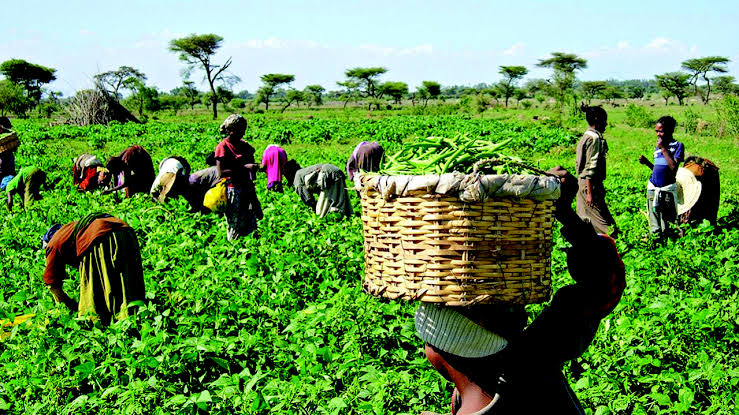
Financial experts and stakeholders in the Nigerian agribusiness value chain have called for financial products that would attract long term funding from the capital market for the Nigerian agricultural value chain.
They made the call during the recent 5th Agri-Investment and Capital. Market Forum (AICM 2025), which was held in Lekki, Lagos State with the theme “Cultivate Change: Agri-Food Investment as a Catalyst for Industrialisation.”
The Group Head, Finance Facilitation, NISRAL, Mr. Michael Adeoye, said that the time has come for the unlocking of the capital market to fund agriculture because people are shying away from raising credits through the money deposit banks because of high lending rates.
Adeoye said: “You can hardly get a loan that is less than 33 or 35 per cent in Nigeria now. The profit can never be okay if you want to fund agriculture with that level of interest rates. So, people are shying away from approaching banks to finance their agro business.”
He disclosed that NISRAL has realised this trend and is moving toward the capital market for “low cost and patient capital.”
Commenting on the theme of the event, Adeoye said that “we cannot underestimate the power of agribusiness because nearly every raw material comes from agriculture.
“NISRAL is providing guarantee to agribusinesses looking for fund from the capital market.
“NISRAL guarantees start from the off stream which means inputs, mechanisation to the upstream, which is the main cultivation and rearing of animals to the midstream, which is value addition, to the downstream which is the market.
“NISRAL coverage is not limited to primary production but covers all the value chain.”
The Group Managing Director/CEO of Raedial Farms, Mr. Uwadiale Agenmonmen, said that agriculture and its value chains are capital intensive and required long term financing.
Agenmonmen said that his firm was constrained to go outside the country to raise finance because of the challenges of accessing suitable long term financing in Nigeria.
He said: “We have accessed a five year fund, which was a mismatch. That has led us to seek funds outside the country that can last 15 years.
“Those are the kind of structures we need in Nigeria’s capital market space. We need government and private sector collaboration to design programs that actually fit into the agricultural space.”
Also, the Chief Operating Officer, AFEX, Ms. Oluwafunto Olasemo, said that financing should flow from the capital market to agriculture that contributes 25 per cent of its gross domestic product.
Olasemo said that the capital market and commodity exchanges should engineer a process that would unlock capital for agro value chain.
She said: “This is where AFEX comes in. What we do essentially is to create products that enable agribusinesses to access the capital market and unlock funding.
“The critical thing that we do is creating the products and developing the standards that drive price discovery so that value will really get to the farmers.”
The Chief Executive Officer, Sourcing and Produce Limited, Mr. Awojoodu Lanre, advised agro firms desiring to raise financing from the capital market to staff their firm with professionals, put in place structured process and entrench corporate governance in the operation.
“The people that give you capital will give you more if you perform. MBO Capital is the first to give me N30 million that has grown to $4 million investment within five years,” Lanre said.
The Program and Partnership Manager, FMN Food and Agro-Allied Group, Ms. Kehinde Akanni, said that access to financing, quality input, access to the market and lack of training are major setbacks to wheat farming in Nigeria.
“Being a major up taker of this produce, it is important for us to ensure that the quality is right. So, we give farmers quality inputs, support them with right technological practices and then buy their produce at a good price. Today, we have over 15,000 farmers that we are supporting with input loans,” Akanni said.