By Emem Benson
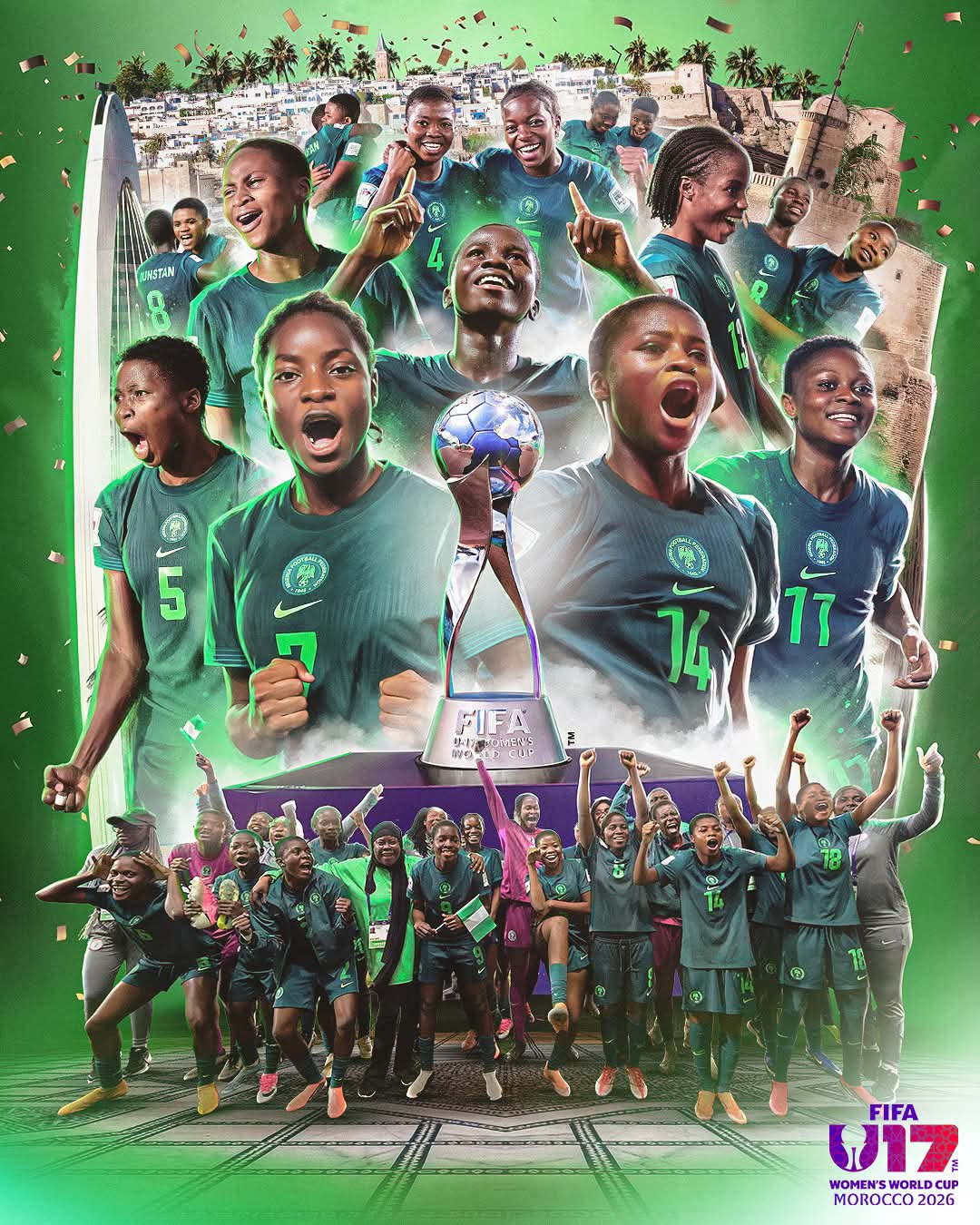
The night of Saturday, 7th November 2026, at the Mohammed VI Football Complex in Rabat, Morocco, will go down in history as a night when Nigeria’s U-17 Women’s National Football Team, the Flamingos, defeated Japan 2-1 to win the FIFA U-17 Women’s World Cup, becoming the first African nation to lift the prestigious trophy.
While the Nigerian football family bask in the euphoria of winning the World Cup, it is important to recollect that the journey was not an easy ride. The Flamingos began their campaign with a loss in their opening Group B game, 2-1 to Poland, then found their rhythm – beating Puerto Rico 2-0, going on to stun the defending champions Korea DPR 3-1, edging Mexico 2-1 in the Round of 16, and overcoming Venezuela 1-0 in the quarter-final through Azeezat Oduntan’s 89th-minute penalty.
Then came the semi-final against Brazil on Wednesday, 4th November, a fearless, disciplined 3-1 victory that took Nigeria to its first-ever final. Queen Joseph opened the scoring, and Awawu Bashiru scored a brace. That night, the world began to truly believe in the mission of the Nigerian team.
The night of Saturday, 7th November 2026, the night of the final match between Nigeria and Japan, was truly a Night of Destiny.
Japan arrived in Rabat as the Little Nadeshiko – disciplined, technical, formidable, and chasing a second world title after winning in 2014 and finishing runners-up in 2010 and 2016. They had conceded only twice on their way to the final. They had beaten defending champions Korea DPR in the semi-final. They were, on paper, the favourites.
Nigeria, by contrast, named an unchanged starting XI – the same winning team that had beaten Brazil. Coach Hakeem Busari trusted his girls completely. And his girls repaid that trust.
From the first whistle, the Flamingos were the better side. They pressed high, attacked with intent, and refused to let Japan settle. They had six shots in the first half alone.
In the 26th minute, Awawu Bashiru threatened. In the 28th minute, Oluebube Umejiaku rounded the Japanese goalkeeper Kou Kadowaki but could not finish.
In the 37th minute, Nigeria came agonisingly close when an effort struck the crossbar. The breakthrough was coming. And in the 39th minute, it came, when Bashiru broke the deadlock. Connecting with a pass from Mary Dunstan, Awawu Bashiru unleashed a dropping, long-range effort from outside the box. It was not the cleanest strike, but it was brave and decisive. Kadowaki looked destined to catch it, only to see it squirm between her gloves and drop into the net.
1-0 to Nigeria. The Nigerian bench erupted. The stadium, filled with Nigerian voices, roared. Bashiru, already the heroine of the semi-final, had done it again. The midfielder who had scored twice against Brazil had now scored in the final. Big players score in big games, and Bashiru was proving herself a truly big player.
Nigeria went into half-time 1-0 up – 45 minutes away from an achievement no African team had ever managed.
On resumption of proceedings for the second half, Nigeria could hardly have asked for a better start. Just two minutes after the restart, the game was transformed.
Esther Stephen sent a long, raking pass upfield. Umejiaku raced onto it, chased it down, controlled it beautifully with her left foot, and then, with ice-cold composure, delicately lifted the ball over the advancing Kadowaki, the Japanese goalkeeper.
It was a goal of pure class – pace, control, intelligence and finish. It was the goal of a player who had already missed a chance in the 28th minute but refused to let that define her. And that goal, Umejiaku’s fourth of the tournament, proved to be the winning goal.
At 80 minutes, Japan refused to surrender. They are champions for a reason. They increased the pressure, moved the ball with precision, and in the 80th minute, they were rewarded. Following a pass from Anri Ito, Fuki Ito converted to make it 2-1. After the Japanese goal, the final 15 minutes became a test of Nigerian composure, character and courage. Japan pushed for an equaliser. Mashiro Yamaji came close with a late effort. Nigeria, meanwhile, refused to retreat completely. They kept threatening through Umejiaku and Kanyinsola Yusuf. Yusuf was booked in the 83rd minute for a committed challenge, a symbol of how much this team was willing to give.
Captain Harmony Chidi, who before the final had said winning the trophy would be a moment her country would never forget, led by example – organising, encouraging, holding the line together.
Goalkeeper Jane Ijirigho, who had anchored the team throughout the tournament, remained calm, commanded her box, and made sure nothing else passed her.
Umejiaku was flagged offside in the 94th minute, still chasing a third goal even in added time. That hunger summed up this team.
When the referee blew the final whistle after five minutes of added time, Nigeria were world champions.
Indeed, one remarkable strength of Busari’s Flamingos was that they were not a team that depended on one star. They defended as a unit, pressed with intelligence, countered with pace, and finished with composure beyond their years.
The individual creativity, talents and contributions of each player in the team was what made the Flamingos tick. Mary Dunstan was the creator – her assist for Bashiru’s opener and her tireless work on the flank gave Nigeria width and penetration. Esther Stephen was the visionary – her long pass for Umejiaku’s goal was a moment of perfect reading of the game.
Queen Joseph, who had opened the scoring against Brazil, brought energy and directness. Oluwakemi Adegbuyi stretched Japan with her runs. Azeezat Oduntan, whose penalty had beaten Venezuela, brought leadership and steel. Precious Oscar, Kanyinsola Yusuf and the entire bench added depth and fresh legs when it mattered.
And behind them all, Jane Ijirigho and the defence stood firm when Japan threw everything at them in the final minutes.
This was a collective triumph – a triumph of belief, discipline and the true Naija spirit.
In terms of individual laurels and accolades, the Flamingos were not found wanting. Awawu Bashiru – the Big-Game Player, two goals scorer against Brazil. She scored the opening goal in the final. Bashiru scored when it mattered most. She was the heartbeat of Nigeria’s attack, fearless from distance, relentless in her running, and utterly decisive.
Oluebube Umejiaku was the Golden Girl of the historic night. In one historic night, she got two awards and one unforgettable performance. The 16-year-old Heartland Queens forward was named Player of the Match in the final and crowned with the adidas Golden Ball as the best player of the tournament. She scored Nigeria’s second goal in the final, her fourth of the tournament. She had earlier won Player of the Match against Mexico in the Round of 16. She contributed to goals in all seven of Nigeria’s matches – a remarkable feat of consistency for one so young. Umejiaku is not just a champion; she is the future of the Super Falcons.
Harmony Chidi, the Captain who led with calm, maturity and pride. Her words before the final – that winning would be something she, her country, her teammates and her coaches would never forget – became prophecy.
Coach Hakeem Busari was the Chief Architect and Tactician. Busari built not just a team, but a belief system. After the semi-final, an emotional Busari said:
> “We told the girls from day one – we are not in Morocco to participate, we are here to make history. They have fought, they have bled, they have shown the true Naija spirit. To reach the final of the World Cup, no Nigerian team at this level has done it before. We have broken a jinx.”
> “People doubted us. They said we could not go past the quarter-final hurdle. But I trusted my girls. These girls are warriors. They are disciplined, they are hungry, and they want to bring the trophy home.”
He was right. The job is now finished – and finished in gold.
To Nigeria and Nigerians, we must be reminded that this victory is bigger than a trophy. It is a statement. It is an inspiration to the next generation. It is a reminder of the enormous talent we have in Nigerian women’s football.
The Flamingos have broken the glass ceiling for the entire continent. For every young girl in Lagos, Uyo, Oron, Kano, Enugu, and across Africa who has been told football is not for her, this team is living proof that it is. For every grassroots coach working with limited resources, this is validation. For Nigerian football, long criticised for underdevelopment, this is a powerful reminder of what is possible when talent meets preparation and belief.
Today, the Flamingos have written their names in history, not just for Nigeria but for the entire African continent. They have shown the world that Africa can compete, dream big and conquer the highest level of youth football.
*THE WORLD IS OURS! THE TROPHY IS HOME IN NIGERIA!*
Congratulations, champions! You have made Nigeria and the entire African continent proud. Enjoy every moment of this historic achievement. You deserve it!
● Emem Benson, Esq
*8th November, 2026*