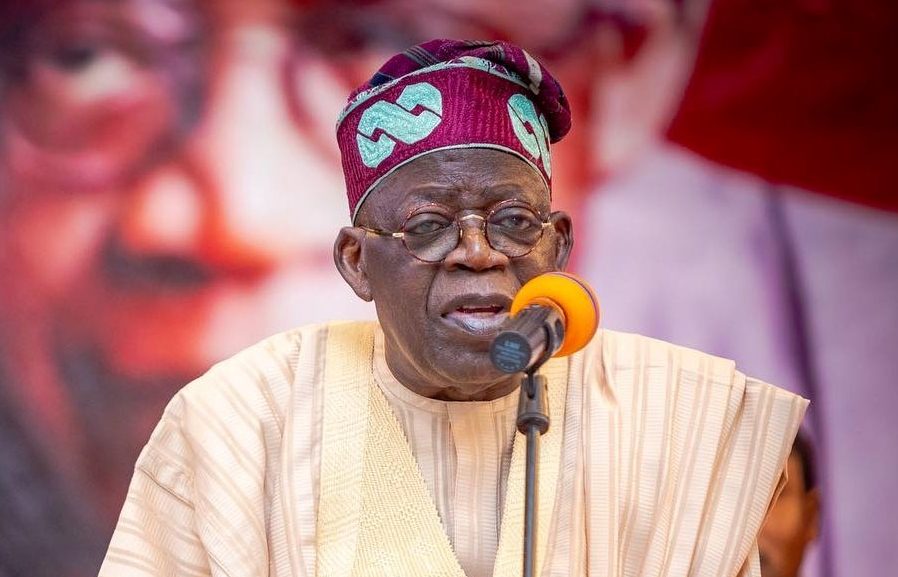
By Isaac Samuel
President Bola Ahmed Tinubu has blamed past administrations for failing to take difficult economic decisions over the years, saying their policies allowed deep-rooted distortions to persist and contributed to the hardship Nigerians face today.
Tinubu stated this in his Independence Day address to Nigerians on Thursday, themed “From Reforms to Prosperity.”
The President said Nigeria’s economic challenges did not emerge suddenly, arguing that successive governments had often chosen to postpone difficult decisions while sustaining inefficient arrangements.
He said the consequence was a buildup of economic problems that eventually left the country with little room for manoeuvre.
“For too long, the promise of Nigeria was undermined by choices that postponed difficult decisions and allowed deep economic distortions to grow.
“By 2023, poverty was rising, and hope was nearly gone. The country’s situation was darker than ever. We had no choice but to act.”
Tinubu compared Nigeria’s previous economic management to a patient being given painkillers instead of receiving treatment for the underlying disease.
According to him, governments had concentrated on managing the symptoms of economic problems rather than confronting their root causes.
He added: “Nigeria was like a sick patient who receives the terrible news that he has cancer. His doctor explains that the treatment will be difficult and painful, but that it offers a strong prospect of recovery.
“The patient has a choice. He can begin treatment, endure its discomfort and fight the disease. Or he can ask only for morphine, dull the pain and leave the cancer to spread.”
The President said successive leaders had continued to defer difficult decisions in the hope that the problems would eventually disappear.
“For too long, Nigeria’s leaders chose morphine while praying for a miracle that never came.
“They focused on symptoms while allowing the disease to take hold deep within the fabric of our society. We spent enormous sums sustaining inefficient arrangements that were never intended to last. We hid from difficult truths and passed the consequences from one generation to the next.”
But Nigerians will remember that Tinubu was among those who led protests in Lagos to sabotage President Jonathan’s attempt to remove fuel subsidy in 2012.
Tinubu said his administration decided to adopt a different approach when it assumed office in 2023, acknowledging that the reforms introduced since then had imposed significant hardship on Nigerians.
He nevertheless argued that the difficulties were the consequence of correcting existing weaknesses rather than the reforms creating those weaknesses.
The President added: “When this Administration assumed office, we resolved to do things differently. We chose to excise the cancer. The reforms that followed were difficult.
The side effects were real. Yet, we must never confuse the medicine with the disease. Our reforms did not create the weaknesses in our economy. They confronted them.”
The President specifically defended the direction of his administration’s economic policies, saying the government had spent the first three years trying to correct the country’s economic course.
He said the next phase would now focus on translating the reforms into improved living conditions and broader prosperity.
“My fellow Nigerians, we have reached a turning point. The emergency treatment is over. The foundation has been repaired. The central economic task before us has changed. For three years, our overriding purpose was to correct our nation’s course.
“Now, our purpose is simple: shared and widespread prosperity”, he said.
Tinubu said the government’s definition of prosperity went beyond improved economic statistics, stressing that it should ultimately be reflected in the daily lives of Nigerians.
He said his administration wanted a country where farmers could produce safely and profitably, manufacturers could access reliable power, businesses could obtain credit and young people could secure productive employment.
“When I speak of prosperity, I do not speak merely of a larger economy, abstract numbers or better statistics. I mean something much more personal.”
He described the Nigeria he wanted to see as one where food and transportation were affordable, education was within reach and families could look towards the future with greater confidence.
On the cost of living, Tinubu said the government’s strategy would focus on reducing the cost of production and transportation rather than relying only on measures that address prices after they have risen.
“Our priority is to bring down the cost of living. We will achieve this by lowering the cost of producing and moving the things Nigerians consume.”
He said the government would expand mechanised irrigation and dry-season farming, improve access to seeds and fertiliser, increase agricultural mechanisation and invest in storage and transportation.
The President also linked lower prices to improvements in infrastructure and the business environment, saying lower production and distribution costs would eventually benefit consumers.
The President added:“Our logic is simple. When a farmer produces more cheaply, when fewer crops are lost between the farm and the market, when a manufacturer spends less on electricity, when a truck reaches its destination faster, and when the business environment fosters fair competition, all those savings will ultimately find their way into the price of goods in the market.”
Tinubu also identified Nigeria’s youthful population as a major factor in the country’s economic future, saying government must ensure that the growing working-age population becomes an economic asset.
“Nigeria is a young country. Millions of young Nigerians enter adulthood every year with talent, energy and ambition. Our responsibility is to ensure that this great demographic strength becomes an engine of production rather than a source of despair.”
He said the administration would therefore prioritise employment, enterprise and industrial expansion.
“We are therefore placing jobs, enterprise, and industrial growth at the heart of our government’s policies.”
According to the President, the government would use gas to support new industries, help revive factories, expand digital connectivity and provide skills and infrastructure needed by businesses.
He said his ambition was for Nigeria to become a country that produces more of what it consumes and exports more Nigerian-made products.
“I want to see more Nigerians making things. I want to see more Nigerian farms feeding our cities and supplying our factories. I want to see Nigerian businesses selling Nigerian goods to the whole world. I want young Nigerians building unicorns and creating opportunities for others here at home.”
However, Tinubu acknowledged that the economic reforms had not eliminated the immediate difficulties confronting millions of Nigerians.
He said many families still struggled to afford food, school fees, medical bills and transportation.
The President argued that these difficulties predated his administration and were linked to structural problems that had accumulated over many years.
“Their circumstances did not begin with the reforms of the last three years. Their struggle is the accumulated consequence of decades of low productivity, inadequate infrastructure, insufficient opportunity and institutions that too often failed those who needed them most.”
He said the government could not reverse decades of economic problems within a single four-year administration but could alter the country’s trajectory.
“We cannot erase in four years what accumulated over generations. But we can change its course. We can build an economy that steadily lifts people out of poverty while ensuring that those who remain vulnerable are not abandoned along the way.”
Tinubu said the government was consequently strengthening direct support for poor households and improving the National Social Register to ensure that assistance reached those who genuinely needed it.
He also highlighted the Nigerian Education Loan Fund, CREDICORP, primary healthcare and basic education as part of the government’s efforts to support vulnerable citizens while the wider economy expands.
According to him, these interventions were not intended to become permanent substitutes for economic opportunity.
The president said “these programmes are not substitutes for prosperity. They are a bridge to aid our nation’s citizens on their path towards it. Our objective is not to manage poverty more efficiently. We will defeat it.”
The President said achieving that objective would require sustained economic growth, discipline and the creation of millions of productive opportunities.
“It will take time. It will require discipline. It will require sustained growth year after year and the creation of millions of productive opportunities across our country.”
Tinubu also listed what he described as improvements in key economic indicators since the reforms began, including economic growth, lower inflation from its peak, rebuilding of foreign reserves, improved stability in the foreign exchange market and increased non-oil exports.
He said the economy had grown by more than four per cent in 2026, with both oil and non-oil sectors contributing to growth.
According to him, oil theft had declined, while Nigeria recorded more than $6 billion in non-oil export revenue in 2025.
The President said these developments showed that the reforms had begun to strengthen the country’s economic foundations.
“But for the first time in decades, we embark on this task from a position of strength; with an economy whose fundamental direction has been corrected. We confronted the difficult choices we faced and have laid the foundations for lasting prosperity.”