By Isaac Samuel
Former Nigerian Head of State, General Abdulsalami Abubakar (rtd), has featured in promotional material of an Indian hospital where he had a knee replacement surgery in 2023.
It is not clear if the hospital has obtained the approval of the former Nigerian leader before the advert was released, but the material has drawn wide comments from Nigeria and drawn fresh attention to Nigeria’s long-running medical tourism crisis.
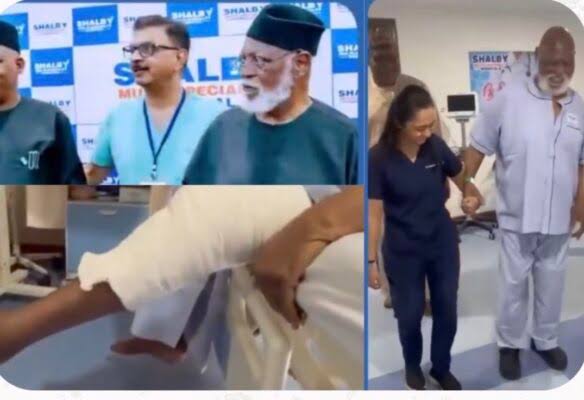
The footage shows Gen. Abubarkar in Krishna Shalby Hospital in Ahmedabad, India, posing with doctors, undergoing physiotherapy and learning to use his left leg after the surgery. The hospital says his treatment is a milestone in international patient care.
According to the hospital’s official website, Krishna Shalby Hospital is a 210-bed multispecialty facility in Ghuma, Ahmedabad, India, with particular expertise in joint replacement and complex orthopaedic procedures.
The website says the hospital attracts international patients and has a dedicated floor for international patients, 24-hour emergency services and a rehabilitation centre.
Shalby says its hospital group has performed more than 100,000 joint replacement surgeries and has established itself as a medical tourism provider.
Its international-patient programme offers services including airport transfers, medical appointment coordination, accommodation arrangements and travel assistance.
The development has prompted criticisms from activist and former presidential candidate Omoyele Sowore, who described Abubakar’s appearance in the advert as an indictment of decades of neglect of Nigeria’s healthcare system.
Sowore questioned why Nigerian leaders who had opportunities to strengthen healthcare infrastructure while in office continue to seek specialised treatment abroad.
He also suggested that the episode could eventually be replicated with other Nigerian political leaders seeking treatment overseas.
The controversy, however, extends beyond the individual case to a much larger question: why does a country of more than 200 million people continue to send patients abroad for treatments that could potentially be developed locally?
Nigeria has battled medical tourism for years, with India emerging as one of the principal destinations for Nigerians seeking specialised treatment.
A 2026 BusinessDay report, citing figures from the Indian High Commission, said 47 per cent of Nigerians visiting India were travelling for medical treatment, while about 18,000 medical visas were issued in a period cited by the report.
The report also noted that India has become attractive to Nigerian patients because of its combination of specialised care and comparatively lower costs.
The Indian government itself has deliberately positioned the country as a global medical-tourism hub. Its Ministry of Tourism said India recorded 507,244 foreign arrivals specifically for medical treatment in 2025, while describing medical value travel as a growing international industry.
For Nigeria, the consequences go beyond the cost of individual treatment.
When Nigerians travel to India, the United Kingdom, the United States or other countries for surgery and specialist care, money is spent on hospital bills, doctors, accommodation, flights, local transportation and other services outside Nigeria.
At the same time, Nigerian hospitals lose potential revenue that could otherwise support investment in equipment, specialist services and training.
Central Bank data reported showed that Nigerians spent about $2.41 billion on foreign healthcare-related services in 2024, down from $3.82 billion in 2023.
The irony of the Abubakar episode is striking because he is not an ordinary Nigerian travelling abroad for treatment.
He served as military Head of State from 1998 to 1999, before handing over to an elected civilian government in May 1999.
His treatment abroad provides a highly visible illustration of a problem that has persisted across successive administrations.
Nigeria has struggled to build enough specialised capacity at home to retain even some of its most prominent citizens when they require complex medical care.
Indeed, India’s success demonstrates what sustained investment in specialised healthcare can produce.
Shalby hospital said it began in 1994 as a six-bed hospital and built its reputation around joint replacement before expanding into a multispecialty hospital network.
In addition, Nigeria faces the opposite challenge.
This is because developing hospitals that can provide complex treatment domestically, retaining doctors and other health professionals, investing in diagnostic and surgical technology, and creating an environment in which patients trust local institutions.
Abubakar’s appearance in an Indian hospital advertisement has become more than a photograph of a former Nigerian leader recovering from surgery.
Many Nigerians believe that it has become an uncomfortable symbol of Nigeria’s medical-tourism paradox.
That means, a country whose citizens spend money abroad to access specialised healthcare while its own health system continues to struggle to provide comparable services at scale.