The Silent Majesty of Ibom Hotel and Golf Resort

The Silent Majesty of Ibom Hotel and Golf Resort

By: ‘dayo Adedayo

There are places that whisper their greatness rather than shout it.

The Ibom Hotel and Golf Resort, Uyo, tells a story akin to the most successful souls among us, always silent, always smiling, yet always magnificent.

The last time I stood on this sacred ground, it was but a bustling construction site, a promise under creation. I took photographs that day, as if to capture the heartbeat of a dream in its infancy, vowing silently to return.

In the span of time between then and now, the name has changed thrice, yet one thing remains immovable: the serenity that wraps the resort like an eternal embrace.

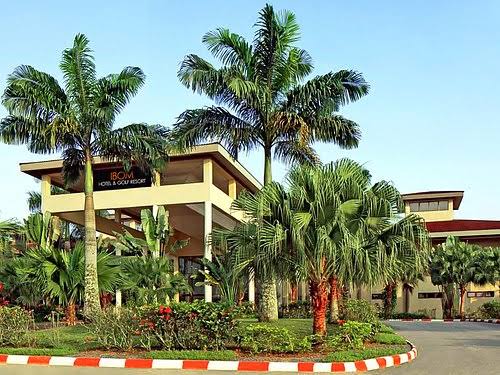
Set upon 174 hectares of verdant earth, the Ibom Hotel and Golf Resort is an architectural masterpiece, a sanctuary of calm and timeless beauty.

Its 163 luxurious rooms, seven chalets, world-class conference centre, and international-standard amenities sit gracefully amidst nature’s grandeur, offering a hospitality experience unmatched anywhere else in Nigeria.

From the moment you turn into the long, winding drive from the main gate, you are seized by wonder, as if journeying into a secret world.

ALSO READ  The Persisting Dearth of FDI in Nigeria and its Implications

It is here, at the end of that awe-filled drive, that Nigeria’s largest and most exquisite resort reveals itself, not with pomp, but with quiet majesty.

Yet the story of Ibom Hotel and Golf Resort is as compelling as the landscape it rests upon.

This magnificent resort was born out of a historic struggle, with three communities contesting ownership of this breathtaking land.

Through the hands of two visionary military administrations and the dreams fulfilled under a civilian government, the Ibom Resort rose, a testament to resilience, unity, and the power of vision. (Details of this fascinating journey will be revealed in my forthcoming book, where you will experience even more about the history behind this magnificent destination.)

The 18-hole golf course stretches like a living tapestry of endurance and beauty, each tee-off daring you to outwit the lush, thick vegetation that rises as your next challenge. Every stroke here is a dance with nature; every round, a story of triumph against the elements.

ALSO READ  Salient historical mistakes some Igbo leaders made By Prof Lawrence ETIM Discussions about Nigerian history, particularly the events leading to the Civil War and the continuing agitation for self-determination, often evoke strong emotions and divergent interpretations. While many people focus on external factors that affected the Igbo people, it is equally important to examine certain decisions and actions by prominent Igbo leaders that some critics regard as STRATEGIC ERRORS or POLITICAL MISTAKES. Whether one agrees with these assessments or not, they remain part of the broader historical debate. 1. Dr. Nnamdi Azikiwe's Rejection of the Right to Secession Before Nigeria attained independence, Chief Obafemi Awolowo reportedly supported constitutional provisions that would allow any region to withdraw from the federation if it so desired. Dr. Nnamdi Azikiwe, however, opposed such provisions, favouring a stronger and more indivisible Nigerian federation. As a consequence, the Nigerian Constitution evolved without a recognised legal pathway for secession, making any attempt at breaking away from the federation constitutionally impermissible. Critics argue that this position reflected a lack of foresight, particularly in light of later political crises. Interestingly, many of those who advocate self-determination today, notably the Igbos, rarely attribute any responsibility to Azikiwe for supporting a constitutional framework that effectively foreclosed the option of lawful secession. Canada has a constitutional provision that guarantees the right of any region to break away through a plebescite. In 1992, a French speaking region Quebec narrowly missed the threshold score in a referendum that would have allowed it to break away. Ethiopia, former Soviet Union, Yugoslavia, St Kitts and Nevis are other examples of countries that provide constitutional rights for any of its region to break away. Critics say Nigeria missed such opportunity because of Zik's opposition during the pre-indepedence constitutional conference and public debate. 2. The January 1966 Coup and Its Perceived Ethnic Imbalance The January 15, 1966 military coup, led principally by Major Chukwuma Kaduna Nzeogwu, remains one of the most controversial events in Nigerian history. During the coup, several prominent Northern political leaders and senior military officers were killed, while leading Igbo military officers and politicians were spared. Ojukwu himself was living in Kano but was spared. Madiebo (who would later serve as the chief of defence staff in Biafra) and many other military officers of Igbo extraction were also spared. This apparent imbalance created widespread perceptions in Northern Nigeria that the coup was ethnically motivated, regardless of the intentions of its planners. The resulting suspicion and resentment contributed significantly to the counter-coup of July 1966. Critics contend that Nzeogwu's actions unintentionally deepened ethnic divisions and destabilised the country. They further argue that many Igbo commentators have been reluctant to subject Nzeogwu's actions to the same level of criticism directed at other historical actors. 3. The taking over of power by Aguiyi-Ironsi was uncalled for. J. T. U Aguiyi-Ironsi had no business taking over power when the president, speaker of Parliament and chief Justice of the Federation where there. These were the people (in that order) stipulated by the Constitution to take over power in the event of the absence of the Prime minister. So, it was mistaken for Ironsi to take over the reigns of power. According to critics, that action also portrayed Ironsi as being sympathetic to the coup plotters. No Igbo person has ever openly criticized Ironsi for that malfeasance. 4. General Ironsi's Failure to Swiftly Prosecute the Coup Plotters Following the January 1966 coup, Major General Johnson Aguiyi-Ironsi assumed power as Nigeria's Head of State. During his six-month administration, the principal coup plotters were not prosecuted or subjected to any judicial proceedings. To many Northern officers and political leaders, this appeared to validate suspicions that the new government was sympathetic to the coup's objectives. Whether justified or not, these perceptions further eroded trust in the federal government and intensified regional tensions. Critics therefore argue that Ironsi missed an important opportunity to reassure the country and restore confidence in national institutions. The Igbos have never blamed ironsi for such inertia. 5. The Introduction of a Unitary System of Government by Ironsi One of the most consequential decisions of the Ironsi administration was the promulgation of Decree No. 1, which sought to replace Nigeria's federal structure with a unitary system of government. By concentrating greater authority at the centre and reducing regional autonomy, the decree generated widespread opposition, particularly in Northern Nigeria. Critics maintain that the policy was politically ill-timed and insufficiently sensitive to Nigeria's ethnic and regional diversity. They also argue that it made any future attempt at regional self-determination more difficult by strengthening the authority of the central government. I'm not aware of any Igbo person clamouring for cessation today who had ever blamed Ironsi for promulgating such a retrogressive law, whose reverberations are still felt upto this moment. 6. Ojukwu and the Decision to Go to War History offers numerous examples of leaders who have faced scrutiny for taking their nations into unsuccessful wars. Critics often cite the example of General Leopoldo Galtieri the military president of Argentina, whose decision to engage the United Kingdom in the 1982 Falklands War led to military defeat and subsequent legal consequences. After the war, Argentina prosecuted Galtieri in a court of law and jailed him for 12 years for losing the war and bringing opprobrium to the country. Similarly, Lieutenant Colonel Chukwuemeka Odumegwu Ojukwu led the Eastern Region into the Nigerian Civil War following his declaration of the Republic of Biafra in 1967. With huge propaganda machinery but little arms and ammunitions, Ojukwu dragged his people and other Easterners into a three-year period of mass suffering and death. The war ended in Biafra's defeat with immense human suffering, humongous loss of life, and severe economic devastation. Critics argue that Ojukwu should have taken responsibility for the consequences of the conflict. They further contend that many Igbo people continue to celebrate his legacy while paying comparatively little attention to his strategic errors that contributed to the catastrophic outcome. Had Ojukwu been prosecuted or even criticized for losing the war, younger generations of IPOB leaders would have been more circumspect with a lesson to learn. President Obasanjo should always be appreciated for not dragging Nigeria into a senseless war with Cameroon over Bakasi Peninsula. History will for ever remember President Jonathan for knowing that his political ambition is not worth the blood of any Nigerian. 7. Nnamdi Kanu and Contemporary Separatist Agitation In contemporary times, Nnamdi Kanu emerged as the leading figure of the Indigenous People of Biafra (IPOB), advocating the creation of an independent Biafran state. His movement has generated both support and controversy. Critics argue that aspects of the agitation, including the enforcement of Monday sit-at-home orders by various actors claiming allegiance to the cause, have inflicted substantial economic losses on businesses and communities in the South-East. They further contend that violence associated with separatist activities has disproportionately affected the very communities the movement seeks to protect. From this perspective, Kanu's leadership deserves critical scrutiny alongside criticism directed at other political actors in Nigerian history. Sadly, no Igbo person has ever openly criticized Kanu. 8. Important Igbo political leaders do not support Peter Obi presidency. Is it a big mistake that many important Igbo political leaders do not support Obi's presidential bid? For instance, the governor of Anambra State Chukwuma Charles Soludo is in the wont of declaring his anti-Obi sentiments openly, declaiming that Obi will never win. The Minister of Works Engr David Umahi does not support Obi either. Obi's public campaigns are essentially plebs-driven. Critics are wondering why Igbos do not criticize their leaders for not supporting Obi. A mature assessment of history requires the willingness to examine both external injustices and internal mistakes. No ethnic group, political movement, or historical figure is beyond criticism. Understanding the successes and failures of past leaders can provide valuable lessons for future generations and contribute to more balanced and constructive discussions about Nigeria's past, present, and future.

But Ibom’s treasures are not limited to the fairways alone.

At the Marina side of the course lies a relic of profound national memory: the ancient boat sent to arrest King Jaja of Opobo, sunk in an act of defiance, killing all aboard, and lost beneath the waters for over a century.

Manufactured in England in 1810, this ghost of history was only recently unearthed, its silent presence lending the resort a sacred weight that few places on earth can claim.

For lovers of nature, the Ibom Hotel and Golf Resort offers yet another marvel.

Surrounded by untouched primary forest stretching as far as the eyes can see, it is a bird-watcher’s Eden, alive with the colours and songs of rare and dazzling species.

Beyond the greens and groves, the vast river at the resort’s edge calls out to the wanderer’s heart.

Its waters stretch like a liquid ribbon, ready to carry you to Calabar in just 45 minutes, or even to Cameroon in under an hour, a timeless reminder that the world itself is never too far from this hidden paradise.

ALSO READ  Amupitan: New Broom At INEC

Ibom Hotel and Golf Resort is more than a destination. It is a living poem, a breath of grace, a triumphant monument to patience, endurance, and silent excellence. And once it holds you in its quiet embrace, you may never wish to leave.

For those whose hearts are stirred by this glimpse into Akwa Ibom’s wonders, there is even more to behold.

In 2026, I will be releasing a definitive publication dedicated to celebrating the beauty of Akwa Ibom State and its vibrant people, a masterpiece that will weave together its rich history, breathtaking landscapes, timeless monuments, festivals, traditional foods, clothing, and culture through thematic storytelling and powerful imagery.

Stay tuned, the story of Akwa Ibom is just beginning to unfold through the lens of love, history, and heritage.
Share

Leave a Reply

Your email address will not be published. Required fields are marked *