Isaac Samuel
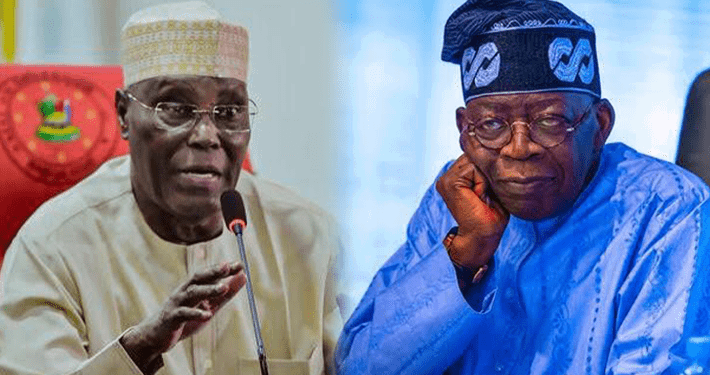
Former Vice President and Presidential Candidate of the African Democratic Congress (ADC), Atiku Abubakar, has described the latest Central Bank of Nigeria (CBN) Household Expectations Survey as a damning indictment of President Bola Tinubu’s economic policies.
Atiku said the findings had stripped the Tinubu administration’s economic propaganda of whatever credibility it had left, arguing that an economy where citizens were increasingly abandoning plans to buy homes, vehicles and basic household assets could not credibly be described as one on the path to prosperity.
He stated this in a statement issued by his Senior Special Assistant on Public Communication, Phrank Shaibu.
The CBN survey indicated that rising living costs were putting increased financial pressure on households and businesses, with buying conditions remaining low across major categories.
According to the survey, buying conditions stood at 28.7 points for motor vehicles, 28.9 points for consumer durables and 30.0 points for buildings and landed property.
Atiku said the figures were even more troubling when measured against Nigerians’ willingness to make such purchases, noting that willingness to purchase vehicles fell to 18.7 points, while that for buildings and landed property stood at 19.2 points.
He said the figures were not opposition propaganda but the outcome of responses from Nigerian households captured by the CBN under the Tinubu administration.
“These are not figures manufactured by the opposition. They are the verdict of Nigerian households captured by the Central Bank under President Tinubu’s own government,” he said.
According to Atiku, the survey showed that Nigerians were increasingly being priced out of a decent standard of living.
“What the figures tell us is simple: Nigerians are being priced out of decent living. A home is becoming a fantasy. A car is becoming a luxury.
“Household appliances are increasingly beyond reach. Families are exhausting their incomes on food, transportation, electricity, school fees and other necessities, leaving practically nothing for savings, investment or asset acquisition,” he said.
The ADC candidate also linked the CBN findings to the recent SBM Jollof Index, which he said highlighted the growing pressure on Nigerian households.
“Only recently, the Jollof Index told us what Tinubu’s economy has done to the Nigerian kitchen. Now the CBN survey is telling us what it has done to the Nigerian dream,” Atiku said.
He noted that the latest SBM Jollof Index put the average cost of ingredients required to prepare a pot of jollof rice for a family of five at ₦29,578.
Atiku said the figure was particularly significant in relation to the ₦70,000 minimum wage, arguing that one pot of jollof rice could consume more than 40 per cent of a worker’s monthly income before accounting for rent, transportation, electricity, school fees and healthcare.
“And this is the same economy in which Nigerians are now postponing the purchase of homes, cars and basic household assets because there is simply no disposable income left.
“Tinubu has not merely made life more expensive; his policies are steadily pricing ordinary Nigerians out of food, comfort, asset ownership and the basic dignity of a decent life,” he said.
Atiku also criticised the administration for celebrating headline macroeconomic indicators while, according to him, household finances continued to deteriorate.
“Government officials can celebrate GDP growth, foreign reserves and other statistics from air-conditioned conference rooms, but ordinary Nigerians have become unwilling economists, calculating every cup of rice, every litre of fuel and every transport fare before deciding what their families can afford.
“Between official statistics and empty cooking pots, the cooking pots do not lie,” he said.
The former Vice President maintained that economic success should be measured by improvements in the lives and purchasing power of citizens rather than favourable government statistics.
“An economy is not successful merely because government officials can quote favourable statistics. An economy succeeds when citizens can work, earn, eat, save, invest and progressively improve their standard of living.
“Before there is GDP, there must be dinner. Before there is prosperity, there must be purchasing power. And before a government congratulates itself on reform, ordinary citizens must be able to see and feel improvement in their own lives,” he stated.
Atiku said Nigerians deserved an economy where work translated into dignity and income created opportunities, rather than one where households were forced to sacrifice their ambitions simply to survive until the next payday.
He consequently urged President Tinubu to stop celebrating what he described as “PowerPoint economics” and focus on policies that would translate into tangible improvements in the living conditions of Nigerians.