Isaac Samuel
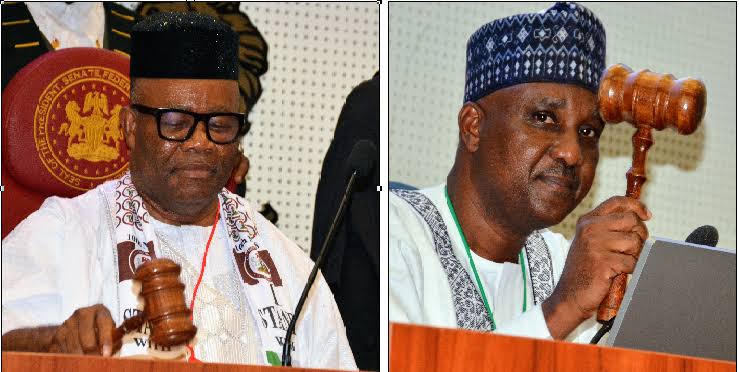
The Federal High Court sitting in Lagos has ruled that Senate President Godswill Akpabio and Speaker of the House of Representatives Tajudeen Abbas presided over a procurement process that breached procurement laws in the controversial N110 billion National Assembly vehicle and allowance expenditure.
The court declared the spending comprising N40 billion for 465 luxury vehicles for lawmakers and N70 billion in support allowances for newly elected members unlawful, holding that it violated due process requirements, procurement regulations, and constitutional principles of accountability.
Delivering judgment in Suit No. FHC/L/CS/1606/2023 on Wednesday, May 6, 2026, Justice Yellim Bogoro ordered Akpabio, and Abbas to ensure strict compliance with procurement laws and principles of transparency, accountability, and value for money in future expenditures.
A certified true copy of the judgment was sighted on Sunday.
The suit was filed by the Socio-Economic Rights and Accountability Project (SERAP) in August 2023, challenging the planned spending amid worsening economic hardship.
In her judgment, Justice Bogoro described the expenditure as unjustifiable, stating that “looking at the magnitude of the expenditure, coupled with the absence of demonstrable due process, leads me to conclude that the procurement is arbitrary, disproportionate and inconsistent with statutory procurement standards.”
She further held that the arrangement amounted to self-interest, noting that “the beneficiaries of the expenditure are the very officials approving it, and the expenditure confers direct pecuniary and material benefits. This to my mind constitutes a case of self-dealing and conflict of interest.”
Taking judicial notice of Nigeria’s economic hardship, the judge said, “I have taken judicial notice of the economic realities in Nigeria and the widespread financial hardship affecting Nigerian citizens. In this context, the allocation of N110 billion for the benefit of lawmakers demonstrates a failure to prioritise national interest.”
Rejecting the argument that the court lacked jurisdiction due to legislative autonomy, she stated: “The doctrine of separation of powers does not operate as a shield for illegality. It is noteworthy that the Court is concerned with the legality and constitutionality of legislative spending.”
She added that public office is a trust, stressing: “Public office must not be used for personal enrichment. Public officers must act within constitutional boundaries and in good faith. I hold that the conduct complained of is inconsistent with the oath of office.”
On procedural objections, the court held that SERAP had the right to sue, stating: “SERAP has the requisite locus standi to institute this action… NGOs can institute actions to protect public interest.”
Justice Bogoro also dismissed claims that failure to serve pre-action notice invalidated the case, holding that exceptions exist in matters of urgency and public interest.
The court further ruled that the case was not academic despite the expenditure having already been carried out, maintaining that constitutional questions remained alive for determination.
SERAP, through its deputy director Kolawole Oluwadare, described the ruling as a landmark victory, saying it was “a major victory for transparency, accountability and responsible management of public resources in Nigeria.”
Human rights lawyer, Femi Falana (SAN), also welcomed the judgment, stating that lawmakers’ lifestyle choices in a period of national hardship could not be justified.
He said SERAP “deserves commendation,” adding that public office holders must ensure that national resources are not used for personal comfort at the expense of citizens.
The court ultimately held that the procurement of vehicles and payment of allowances violated the Public Procurement Act, the Code of Conduct rules, and constitutional provisions, ordering strict adherence to due process in future National Assembly spending.