by
Reuben Abati
“What a country?
“Which country?
“What other country do you think I could possibly be talking about? Nigeria of course”
“Baba Gbeborun. Community Radio! O ya, shoot. I am all ears”
“What my eyes have seen, what my ears have heard, my mouth cannot tell.”
“Leave that one. Tell me. There is no matter so weighty that it cannot be dissected with the knife of the human mouth.”
“I saw a report from Kano. It was a video. A political rally event”
“So? This is the season of political campaigns.”
“I saw women in Kano, carrying banners, dancing, and displaying panties, red panties that they had been given at an event.”
“Red panties? How? As in female underwear? What has that got to do with politics? They are no longer sharing bags of rice? It is now female underwear? What are the women supposed to do with that?”
“Wear the panties of course. And you know the picture of the state Governor was boldly printed on the garments. I do not know how a woman will go home to her husband, wearing an underwear that has another man’s face boldly printed on it.”
“This must be some kind of comedy. Too intimate. A joke carried too far. An invasion of privacy. But I thought they had the Hisbah in Kano. Asking a woman to wear such a branded underwear could result in issues in many relationships. I wonder who will take that. And why a red underwear. Sounds like someone is trying to mock the Kwankwasiyya movement in Kano politics. From red caps to red panties! Politicians and their many games.”
“Nigerian politicians. I understand the underwear was distributed by supporters of the state Governor across the entire state. The Governor is now in the APC. The idea is that even when the women go to bed, they will think about the APC.”
“You must be kidding me. But this is the thing about the political campaign season. Plenty of entertainment. Africans have a way of making a joke out of everything. I won’t be surprised if tomorrow, another politician comes up with the idea of distributing sanitary pads, brassieres, wigs, make up kits. Women may not be well represented in Nigerian elective positions but they are the ones who turn out in large numbers to vote on election day. This must be a year of fun. Elections. Campaigns and then in June and July, the World Cup. I am going to order a popcorn machine.”
“Hey, hey guys. Both of you are getting it wrong. I was busy on my phone. Stop dragging the Governor into it. What I hear is that the state governor, Governor Abba Yusuf has since condemned the display of women undergarments as disgraceful and contrary to the state’s values. He had nothing to do with it. The undergarments were distributed to mock Dr. Musa Kwankwaso. They called it Tsula pants. A stunt by overzealous youths trying to heat up Kano politics.”
“Oh, what a relief!”
“This is why I always double check whatever I see or hear this political season. You know, it was actually a female APC member that distributed the panties. She has since apologized for her provocative political conduct.”
“Good to hear that.”
“The Kano Governor is a decent man”
“I don’t take sides. I have no opinion on that. The thing is whatever people choose to do in the name of politics should be seen to be decent, conscience-led and reasonable. When the political season is over, we should still have a country.”
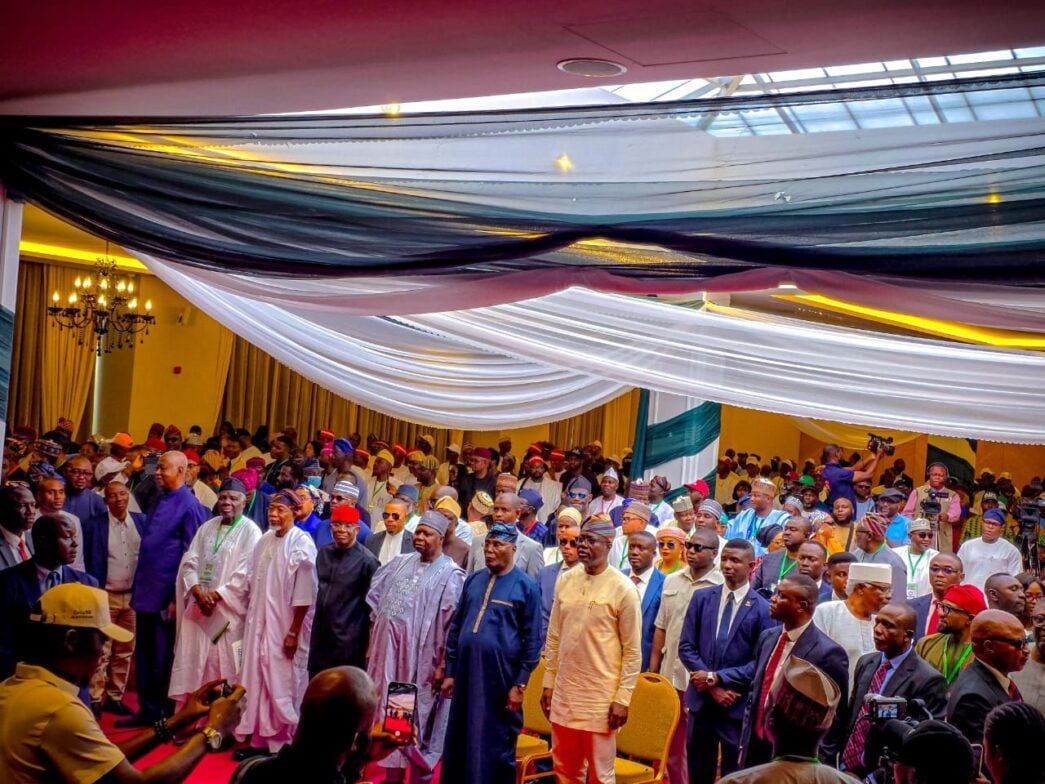
“I agree. Nigeria First. This country is bigger than all of us. Which is why I was surprised when the Ibadan Summit of opposition leaders ended up with Governor Seyi Makinde threatening the APC that they should remember that “Operation We tie’ started in Ibadan, which became the Wild Wild West in 1964/1965, often cited as one of the incidents that led to the collapse of the First Republic.”
“No. That was not a threat. It was a word of caution. A metaphor. A reminder.”
“I have a problem with it. Look at how that single statement has heated up the entire polity. Have you read the statement by Felix Morka, the APC spokesperson? He practically called Makinde an architect of violence, an unworthy Governor, an anarchist inciting rage and lawlessness. Sunday dare dismissed the entire opposition summit in Ibadan as an opportunistic alliance, a collection of recycled politicians, standing on sinking ground, destined to fail. Festus Keyamo has dismissed those who gathered at that event as a bunch of confused people.”
“And what was Mr. Bayo’s comment? And Daniel Bwala?”
“What do you expect them to say? They have all said what they have to say as vigorously as possible. But I insist that I do not think Makinde’s comment should be interpreted the way they have. I have even heard one or two snide comments that Makinde may be a Governor today, but he was not yet born at the time of the “Operation We tie” – the blow out in Western Nigeria – that he is talking about. A legacy of violence, arson and chaos. ”
“But that is a fact. Makinde did not witness that history.”
“It is an irrelevant fact. Historians do not necessarily have to live in the moment. Those who fail to learn from the lessons of history are bound to repeat it, first as a tragedy and then as a farce. Karl Marx. George Santayana. Winston Churchill. Mark Twain.”
“Get to your point. I don’t have the time for a lecture. Must you turn everything into a lecture?”
“History is important. Makinde’s statement is a warning with its roots in history. In the Federal elections of 1965, the Federal Government, then in Lagos thought it could overwhelm the opposition in the regions and impose the Federal will. This was resisted in the South West. Ibadan at that time was the centre of opposition politics. Chief Samuel Akintola vs. Chief Obafemi Awolowo. Federal vs. Action Group. What followed was a blow out after the sham Federal elections. What Makinde is simply saying is that the APC must learn from the lessons of history. I think all politicians must listen. There were other episodes too in more recent history.”
“Now you are giving a lecture.”
“Let me just say this. In 1983, the ruling National Party of Nigeria (NPN) tried to capture Ondo state by all means. Remember the Omoboriowo and Ajasin saga. The state descended into chaos. We witnessed the failure of Federal Might. The people revolted. They burnt down houses and human beings. Ondo State became what Mr. Dare Babarinsa calls “A House of War” in a book of the same title. He was a correspondent for the National Concord at the time. His book on the crisis is a truthful, eyewitness account. President Tinubu may want the APC to win in all the South West states in the 2027 elections, but it is not always easy to manipulate the South West. Yoruba people can be treacherous. There is danger in one-party domination, and the suppression of the opposition.”
“Hey, Oga, speak for yourself.”
“If I can chip in something…”
“Yes, why not?”
“The way I see this thing. Let us be honest with ourselves. I think the problem is the way the opposition leaders went about it. I do not support the idea of a one-party state. I believe that the opposition must be allowed to flourish. I also think that the 2027 general elections must be free, fair and credible, and a level playing field must be provided for every stakeholder. But I think the opposition parties went overboard. They were trying to intimidate the Tinubu administration. They were sounding like they were preparing for war. No responsible government will sit idly by and allow anybody to entertain such grand delusions.”
“How? How is it delusionary for the opposition to say that they want to displace the government of the day by beating the ruling party at the polls, by uniting behind one candidate. We have seen opposition party politics at work in Senegal, Ghana, Kenya, The Gambia, Zambia Botswana, Malawi, DR Congo. Why should Nigeria be different?”
“They are calling on the National Assembly to amend the Electoral Act 2026. They want the INEC Chairman, Professor Joash Amupitan removed. They want all political detainees to be released. Who are those? They want party primaries to be extended till the end of July. They should just say they are not ready. They don’t see anything good in what Tinubu has done. It was all about economic hardship, economic injustice, insecurity, collapse of democracy and governance. You say they are uniting. You are quoting other countries in Africa. I don’t see any unity among the opposition leaders. Peter Obi and Kwankwaso have set up their own movement. Obidients are saying it is either Obi or nobody. Atiku’s supporters who call themselves Atikulates are of the view that Atiku has a birthright to the Presidency of Nigeria. I have not heard Rotimi Amaechi conceding that he would step down for anybody. The way I see the Oyo State Governor, he has his own agenda too. The opposition parties or individuals would have to put their own house in order. Let them start from there.”
“These are experienced politicians. You are not the one to teach them what to do. The APC did not see them coming. They used a shock and awe strategy. It is fair in politics.”
“Nobody is talking about the people. The opposition must be seen to be credible.”
“Which people? The people are queuing up to collect undergarments, bags of rice, cash. In Owerri, they made away with campaign items, and fought over television sets and other items. Our people have become cynical, and stomach-driven. Please, give them rice!”
“For me, the big gain of all this is that the APC has been forced to wake up. The opposition leaders have shown them that with all their 31 Governors and two thirds majority in the National Assembly, 2027 elections will not be a walk in the park. There will be fierce competition.”
“The opposition leaders too don’t have it all. What we need is a credible opposition, not mere slogans. Out of 21 political parties, only 14 parties had their representatives in attendance. Omoyele Sowore of the African Action Congress (AAC) says the Ibadan Summit was a collection of failed politicians. APGA stayed away. Some groups within the opposition parties have also dismissed the summit. Wike’s faction of the PDP and factions in the ADC to be specific. They say it is a “coalition of confusion.” The Labour Party also did not attend.”
“My point is that the APC has been forced to wake up. All that talk about the APC having 31 Governors… Now, they are planning a nationwide media tour to monitor and showcase the achievements of the Tinubu administration. I hear they will pay estacodes.”
“I hope they will be fair about that, and not invite only APC journalists.”
“We have APC journalists?”
“Journalists are human beings. They are all involved in politics.”
“The National Broadcasting Commission (NBC) has warned journalists in print and broadcast media to stay away from politics, reckless and partisan commentaries and stick only to professional standards.”
“Let them go and say that to the people on social media. Those are the ones who pose a threat at a time like this.”
“Social media commentators are not journalists.”
“But they control political narratives.”
“Sorry, I don’t like journalists. Look at those White House journalists at the Correspondents Dinner in Washington DC. They were hearing gunshots, as one Cole Tomas Allen was being apprehended by law enforcement, a so-called “friendly federal assassin”, federal officials were being taken to safety by security, but some journalists sat down there eating, some were recording and reporting, and some were seen rescuing bottles of wine.”
“They were doing their job. In the midst of chaos, the journalist must get the story, tell the story, file the story, stay on top of the story.”
“For how much? I hear most of these media houses don’t even pay their staff or they pay starvation wages.”
“Not in America though. And in Africa, it is the thrill of the hunt that motivates journalists, the courage that is required…”
“With volatile fuel prices, astronomical rent, schools increasing their fees, airlines threatening to shut down operations. I don’t know who is worse between politicians and journalists.”
“Guys, I have to get going…”
“Let me guess. Madam has summoned you.”
“Yes. I am not like some people who are afraid to marry.”
“I will marry when I want.”
“That is what you all say. Let me guess. Your wife-to-be is in the United States, and you are in touch with her via social media. You talk every day. When you get home, switch on your television set. You will see King Charles III, with Queen Camilla beside him, on a state visit to the United States. Dignity. Royalty. To be a King, you must have a Queen. Even in the game of chess.”
“I hear the King and the Queen will not see Prince Harry, Meghan and their children.”
“No. Harry and Meghan are non-working royals. They and their children will watch the King on television just like the rest of us.”
“I am just waiting to hear what Trump will say about how an excellent host he is, and how America is the best country ever visited by King Charles.”