By ETIM ETIM
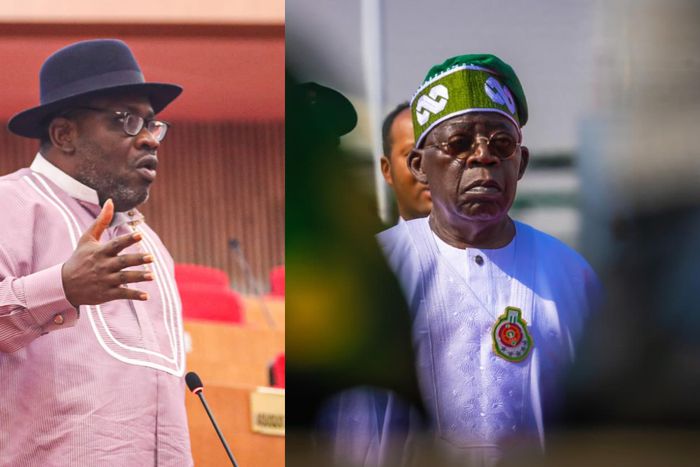
Senator Henry Seriake Dickson has formed a political party known as Nigeria Democratic Party (NDC) and he has resigned from PDP and taken up the role of National Leader of NDC. The party was registered in February by INEC and its first National Executive Council (NEC) meeting was held last week, a month after its registration. New protem leaders of the party were appointed by the NEC, and they are Senator Moses Cleopas, National Chairman and Barr. Ikenna Alex-Morgan Enekweizu, National Secretary. Disckson has spoken of how he will make NDC different in both ideology and governance. From all indications, he would want to build and nurture NDC into a formidable national platform just as President Bola Tinubu created Alliance for Democracy (AD), with other like-minded leaders, in 1998 and built it into a party that won the 2015 presidential elections.
But can Dickson achieve the same feat? The prospects are daunting. A few things that worked for Tinubu in those early days which conduced to the thriving of his political party are absent now. AD was a regional party with a base in the South West of Nigeria. In a press interview soon after he handed over power, Gen. Abdulsalami revealed that AD did not meet some of the basic requirements for registration as a political party, but the military government broke the rules and approved its registration as one of the three registered parties just to appease the Yoruba for their loss during the IBB-Abacha era. And trust the Yoruba for their ‘’ntiwatiwa’’ (this is our own) mentality, AD ended up winning governorship elections in all of the six SW states in 1999, producing the following governors: Lagos (Bola Tinubu); Ogun (Segun Osoba); Ondo (Ade Adefarati); Osun (Bisi Akande) and Ekiti (Niyi Adebayo). So in less than one year of its creation, AD had six governors and many other elected officials. It was a big financial and moral boost for the party.
Seriake Dickson does not have that type of fortune and the circumstances of NDC’s birth are different. Although NDC was registered just about a year to the general elections just as AD was, it is doubtful that it would win the governorship election in his native Bayelsa, talk less of the six regional states. The governor of Bayelsa, Douye Diri, is Dickson’s protégé who defected from PDP to APC last year, to the utter disappointment of Dickson. The governorship election in Bayelsa next year will thus be a fight between Dickson and Diri. If Dickson is defeated, it would be a great psychological blow to him and NDC might just suffer a stillbirth. APGA was founded by the late Emeka Odumegwu Ojukwu in 2002 and the following year, Peter Obi emerged its first elected governor. Since then the party has won all governorship elections in Anambra, the home state of its founder. That’s why the party is still alive, sometimes winning legislative elections in other South East states. Dickson will have to fund his party and its activities by himself until such a time the party will win a governorship race; and in Nigeria, it is the governors that fund and sustain political parties. Bayelsa’s election will be interesting to watch.
The political environment today is also different from the era when AD thrived. Between 2006 and 2013, AD underwent significant inorganic growth, merging with other parties and groups to eventually become APC. It was a herculean and difficult process midwifed and carefully supervised by its National Leader, Tinubu. But in those seven years, the PDP federal government did not in any way deliberately place obstacles to thwart or frustrate the evolution of AD from a regional to a major platform. That golden era is now a distant memory. Today, opposition parties are under serious threat. PDP has been completely weakened and destabilized and ADC is facing imminent destruction. The announcement by INEC on Wednesday that it has withdrawn its recognition of the David Mark-led NWC of ADC is quite troubling. President Tinubu will end up being the first Nigerian leader to go for a reelection without an opponent on a major political party. Many people have described this as an Abacha-like game plan. If Dickson founded NDC because PDP was deliberately sabotaged, what’s the guarantee that NDC would fare better? See what happened to Kwakwanso’s NNPP in Kano?
Tinubu’s enormous wealth gave him the needed political clout and social leverage to build wide networks and contacts across the length and breadth of the country and it helped him to attract membership and support for his party. For eight years after he left office as Lagos governor, he travelled the country bringing new members into APC and facilitating others to contest elections. In late November 2014, Tinubu visited Uyo to welcome new members who had just defected from PDP into APC. The new members were led by Obong Umana Okon Umana, former Minister of Niger Delta Affairs, who became the first APC governorship candidate in Akwa Ibom State. I was at the Uyo airport with Umana to welcome the APC National Leader and his entourage, and that was my first close contact with him. Tinubu was visibly excited to welcome the new members into APC at the rally later in the day. I don’t know how wealthy Senator Dickson is and the extent to which his treasures could be linked to Bayelsa State government. But like Tinubu, Dickson served as governor for two terms, but unlike Tinubu who established media outlets after office, Dickson founded a university, Hensard University, in his village in 2023. Tinubu’s TVC and The Nation newspaper have helped to boost the profile of political party. How will the university help NDC?
The mood of the nation will also influence how far NDC goes. Twenty seven years ago when AD was formed, the nation was ecstatic about the prospect of unfolding democracy and the promise of a new beginning. The struggle to get the military out was long and bloody and there were formidable and reputable Nigerians like Alex Ekwueme, Bola Ige; Olu Falae; Victor Attah; Adamu Ciroma; Balarabe Musa; Abubakar Rimi and many others waiting to take over from the military. I lived in Ibadan in 1997 and 1998 and I witnessed the fervency of the Yoruba people as they looked forward to the new dispensation after such a traumatic period. AD was well positioned as a Yoruba party and branded as a platform with a strong social welfare orientation. About three decades later, Nigerians are sorely disappointed in the conduct of politicians and tired of the misbehavior of party leaders. There were three parties in 1999 and over 20 now, and they’re all look the same. What makes NDC different from the rest of the pack? What’s ideological orientation and what message is it going to give to Nigerians? I wish Senator Dickson all the best.
ETIM ETIM is a veteran journalist and PR professional with over 35 years of cognate experience.
He is the publisher and editor-in-chief of Policy & Politics (www.policyandpolitics.com.ng), an online newspaper dedicated to insightful analysis of Nigerian news and world’s report. He is also a columnist with BusinessDay and The Cable and is a regular contributor to other newspapers.
Contact: +234802 3159969 (WhatsApp Only)