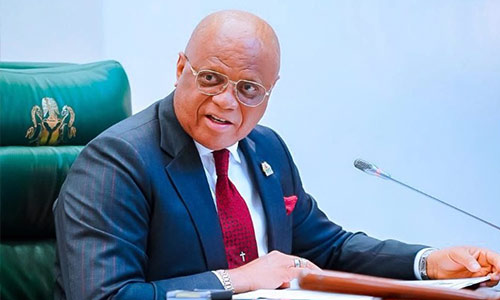
Prof Lawrence ETIM
SUMMARY
After South Africa, where will the next “Igbo King” protest take place? There is no need answering this question because the answer will be conjectural. Nevertheless, we could say with utmost certainty that the next protest against an “Igbo King” coronation will be catastrophic, disastrous and several orders of magnitude worse than the Ghanaian and South African cases combined. Why? The host country will have “prepared for you Nigerians”. There is a felt need to prevent avoidable violence against innocent Nigerians in foreign lands. I have suggested different preventive approaches in this essay.
Introduction
The Igbo King conundrum raises a troubling question: SHOULD THE ACTIONS OF A FEW INDIVIDUALS BE ALLOWED TO ENDANGER THE SAFETY AND REPUTATION OF ALL Nigerians ABROAD? There is an urgent need for reflection, restraint, and responsible leadership – particularly within the Igbo community – so as to prevent avoidable violence against Nigerians in foreign lands.
At home, the Igbo people TRADITIONALLY operate an acephalous socio-political system – a structure without centralized kingship and so, no kingdoms. Authority is diffused across councils of elders, age grades, and community institutions, rather than concentrated in a single king, monarch or potentate, as is more common among ethnic groups like the Yoruba, Efik, or Fulani, etc. This system emphasizes collective decision-making, social balance, and republican values.
WHY THEN SHOULD SOME IGBOS ABROAD ADOPT THE PRACTICE OF SELF-CORONATION AS “KING,” ESPECIALLY IN WAYS THAT PROVOKE THEIR HOST COMMUNITIES? This contradiction lies at the heart of the conundrum.
A recent example in Ghana illustrates the danger. A wealthy Igbo individual acquired extensive land, declared it an “Igbo Kingdom in Ghana”; and after building sprawling houses on the property, he then projected royal authority publicly with supercilious airs. This act, widely perceived as insensitive and provocative, triggered protests among Ghanaian citizens. In the ensuing unrest, properties belonging to Nigerians (not only Igbos) were attacked and destroyed. It took the timely intervention of the Ghanaian President to prevent a more catastrophic outcome, including possible loss of lives.
It is important to recognize that ostentatious displays of wealth – especially by the newly affluent – can generate resentment in host societies. This is not unique to any one culture; it is a well-documented social reaction. It’s human nature. Where such displays are coupled with perceived cultural or political overreach, tensions can escalate rapidly.
Regrettably, a few days ago, a similar pattern re-emerged in South Africa, where longstanding social fragilities – including a history of violent protests and internal conflicts – create a volatile environment. In such a context, even a small provocation can spiral into widespread violence. The, therefore, result was an indiscriminate attacks few days ago, with innocent Nigerians – regardless of ethnicity – bearing the consequences. Businesses were looted or burned, and lives were disrupted or endangered.
After South Africa, where next⁉️There is no point answering that question because the answer will be conjectural. Nevertheless, we could say with utmost certainty that the next country’s protest against an “Igbo King” will me many orders of magnitude worse than the Ghanaian and South African cases combined. Why⁉️ The host country will have prepared for “you”.
The tragedy here is twofold. First, the actions of a few individuals triggered reprisals that affected an entire Nigerian community. Second, those who carried out such reprisals rarely distinguish between one Nigerian ethnic group and another. Thus, all Nigerians became unintended victims of the same backlash.
This raises a profound question: why does this pattern persist despite past experiences? IT IS DIFFICULT TO ARGUE THAT LESSONS HAVE NOT BEEN AVAILABLE. Rather, the issue may lie in weak social regulation, generational disconnect, and the erosion of traditional authority structures.
Historically, Igbo elders, like other traditional elders in Nigeria, played a moderating role in guiding communal behavior. Today, however, many of these elders are constrained – sometimes by social pressures, sometimes by political developments that have diminished their influence. In some cases, they have been effectively silenced or sidelined by armed lads bellowing “sit-at-home” orders. Meanwhile, political leaders have not always acted decisively to address emerging cultural and behavioral excesses among diaspora populations. Over time, this has allowed a degree of impunity and recalcitrance to take root.
Yet, this is not merely an Igbo issue; it is a Nigerian issue. The international image and safety of Nigerians are collective concerns. No individual or group, regardless of wealth or status, should act in ways that jeopardize the well-being of others and the entire nation.
A Way Forward
The Igbos, especially those in foreign lands, “MUST USE THEIR TONGUES TO COUNT THEIR TEETH” – an Igbo proverb.
1. Diaspora Sensitization
Nigerians living abroad – particularly those in influential positions and notably the nouveau riches – must be encouraged to act with cultural sensitivity, humility, and over and above this, respect for host communities.
2. Community Accountability
Igbo leaders, both traditional and modern, should reassert moral authority by discouraging practices that contradict core Igbo values of communalism and modesty.
3. Legal and Policy Measures
State governments in the South-East could consider policies that discourage or sanction the assumption of unauthorized traditional titles abroad. The only titles allowed should be Chairmen, etc of recognised associations; which should never be translated into indigenous Nigerian language. Governors should legally be authorised to seize landed properties of any one whose coronation as an Igbo king had precipitated any protest in a foreign country.
4. Civic Education
There is a need for ceaseless sensitization and continuous education on the responsibilities of citizenship – at home and abroad. Cultural PRIDE must NOT translate into cultural INSENSITIVITY.
5. National Diplomacy and Protection
The Nigerian government must strengthen diplomatic engagement with host countries to protect its citizens, while also addressing behaviors that may provoke hostility.
Conclusion
The Igbo King conundrum is, at its core, a conflict between identity, ambition, and responsibility. No one is bigger than society. Cultural expression must be balanced with respect for others, especially in foreign lands where sensitivities are heightened. The Igbos must be able to shun conspicuous consumption, avaricious and rapacious ways of life notably outside Nigeria.
If Nigerians – particularly the Igbos, known for their resilience and enterprise – can align their global success with RESTRAINT and WISDOM, they will not only safeguard themselves but also elevate the dignity of the nation as a whole.

Prof. Lawrence Etim is the Emeritus Professor of Fishery Biology and Former Dean, Postgraduates School, University of Uyo.