Isaac Samuel
In Nigerian politics, the temptation to draw parallels between rising political figures and established power brokers is almost irresistible.
It is even more compelling when the comparison involves President Bola Ahmed Tinubu, whose political trajectory from a pro-democracy activist to governor of Lagos State, national kingmaker, and ultimately President of the Federal Republic has become one of the most studied pathways to power in the Fourth Republic.
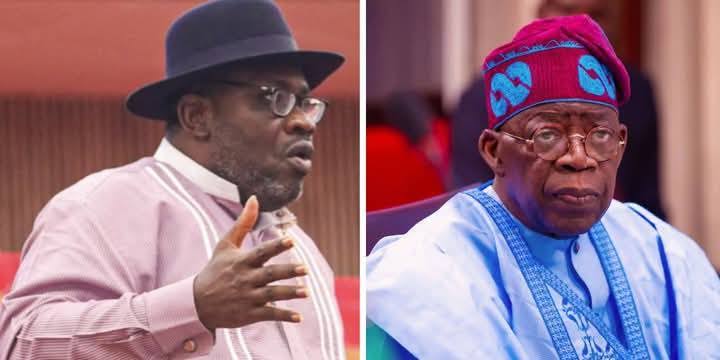
It is against this backdrop that the emergence of former Bayelsa State governor and serving senator, Seriake Dickson, as the founder and sole financier of the National Democratic Coalition (NDC), invites a provocative question: can Dickson replicate Tinubu’s model and rise to similar national prominence?
At first glance, the parallels appear attractive. Like Tinubu, Dickson is attempting to build a political platform outside the dominant party structures.
He is investing personal resources into party formation and positioning himself as the central figure in its ideological and organisational direction.
There is also a shared narrative of political independence of stepping outside entrenched systems to create an alternative.
However, a closer look reveals that while the comparison is intellectually stimulating, the realities on ground present a far more complex and uncertain picture.
Tinubu’s rise was neither accidental nor spontaneous. It was the product of a carefully constructed political architecture, built over decades, anchored on strategic geography, sustained financing, and an expansive network of loyalists.
His tenure as governor of Lagos State between 1999 and 2007 provided the foundation upon which his national influence was constructed.
In 1999, the AD, largely a South-Western party, won Lagos decisively. Tinubu himself became governor, giving him a foothold in Nigeria’s most economically vibrant and politically strategic state.
The party, however, lost in other South-West states and nationally, where the PDP dominated. Lagos became Tinubu’s stronghold, a base he would leverage in subsequent elections
The AD lost most of its South-West strongholds in the 2003 elections but Tinubu retained Lagos.
Rather than succumb to political isolation, he consolidated power within the state, transforming Lagos into both an economic hub and a political fortress.
Through deliberate succession planning, he ensured that governance in the state remained within his political orbit, producing a succession of governors, from Babatunde Fashola, Akinwunmi Ambode who sustained his influence.
This continuity enabled the development of a robust political machinery, supported by a steady flow of resources and a loyal cadre of political actors.
Over time, Tinubu expanded beyond the South-West, forging alliances across the North and other regions. This culminated in the formation of the All Progressives Congress (APC) in 2013, a coalition that successfully challenged the then ruling Peoples Democratic Party (PDP) and reshaped Nigeria’s political landscape.
By the time Tinubu contested for the presidency in 2023, he was not merely a candidate; he was the product of a long-standing political ecosystem that he had painstakingly built.
But Dickson’s situation is markedly different.
While he brings to the table significant political experience, including two terms as governor of Bayelsa State and his current role in the Senate, the structural advantages that underpinned Tinubu’s rise are not readily available to him.
One of the most critical differences lies in geography and economic leverage. Lagos is Nigeria’s commercial capital, with a population and economic base that far exceeds that of most states in the federation.
Its internally generated revenue provides financial autonomy and political significance, making it a strategic asset for any ambitious politician.
Bayelsa, on the other hand, while rich in oil resources, does not wield the same level of economic or demographic influence. Its dependence on federal allocations limits its capacity to serve as a springboard for national political dominance.
This disparity raises a fundamental question: can a political movement rooted in a relatively smaller and less influential state scale to national relevance in the way Tinubu’s Lagos-based structure did?
Closely tied to this is the issue of financial sustainability. Dickson’s role as the major funder of the NDC may demonstrate commitment, but it also shows a potential vulnerability.
Political parties in Nigeria require enormous financial resources, not just for elections, but for maintaining structures, mobilising supporters, and sustaining visibility across the country.
Tinubu’s model evolved beyond personal funding into a system where resources were generated through a network of loyal officeholders, private sector allies, and institutional support.
This created a self-sustaining political economy that ensured continuity and resilience.
For Dickson, the challenge will be to move beyond personal financing and build a funding architecture that can support long-term growth. Without this, the NDC risks remaining a personal project rather than a viable national platform.
Equally significant is the question of national spread and political networking. Tinubu’s influence was not confined to Lagos or the South-West. Over the years, he cultivated relationships with political actors across different regions, positioning himself as a unifying figure within opposition politics.
His ability to bridge regional divides was instrumental in the formation of the APC and its eventual electoral success.
Dickson, by contrast, is still largely perceived as a regional figure, with his influence concentrated in the South-South. For the NDC to gain national traction, he must build alliances that transcend regional and ethnic boundaries. This will require not only political negotiation but also the ability to attract credible figures from across the country into his fold.
The challenge here is twofold. First, the existing political space is already crowded, with established parties and emerging movements competing for attention and loyalty.
Second, the willingness of established politicians to align with a relatively new and untested platform remains uncertain. In a system where political survival often depends on access to power and resources, many actors may be reluctant to take the risk.
Perhaps the most immediate test of Dickson’s political project lies in Bayelsa itself. Tinubu’s enduring strength was his control of Lagos, a base that provided both legitimacy and leverage.
For Dickson, the equivalent would be the ability of the NDC to assert dominance in Bayelsa politics.
Can the party win the governorship? Can it displace or significantly challenge the entrenched structures of the APC in the state?
The answers to these questions will determine the credibility of the NDC as a political force. Without a strong home base, the prospects of national expansion become significantly diminished.
Beyond these structural considerations, the bigger political environment has also evolved. The period between 1999 and 2015, during which Tinubu built his influence, was characterised by a relatively stable two-party dynamic and clearer regional alignments.
Today’s political landscape is more fragmented, with shifting loyalties, increased voter awareness, and the rise of alternative movements that challenge traditional party structures.
The 2023 elections, for instance, demonstrated that voter behaviour is becoming less predictable, with issues such as economic performance, governance, and credibility playing a more prominent role.
This evolving dynamic presents both opportunities and challenges for new political platforms like the NDC.
On one hand, there is space for alternative voices and movements that can tap into public dissatisfaction with existing parties. On the other hand, translating this sentiment into electoral success requires more than rhetoric; it demands organisation, strategy, and sustained engagement.
It is also important to consider the element of time. Tinubu’s rise to the presidency was the culmination of over two decades of political investment. It involved periods of uncertainty, strategic retreats, and calculated advances. Any attempt to replicate this model must be approached with a similar long-term perspective.
For Dickson, this means that the success of the NDC cannot be measured solely by immediate electoral outcomes. Rather, it should be evaluated in terms of its ability to build structures, attract talent, and establish a distinct identity within Nigeria’s political landscape.
Ultimately, the question of whether Seriake Dickson can be “another Tinubu” may be the wrong framing.
While there are lessons to be drawn from Tinubu’s experience, replicating it in its entirety may neither be feasible nor desirable.
What is clear, however, is that Dickson’s initiative represents an attempt to redefine political engagement outside the dominant party system. Whether this effort will succeed depends on his ability to navigate the complex interplay of money, structure, and influence that defines Nigerian politics.
Indeed, ambition alone is not sufficient to build a political empire. It must be matched by strategy, resilience, and an acute understanding of the environment in which one operates. Tinubu’s story illustrates the power of long-term planning and structural investment. Dickson’s journey, still in its early stages, will test whether similar principles can yield comparable outcomes under different conditions.
For now, the NDC remains a work in progress.
Whether it evolves into a formidable force or fades into the background will depend on decisions made in the months and years ahead and how well the party will perform in the 2027 elections.