Isaac Samuel
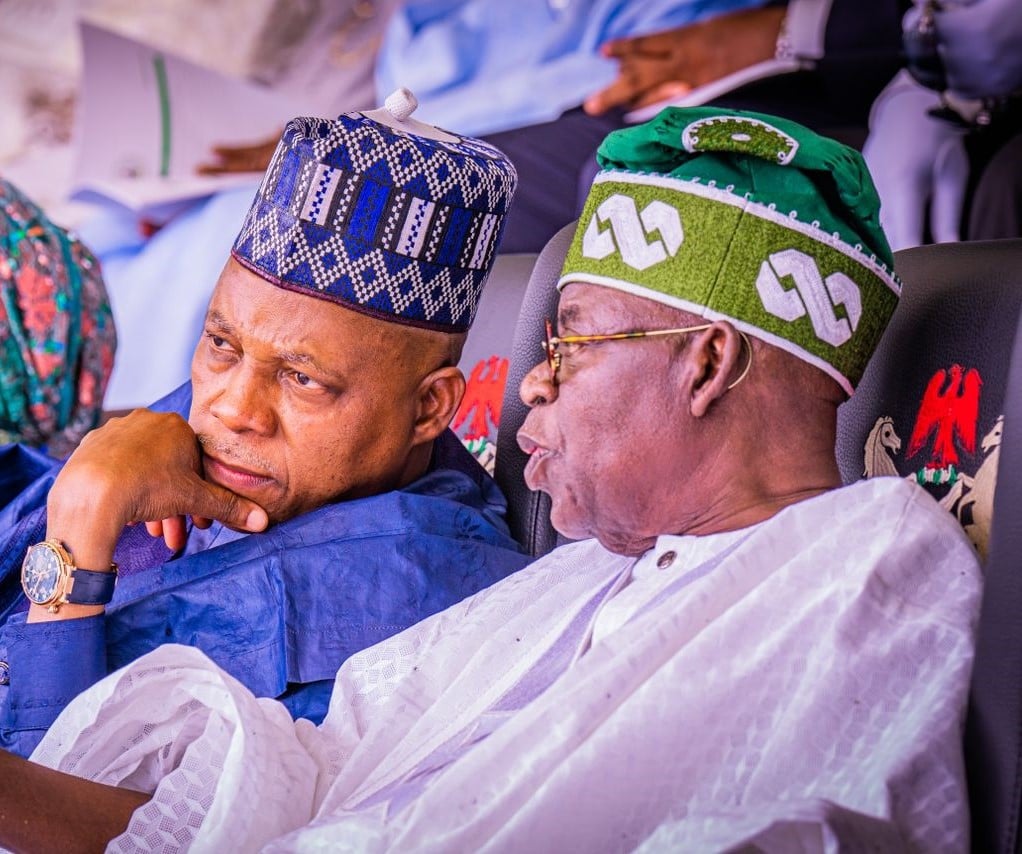
With barely a year to the 2027 general election, fresh political tremors are running through the ruling All Progressives Congress (APC) and the wider northern political establishment following reports of an alleged plan to drop Vice President Kashim Shettima from President Bola Ahmed Tinubu’s re-election ticket and replace him with a northern Christian.
Although the Presidency and the APC hierarchy have not made any formal pronouncement, the claims, already circulating within political and diplomatic circles, have ignited debates around zoning, religious balance, regional inclusion and the limits of external influence in Nigeria’s democratic process.
Indeed, at the heart of the controversy is the suggestion that President Tinubu may be under pressure to abandon the Muslim–Muslim ticket that brought him to power in 2023 and instead opt for a Muslim–Christian pairing in 2027.
Politicians who are pushing this recalibration argue that it would help ease religious anxieties, repair Nigeria’s international image and broaden electoral appeal.
Those opposing it, especially from the Northeast zone see it as a dangerous concession that could unsettle the fragile internal balance within the APC and the North, while undermining the principle of political loyalty.
This is not the first time such political experiment is laid bare in public. In June last year, the APC stakeholders’ summit in Gombe descended into chaos after some speakers endorsed Tinubu for a second term without mentioning Kashim Shettima.
The incident occurred during speeches by top party officials, beginning with Mustapha Salihu, APC national vice-chairman (north-east), who endorsed Tinubu as the party’s unopposed candidate for the 2027 presidential election.
However, his failure to acknowledge Shettima sparked an immediate backlash from attendees.
Delegates, visibly angered by the omission, began shouting and disrupting the meeting, with some issuing threats of violence. After that incident, it was learnt that those pushing for Shettima’s replacement went underground to recalibrate their move.
Recall that when Tinubu unveiled Shettima, a former governor of Borno State, as his running mate ahead of the 2023 election, the decision was widely criticised by Christian groups and civil society organisations for breaching Nigeria’s unwritten convention of religious balancing at the top of the ticket.
The APC leadership defended the move as a choice driven by competence, experience and electoral arithmetic rather than religion.
Despite the controversy, the Tinubu–Shettima ticket secured victory at the polls, with strong support from much of the North and the South-West.
Since assuming office, Shettima has remained a visible figure in government, representing the President at international engagements and chairing key policy initiatives.
Yet, insiders say conversations about the 2027 ticket began unusually early, fuelled by concerns about governance performance, electoral strategy and Nigeria’s standing with international partners.
Within this context, the idea of recalibrating the ticket along religious lines has gained currency, at least at the level of speculation.
Names reportedly being mentioned in connection with a possible northern Christian vice-presidential slot include prominent figures from the North-East and North-West, spanning politics, religion and security. Among them are a former Speaker of the House of Representatives, Yakubu Dogara, Minister of Defence, Christopher Musa and chief, and a high-profile cleric whose moral voice has resonated beyond the region, Bishop Kukah.
None of the individuals mentioned has publicly acknowledged being approached, and there is no evidence of formal consultations at this stage.
Indeed, for many in the North, the alleged move is unsettling not only because it could see Shettima dropped, but also because of what it symbolises.
Shettima’s emergence as vice president in 2023 was seen in some quarters as compensation for the North-East, a region ravaged by insurgency and long marginalised in national power calculations.
His removal, critics argue, could reinforce feelings of exclusion.
It was learnt that a particularly sensitive aspect of the move is the claim that foreign actors, especially in the United States, are keenly interested in the religious composition of Nigeria’s leadership.
In recent times, U.S. President Donald Trump escalated international attention on Nigeria’s security crisis by publicly asserting that Nigerian Christians were facing an existential threat from violent extremist groups.
Trump described the claim as tantamount to a Christian genocide. Trump followed up this rhetoric with one of the most dramatic U.S. military actions in West Africa in recent history: on Christmas Day, American forces, in coordination with Nigerian authorities, carried out airstrikes targeting Islamic State–linked militants in Sokoto State, firing multiple missiles at what were described as insurgent camps linked to violent attacks on communities.
The U.S President framed the strikes on his social media platform as powerful blows against militants who have been targeting and killing primarily innocent Christians,” declaring a firm U.S. stance against religious violence
Furthermore, statements by American political figures and congressional actors expressing concern over the killing of Christians in Nigeria have amplified perceptions of external scrutiny.
Some Nigerian commentators believe this scrutiny is translating into subtle diplomatic pressure on Abuja to demonstrate greater religious inclusion at the highest levels of power.
Within the APC, the question of what happens to Shettima if he is dropped is itself politically charged. Supporters of the Vice President argue that sidelining him without a clear and honourable pathway would amount to humiliation and could destabilise the party.
It was further learnt that alternative roles could be considered for Shettima after 2027, including international diplomatic assignments or support for a future presidential ambition.
Yet such scenarios are fraught with uncertainty, especially against the backdrop of ongoing debates about power rotation and the place of the South-East in post-Tinubu succession discussions.
For now, APC governors, particularly from the North, are said to favour retaining the current ticket, arguing that stability and continuity offer the President his best chance in 2027. Whether this consensus holds as the election approaches remains to be seen.
Speaking to this medium on behalf of the Northern Peoples Movement NPM, its spokesperson, Abdulrahman Suleiman, said the reports had generated deep unease across northern political networks.
“Vice President Kashim Shettima is not just an individual; he represents a region that has paid an enormous price for Nigeria’s stability and any discussion about replacing him must be approached with extreme caution. While we recognise the importance of national cohesion and religious harmony, decisions of this magnitude should not be driven by external considerations or elite pressure alone.”
According to him, the North’s primary concern is stability within the APC and continuity in governance.
“If the party begins to look like it is punishing loyalty or sacrificing its own for expediency, it will have consequences in 2027,” he warned.
The Arewa Youth Forum (AYF) took a more confrontational stance, rejecting outright any suggestion of dropping Shettima on religious grounds.
Its president, Kabiru Musa, described the reports as politically reckless and deeply unfair, adding that this narrative is dangerous.
“You cannot use Vice President Shettima as a bargaining chip to appease either international actors or domestic critics. He has not failed in his duties, and there is no moral or political justification for removing him simply because of his faith.”
Musa argued that northern youths overwhelmingly supported the APC in 2023 based on trust and shared interests, not religious arithmetic.
“If this move happens, many young people in the North will see it as betrayal. It will deepen cynicism about politics and reinforce the belief that competence and loyalty mean nothing,” he added.
The AYF leader also questioned the premise that Nigeria’s challenges could be solved through symbolic ticket balancing.
“What Nigerians want are security, jobs and economic relief. Changing a running mate does not automatically deliver those things,” he said.