Isaac Samuel
Nigeria’s 2026 federal budget, a N51.59 trillion blueprint spanning nearly 2,800 pages, reads less like a roadmap for national development and more like a catalogue of misplaced priorities.
From ballooning security allocations to the neglect of critical social services, and from lavish executive spending to the underfunding of democratic institutions, the document indeed lays bare a troubling dissonance between the state’s stated goals and the urgent needs of its citizens.
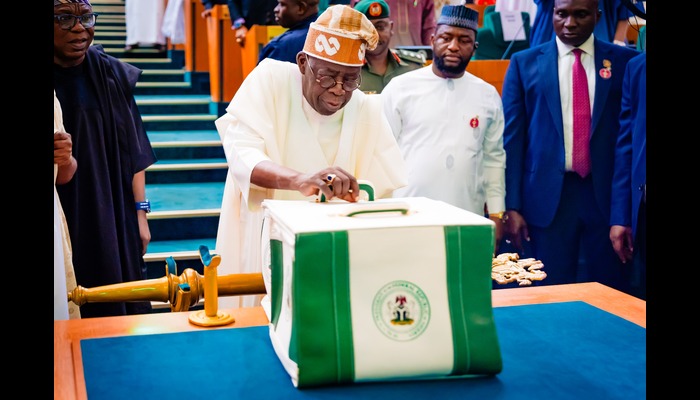
President Bola Tinubu had in December presented the 2026 Appropriation Bill of N58.18 trillion to the National Assembly, prioritising security with a N5.41 trillion allocation to the defence and security sector
The proposed budget, tagged, “Budget of Consolidation, Renewed Resilience and Shared Prosperity,” projected total revenue of N34.33 trillion and total expenditure of N58.18 trillion, including N15.52 trillion for debt service.
The proposed budget puts recurrent (non-debt) expenditure at N15.25 trillion, capital expenditure at N26.08 trillion, and a fiscal deficit of N23.85 trillion, representing 4.28 per cent of Gross Domestic Product.
Presenting the estimates, Tinubu said the figures were not mere accounting lines but a clear statement of national priorities, stressing that his administration remained committed to fiscal sustainability, debt transparency and value-for-money spending.
But a careful review of the Appropriation Bill 2026 by this medium reveals a pattern of choices that suggest immediacy over investment, political convenience over sustainable development, and opacity over transparency.
While over 10 million Nigerian children remain out of school and maternal mortality rates continue to soar, the budget prioritises military hardware over hospitals.
The Defence, Police, and the Office of the National Security Adviser are allocated a combined N5.15 trillion, while major sector and infrastructural development continue to suffer.
In practical terms, the nation appears to be arming itself to contain instability while millions of children remain out of school and citizens struggle to access basic healthcare.
Nigeria’s preference for hardware over social infrastructure is not new. Over the past five years, security spending consistently outpaced education and health.
Critics argue that while security threats like Boko Haram, banditry, separatist tensions are real, a disproportionate focus on weapons and personnel without corresponding investment in education, healthcare, and social services risks perpetuating insecurity.
Despite increases in health allocations under President Bola Tinubu with aboyt
N2.48 trillion to the health sector, Nigeria’s health sector remains persistently underfunded, receiving only a fraction of the resources agreed under the Abuja Declaration, a long-standing continental commitment to prioritise public health financing.
While health spending has increased in nominal naira terms, its share of total government expenditure has consistently remained below six per cent, far from the 15 per cent benchmark African leaders agreed to more than two decades ago.
Meanwhile, the Presidency’s budget highlights a stark contrast between state privileges and public austerity.
Billions are earmarked for international travel, vehicle purchases, villa solarisation, and even wildlife conservation. These allocations overshadow the underfunding of ministries tasked with nationwide power, environmental management, and transport infrastructure, projecting a preoccupation with the comfort of the executive centre over the country’s foundational needs.
For instance, President Tinubu, and his Vice Kashim Shettima and their aides are set to spend the sum N12.2bn on foreign trips and local travel in 2026.
For President Tinubu, a total of N7.014 billion was allocated to travel and transport. Of this amount, N6.14 billion was earmarked for international travel and related logistics, while N873.89 million was set aside for local travel and transport.
The sum of N1.732 billion was budgeted for the Vice President’s travel within the Fiscal Year, including N1.31 billion for international travel and N417.49 million for local movement.
A separate N3. 433 billion was also provided for travels and Transport (General), under State House Headquarters.
The State House budget also provided N179.01 million for the purchase of motor vehicles for the President, alongside N375.19 million for food and catering supplies.
Drugs and medical supplies received an allocation of N79.68 million, while refreshment and meals got N56.43 million.
Overall, total allocation for the President stood at N8.39 billion (including other items not mentioned), with capital expenditure accounting for N777.19 million.
Also, N171.03 million was budgeted for food and catering supplies, N14.99 million for refreshment and meals, as well as N21.8 million for honorarium and sitting allowance.
The budget also allocated N28 million to welfare packages, N11.83 million to publicity and advertisement, bringing the total allocation for the Vice President to N2.64 billion (including other items not mentioned), with capital expenditure estimated at N641.39 million, reflecting spending on assets and long-term support infrastructure.
The State House headquarters received a total budget allocation of N43.20 billion for the 2026 fiscal year, comprising N2.64 billion in personnel costs, N10.10 billion in overheads, and N30.49 billion for capital expenditure.
Further details showed a N11.23 billion allocation for the purchase of motor vehicles; N7 billion for the provision of solar power in the villa; Wildlife conservation in the State House received an allocation of N2.424 billion; N2.12 billion for honorarium and sitting allowance, N2.56 billion for office furniture and fittings, N2.42 billion for wildlife conservation and N513.84 million for welfare packages
Also, a miscellaneous, a term often loosely used for a basket of infinitesimal items, has assumed a more dignified space in the budget.
The State House Headquarters, Nigerian Army and the Economic and Financial Crimes Commission (EFCC) alone are earmarking N16.78 billion for ‘miscellaneous’ expenditure this year.
The Nigerian Army alone will spend N10.52 billion on miscellaneous items in the year.
Understandingly, the Army, an institution whose spending items are largely confidential, has the largest miscellaneous spending in this year’s appropriation. The EFCC and the State House Headquarters will spend N3.09 billion and N3.17 billion, respectively, in the year.
Also, the Ministry of Defence, which allocated N350.57 million for stationery last year, proposes to spend N638 million this year. This figure is 82 per cent above last year’s spending proposal.
The Ministry of Justice, which spent N125 million on papers last year, has had its yearly budget quadrupled to N525 million this year, just as the Ministry of Budget and Economic Planning also marked up its stationery budget from N90 million to N117 million this year.
Ministry of Police Affairs raised its budget from N45.45 million to N60.47 million for the year. Women Affairs stands out as the only ministry that cut its budget for stationery – from N138.47 million last year to N40 million, a 71 per cent reduction.
Political patronage is also evident in the disbursement of agency budgets.
The National Agricultural Land Development Authority, for instance, fragments its allocations into micro-projects across federal constituencies, from mini stadiums to sewing machines for women affected by banditry.
While presented as development, these micro-projects complicate oversight, risk inefficiency, and transform strategic agency mandates into instruments of political settlement rather than coherent national planning.
Hovering over all these allocations is the mammoth debt bill. Debt servicing alone consumes N15.91 trillion, constraining productive investment and reflecting past fiscal decisions whose public benefits remain unclear. With a significant portion of revenue pre-committed to loans, the budget leaves limited room for strategic investment in human capital or infrastructure.
Furthermore, the government reduced its allocation to infrastructure in the 2026 budget by 13.1 per cent.
Infrastructure spending in the 2026 Appropriation Bill dropped to N3.56 trillion from N4.06 trillion in the 2025 fiscal year, representing a reduction of about N500 billion and signalling lower government investment in major development projects.