By Marcel Okeke
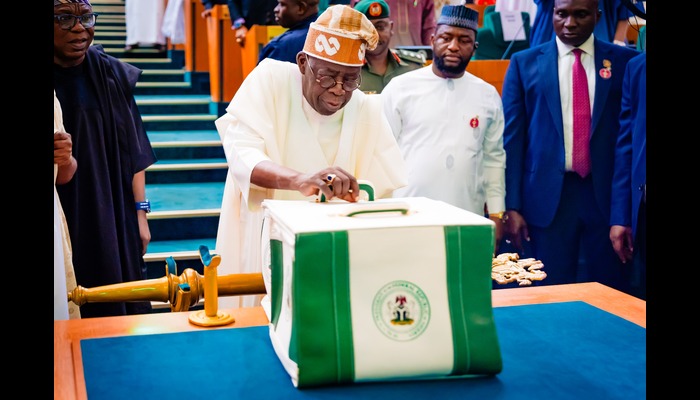
When, on Friday, December 19, 2025—twelve days to end of the year—President Bola Ahmed Tinubu presented the 2026 Appropriation Bill to a joint session of the National Assembly, the entire outing looked like a “fulfilment of all righteousness”. Everything about getting to that date/event showed undue delay or unpreparedness in the budgetary process.
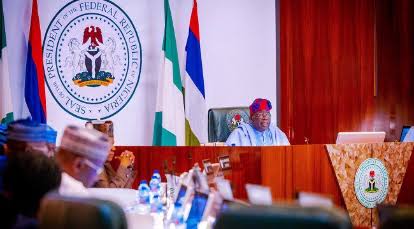
For the first time in living memory, it was the same day Mr. President rushed through to get the approval of the Bill by Federal Executive Council (FEC) that he rushed to the National Assembly to present the same Appropriation Bill. One of the major newspapers in Nigeria captured this absurd situation thus: “Tinubu presides over emergency FEC meeting ahead of 2026 budget presentation.”
The paper said President Bola Ahmed Tinubu “on Friday presided over an emergency meeting of the Federal Executive Council (FEC)…ahead of the presentation of the 2026 Appropriation Bill to a joint session of the National Assembly.” The report said further: “the meeting came just hours after the President formally notified the National Assembly of his intention to present the 2026 budget estimate at 2.00 pm on Friday, December 19, 2025.”
From all indications, it has come to public knowledge that the making of the 2026 Appropriation Bill must have faced glitches arising from power-play or ‘in-fighting’ between the Budget Office in the Ministry of Budget and the Ministry of Finance, also presided over by the Coordinating Minister of the Economy.
All these may have precipitated a major restructuring within the Ministry of Finance, with Mr. President reassigning key revenue-generation and cash management functions from the substantive Minister, Wale Edun to the Minister of State, Dr. Doris Uzoka-Anite. This directive, conveyed via a presidential memo about a week to the presentation of the 2026 Appropriation Bill, represents a significant overhaul of Nigeria’s fiscal architecture in recent times, to improve financial management and revenue collection.Apparently, this internal restructuring has come to be the culmination of a long-standing inertia and/inadequacies in the nation’s fiscal authorities that have caused serious distortions to the budget cycle as well as endless revenue shortfalls. All these have climaxed with the 2024 and 2025 budgets running concurrently; meaning that a substantial part of 2024 budget had been brought forward, and remains partially implemented even as 2025 fiscal year was ending.
As for year 2025 budget, its implementation had been largely stalled by revenue shortage, as revealed by the Minister of Finance and Coordinating Minister of the Economy, Wale Edun, when he said that only about N10 trillion out of the N40 trillion targeted revenue for 2025 would be realized this year. This amounts to a monumental N30 trillion revenue shortfall.
It is against this backdrop that Mr. President went ahead to present the 2026 Appropriation Bill, anchored on so much optimistic assumptions and buoyant revenue projections. Specifically, in the 2026 budget tagged “Budget of Consolidation, Renewed Resilience and Shared Prosperity, ” while the Federal Government plans to spend N58.18 trillion, it only expects to earn N34.33 trillion revenue; thus, leaving a deficit of N23.85 trillion.
These figures are founded on the assumption of crude oil production level of 1.84 million barrels per day (mbp), down from the unmet 2025 budget assumption of over two million barrels per day. Nigeria’s hydrocarbon sector (and the Exploration and Production, E & P, industry in particular) is weighed down by a multiplicity of challenges. These include the lingering crude oil theft, insecurity in oil-bearing communities and the Niger Delta region; organized sabotage and willful damage to critical oil assets/installations.
All these are yet potent, in addition to the wave of energy transition globally, that has practically denied Nigeria of new investments in the E & P sub-sector in recent years. It is therefore highly illusory for the 2026 budget to be founded on a buoyant crude oil production figure of 1.84 bpd. At no time in 2025 was this level of production met.The same unfounded optimism is reflected in the oil price assumption of US$64.85 per barrel for 2026 budget, as against the even much bloated figure of US$75 per barrel that was assumed for the 2025 failed budget. Somehow, in the preliminary parliamentary discussions of the 2026 Appropriation Bill, the Senate has cut the price assumption to US$60 per barrel, citing “geopolitical tensions in Europe and the Middle East, and persistent volatility in the global oil market.”
Year-year-out, the fate of every of Nigeria’s budget has been largely determined by oil price and production/export capacity, both of which are fully beyond the purview of the country. Nigeria as a member of the Organization of Petroleum Exporting Countries (OPEC) is restricted to its allocated quota; and takes the given price in the global market. Thus, the country’s 2025 budget has been marred by the wide gap between over-ambitious oil price and export volume assumptions and the eventual reality.
This has resulted in an indeterminate budget deficit figure each year—leading to the Federal Government opting to keep borrowing humongous sums from within and outside the country. Today, the Federal Government of Nigeria has practically ‘crowded out’ private sector fund users from both the money and capital market—leading, in part, to the much-flaunted improved accretion to the external reserves—mainly from foreign portfolio investors (FPIs).
It is yet worrisome that the 2026 budget will eventually go the same route—especially being a pre-election year in Nigeria—when the politicians usually pour in ‘laundered’ money for electioneering. This is why the optimistic assumptions of an inflation rate of 16.6 per cent, and exchange rate of N1,512/$1 in the 2026 budget are out of place. Electioneering funding, and other political party-related expenditures are certain to burst budgetary assumptions and projections.
All these are on the backdrop of the repeal and re-enactment of the 2024 and 2025 Appropriation Acts by the National Assembly: a very unusual development. The revised 2024 budget stands at N43.561 trillion, while the 2025 budget is now N48.316 trillion, with implementation extended to March 31, 2026. These strange adjustments will certainly form the launch pad for fiscal obfuscation and Abracadabra that Nigeria’s public finance would become in 2026.
It will then mean that the President Tinubu administration would be running the three annual budgets it created simultaneously: that is 2024, 2025, and 2026. So, from all indications, the 2026 Appropriation Bill is more of a mere ritual than any plan in pursuit of a turnaround for the economy of Nigeria. Recent antecedents, and the peculiar challenges in crafting the Bill mark it out as destined for a woeful failure!
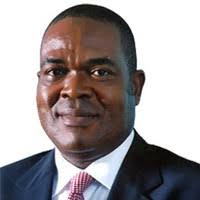
The author, Okeke, a practicing Economist, Business Strategist, Sustainability expert and ex-Chief Economist of Zenith Bank Plc, lives in Lekki, Lagos. He can be reached via: obioraokeke2000@yahoo.com (08033075697) SMS only