Isaac Samuel, Abuja
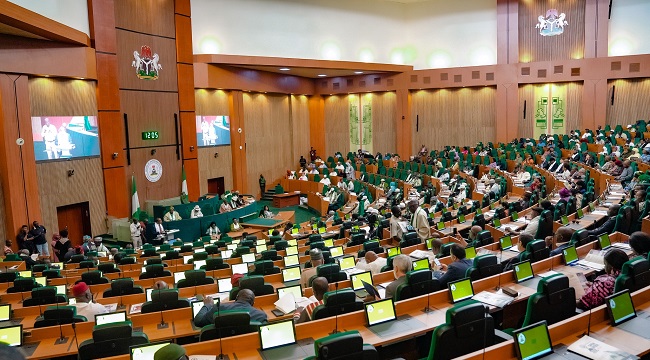
The House of Representatives on Thursday adopted the Federal Government’s proposed crude oil benchmark of $64.85 per barrel for 2026, diverging from the Senate, which earlier approved a lower $60 benchmark under the 2026–2028 Medium Term Expenditure Framework and Fiscal Strategy Paper (MTEF/FSP).
The House decision followed the consideration and adoption of a report by its committees on Finance, National Planning and Economic Development, which endorsed the executive’s oil price assumptions of $64.85, $64.30 and $65.50 per barrel for 2026, 2027 and 2028 respectively.
This is ahead of presentation of budget by President Bola Tinubu scheduled for Friday.
In contrast, the Senate, while approving the MTEF/FSP, reviewed the oil benchmark downward for 2026 to $60 per barrel, citing global economic uncertainties, before adjusting it to $65 for 2027 and $70 for 2028.
Chairman of the Senate Committee on Finance, Sani Musa (APC, Niger East), had told lawmakers that the adjustment was informed by geopolitical tensions in Europe and the Middle East, as well as volatility in the global oil market, stressing the need for fiscal caution.
Despite the disagreement on oil price benchmarks, both chambers retained the same crude oil production projections of 1.84 million barrels per day (mbpd) for 2026, 1.88 mbpd for 2027 and 1.92 mbpd for 2028, expressing confidence in ongoing reforms in the oil and gas sector and efforts to stabilise output.
The lawmakers approved exchange rate projections of N1,512, N1,432.15 and N1,383.18 for 2026, 2027 and 2028 respectively, in line with the Central Bank of Nigeria’s policy to stabilise the naira and strengthen fiscal and monetary policy coordination.
The House also endorsed inflation targets of 16.5 per cent for 2026, 13 per cent for 2027 and nine per cent for 2028, citing the commitment of monetary authorities to moderate inflationary pressures.
On economic growth, the lawmakers sustained the real GDP growth projections of 4.68 per cent, 5.96 per cent and 7.9 per cent for 2026, 2027 and 2028 respectively, expressing optimism that ongoing reforms and the anticipated gains from new tax laws would begin to yield results from 2026.
The House further recommended the effective implementation of the newly enacted Tax Acts as key instruments for driving economic reforms, growth and development.
In line with the ongoing reforms and activation of the Tax Act, the House also urged the Federal Government to implement a National Scanning Policy within the National Single Window of the Nigeria Revenue Service (NRS), in collaboration with relevant agencies, to enhance revenue assurance, improve trade facilitation, curb leakages, and strengthen transparency and national security.
On the fiscal framework, the House sustained the 2026 Federal Government budget estimates, including proposed spending of N54.46 trillion, of which N31.83 trillion is expected as retained revenue. New borrowings were put at N20.38 trillion, covering both domestic and foreign loans, while debt servicing was estimated at N15.52 trillion.
The lawmakers also approved N1.376 trillion for pensions, gratuities and retirees’ benefits, with a fiscal deficit of N22.63 trillion retained under the framework.
Capital expenditure, exclusive of transfers, was sustained at N20.131 trillion, alongside statutory transfers of N3.152 trillion and a Sinking Fund provision of N388.54 billion.
In addition, total recurrent (non-debt) expenditure was projected at N15.265 trillion, while special interventions for recurrent and capital spending were pegged at N200 billion and N14 billion respectively.
The House also sustained other key macroeconomic assumptions, including projected exchange rates, inflation targets and GDP growth estimates, arguing that anticipated gains from tax reforms and broader economic restructuring would support fiscal stability over the medium term.